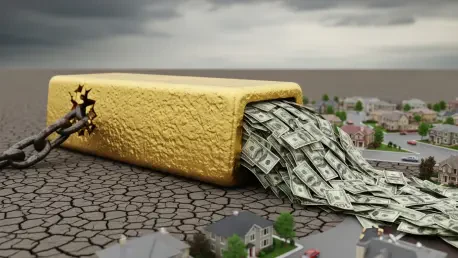

For generations, the American dream was built on a foundation of homeownership. But for many today, that dream feels impossibly distant, with housing prices swinging wildly and affordability at historic lows. Our guest today, a leading voice in monetary history, argues that this crisis has a single, definitive origin point: the moment the U.S. dollar was unchained from gold. We’ll explore how this fundamental shift transformed our homes from places of shelter into high-stakes investment vehicles, forcing every family to become a market speculator.
You argue that leaving the gold standard in 1971 is “100% of the reason” for unaffordable housing. Could you walk us through the immediate chain reaction this caused, and what specific metrics from the 1970s best illustrate this massive rush into “geology” as a currency hedge?
The moment we severed the dollar’s link to gold, we fundamentally broke our money. Before 1971, the dollar was defined by geology—a specific weight of gold, a mineral you couldn’t just print more of. When that definition was erased, people instinctively knew the currency would be debased over time. So, what did they do? They rushed to buy other forms of geology to protect their wealth. You saw it immediately in the 1970s as the prices of gold, silver, and oil just zoomed upwards. But the granddaddy of all geology is land itself. A house is nothing more than a claim on a piece of land, and that’s precisely why home prices took off. This isn’t about building materials or bigger square footage; it was a massive, permanent rush into tangible assets to hedge against a floating, undefined currency.
The article notes that before the late 1960s, variation in the Case-Shiller index was “teeny.” Can you describe what the process and financial weight of buying a home was like for a family then, versus the “pinpoint investment decision” it has become today?
It was an entirely different universe. Before the late 1960s, buying a house was a major life event, but it wasn’t a cosmic investment decision that could make or break your entire financial future. You looked at the venerable Case-Shiller index, and for 75 years, the price variation was so small it was almost negligible. You bought a home based on where you wanted to live, where your kids could play, where you felt a sense of community. Today, it’s an outrage. The decision of where you lay your head has become a pinpoint investment decision, where a gigundo part of your net worth is on the line. Every buyer is forced to act like a high-roller investor, trying to time the market and guess whether this asset is over- or underpriced. We’ve turned a basic human need for shelter into a speculative casino.
Your advice for individuals is to rent when prices are high and buy when low. What key financial indicators should a prospective buyer monitor to identify a true market bottom, and what practical steps can they take to maintain the “nerve” to wait out these long cycles?
The sad reality of our fiat system is that you are forced to think like an investor. The key indicator isn’t some complex formula; it’s recognizing the mania of the cycles themselves. Look at recent history: prices were sky-high in 2007, and people were lining up to buy. That was the time to sell or stay out. By 2010, the market had crashed, prices were low, and fear was everywhere—that was the time to buy. Maintaining the nerve is the hardest part. It requires you to detach from the emotional hype and have the discipline to rent and save your money while everyone else is getting rich on paper. You have to chill, wait for the inevitable bust that our monetary system creates, and be ready to move when prices are low and no one else wants to. It’s a terrible way to have to think about a home, but it’s the game we’re forced to play.
You claim that under a “classical monetary system,” houses were not major investment decisions. What would a modern version of this system look like, and how would its implementation tangibly make housing affordable for the average person again, breaking the current investment cycle?
A modern classical monetary system simply means returning to a system where money is anchored to something real and finite, removing the ability of governments to create it out of thin air. When your currency is stable and holds its value, the frantic need to hedge against its depreciation disappears. If people aren’t constantly worried about their dollars becoming worthless, they won’t pile into land and housing as a store of value. This would completely break the speculative investment cycle. Houses would once again be priced based on their utility—as places to live—rather than as financial instruments. The price variation would become teeny again, and affordability would return for everyone because the asset would no longer be a necessary hedge in a broken monetary world.
What is your forecast for the housing market over the next decade if the U.S. continues with its current fiat monetary system?
If we continue down this path, my forecast is simply for more of the same madness. We will see these wild, distinct cycles of boom and bust continue indefinitely. Prices will power up to the point where they are completely unaffordable for the average person, fueled by monetary policy, and then they will collapse, wiping out wealth. We will continue living in this so-very-dumb housing market where the basic act of finding shelter is a high-stakes gamble. The outrage isn’t just that houses are unaffordable; it’s that every person is forced to speculate on an asset class that should be a source of stability. Until we militate for and achieve a more classical monetary system, the dream of affordable housing for all will remain just that—a dream.