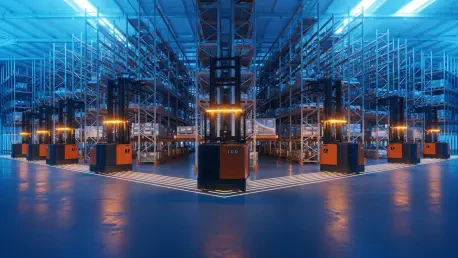

The rapid acceleration of high-density logistics has pushed traditional material handling to its breaking point, forcing a total reimagining of how machines move through shared spaces. As industrial environments become increasingly crowded, the transition from rigid, pre-programmed paths to dynamic, self-governing intelligence is no longer a luxury but a fundamental requirement for survival. Modern Autonomous Navigation Systems (ANS) represent this shift, offering a sophisticated blend of sensor fusion and algorithmic logic that allows a fleet of robots to function as a singular, living organism.
This review examines the current state of autonomous technology, specifically focusing on how centralized frameworks are replacing fragmented, proprietary solutions. By moving beyond the limitations of early automated guided vehicles, today’s systems provide the predictability of structured automation alongside the agility of true robotics. The goal is to move beyond simple movement and toward a state of total operational synchronization.
Fundamentals of Autonomous Navigation and Fleet Coordination
The architecture of modern navigation has evolved from simple magnetic tape followers into complex, map-based ecosystems driven by frameworks like the ANT navigation logic. These systems utilize LiDAR, vision sensors, and encoders to create a real-time digital twin of the environment, allowing robots to locate themselves with millimeter precision. This shift is critical because it eliminates the need for expensive floor modifications, enabling facilities to deploy automation into existing infrastructures without significant downtime.
Beyond individual localization, the true value of these systems lies in how they manage collective intelligence. Instead of each robot making selfish decisions that lead to congestion, the navigation layer communicates with a central mission controller to optimize traffic flow. This coordination ensures that high-priority tasks are completed first while preventing the “bottleneck effect” common in older, less integrated systems.
Critical Components of Advanced Navigation Frameworks
Bounded Autonomy: Intelligent Path Correction
One of the most significant breakthroughs in recent years is the implementation of “bounded autonomy,” a concept that strikes a delicate balance between rigid path following and chaotic obstacle avoidance. Systems like SmartPass allow a vehicle to deviate slightly from its primary route to bypass an obstruction, such as a misplaced pallet, and then immediately return to its planned trajectory. This prevents the entire production line from stopping simply because a single object was out of place.
However, this autonomy is “bounded” to ensure that the robot does not wander into restricted zones or create unpredictable traffic patterns for human workers. By keeping the deviation within a narrow, pre-approved corridor, the system maintains the high throughput required for industrial efficiency. This approach is superior to total autonomy, which often results in robots taking inefficient “scenic routes” that disrupt the overall timing of the supply chain.
Unified Fleet Management: Software Standardization
As companies scale their automation efforts, the challenge often shifts from hardware performance to software complexity. The “Power of One” philosophy advocates for a unified software layer that can manage diverse vehicle types—from small tuggers to massive forklifts—under a single interface. This standardization reduces the training burden on staff and ensures that battery management, mission dispatching, and safety protocols are consistent across the entire global fleet.
A centralized platform acts as the brain of the operation, providing a holistic view of the facility’s health. By standardizing the communication protocols, organizations can avoid the “silo effect” where different robot brands cannot talk to each other. This level of integration is essential for achieving true scalability, as it allows for the seamless addition of new units without rewriting the underlying operational logic.
Current Trends and Innovations in Industrial Automation
The industry is currently moving toward vendor-neutral interoperability, a trend that is breaking down the walls between different hardware manufacturers. Historically, adopting a specific navigation system meant being locked into a single vendor’s ecosystem. Today, the focus has shifted toward platforms that can drive any chassis, allowing businesses to select the best hardware for a specific task while maintaining a consistent navigation and management layer.
Moreover, there is an increasing emphasis on “predictable performance” over “peak performance.” While a single fast robot might look impressive, it is the consistency of a fleet of one hundred robots that determines a facility’s success. Innovations are now focusing on reducing the variance in cycle times and improving the reliability of hand-offs between automated systems and human operators, ensuring that the robotic workforce integrates into the existing culture rather than disrupting it.
Real-World Applications and Industrial Implementations
In high-volume manufacturing sectors, such as the kitchen and bath industry, the deployment of these systems has moved from experimental pilots to full-scale production. Global leaders like Kohler have demonstrated that by standardizing on a single navigation platform, they can harmonize material flow across multiple international sites. This global consistency allows for faster troubleshooting and the ability to share operational data across continents to improve efficiency.
These implementations highlight the importance of choosing a robust navigation framework that can handle the unique challenges of a busy factory floor, such as changing lighting conditions or moving pedestrians. The success of these projects serves as a benchmark for other industries, proving that autonomous navigation is no longer just for high-tech warehouses but is equally effective in the grit and complexity of heavy manufacturing environments.
Technical Hurdles and Market Obstacles
Despite these advancements, several hurdles remain, particularly regarding “deadlock” management in narrow corridors. When two or more autonomous vehicles meet in a space where neither can pass, the system must be intelligent enough to negotiate a resolution without human intervention. While current algorithms are improving, these scenarios still pose a risk to throughput in poorly designed layouts or extremely dense environments.
Safety standards also continue to evolve, requiring a constant balance between speed and protection. Ensuring that a multi-ton forklift can stop instantly when a human steps into its path requires expensive, high-fidelity sensors and rigorous testing. Furthermore, the lack of a universal language for mobile robot communication means that while interoperability is a goal, achieving it often requires significant custom integration work, which can slow down deployment for smaller enterprises.
Future Outlook and Global Impact
The next evolution of autonomous navigation will likely involve deeper integration with Artificial Intelligence to move from reactive to proactive path planning. Future systems will be able to predict where congestion will occur before it happens, adjusting the fleet’s distribution based on real-time production demands. This shift will turn logistics into a truly “lights-out” operation where the movement of goods is as seamless and invisible as the flow of data across the internet.
As these technologies become more accessible, we can expect a democratization of automation. Small and medium-sized enterprises will be able to deploy “plug-and-play” robotic fleets that require minimal technical expertise to manage. This widespread adoption will fundamentally alter global supply chains, making them more resilient to labor shortages and more capable of handling the increasing demands of just-in-time manufacturing.
Summary and Assessment of the Autonomous Landscape
The transition toward standardized, interoperable navigation frameworks has successfully moved the needle from robotic experimentation to industrial necessity. The development of bounded autonomy and centralized management platforms addressed the primary concerns of predictability and control that once hindered large-scale adoption. These systems proved that a unified approach to navigation could mitigate the risks of vendor lock-in while providing the reliability required for high-stakes manufacturing.
Moving forward, the industry was encouraged to prioritize the development of universal communication standards to further lower the barrier to entry for diverse fleet integration. The focus shifted toward creating more intuitive user interfaces that allowed floor managers to reconfigure missions on the fly without needing deep programming knowledge. Ultimately, the successful deployment of these technologies set a new standard for operational excellence, ensuring that the robotic fleets of today remain the flexible backbones of tomorrow’s global economy.