
For millions of freelancers across Latin America, the primary barrier to economic mobility remains a fragmented banking system that consumes nearly a tenth of their earnings in hidden fees and administrative delays. Takenos, an Argentine fintech innovator, has challenged this status quo by facilitating over $500 million in payment volume through a sophisticated blockchain-native ecosystem. This transition marks a departure from the antiquated correspondent banking model, which often leaves remote workers waiting days for fund verification. By integrating decentralized ledger technology, the platform has managed to secure a user base of 500,000 individuals across twenty countries.
The overarching success of these systems relies on addressing the “broken” nature of financial services in developing regions. While Latin America sees an annual inflow of over $100 billion from remote contractors, traditional banks often require several business days to settle funds. Modern fintech solutions have effectively bypassed these intermediaries by maintaining a steady $10 million in monthly on-chain volume. This provides a thorough understanding of how digital assets are shifting from speculative tools to essential infrastructure for the global labor market.
Evolution of Distributed Ledger Technology in Global Finance
The emergence of distributed ledger technology in global finance serves as a direct response to the persistent inefficiencies of the SWIFT network. In the current landscape of 2026, the demand for instantaneous, trustless value transfer has pushed financial institutions to reconsider how liquidity moves across borders. What began as an experiment with digital assets has matured into a robust architecture capable of handling high-velocity commercial activity. This evolution reflects a broader shift toward a tokenized economy where the barriers between local currencies and global markets are increasingly porous.
Furthermore, the context of this evolution is rooted in the failure of legacy systems to innovate at the speed of the digital economy. Traditional correspondent banking relies on a chain of relationships that adds cost and time at every step. By contrast, distributed ledgers provide a single, shared source of truth that simplifies the reconciliation process. This technology has emerged not just as an alternative, but as a necessary replacement for systems that were never designed for the era of borderless remote work.
Core Technical Components of Modern Payment Rails
High-Performance Blockchain Infrastructure
Selecting a high-performance blockchain like Solana as the foundation for payment rails was a strategic move driven by the necessity for extreme throughput. With block times averaging 400 milliseconds, the network allows for settlement speeds that traditional banks simply cannot replicate. This technical edge is critical for high-frequency payroll operations where hundreds of individual payments must be executed simultaneously. It ensures that the user experience remains fluid, regardless of the complexity of the underlying transaction.
Moreover, the performance metrics of such infrastructure allow for median transaction fees of roughly $0.001. This makes micro-payouts and high-frequency payroll waves economically feasible for the first time. In the broader technological landscape, this level of efficiency differentiates modern rails from earlier blockchain iterations that suffered from congestion and high gas fees. Consequently, the technology serves as a scalable solution for companies managing large, distributed workforces.
Proprietary Stablecoin Architecture and Smart Contracts
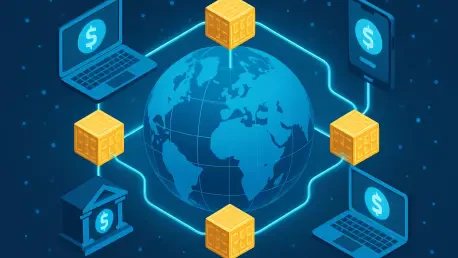
Unlike many competitors who rely on third-party assets, the use of a proprietary USD-pegged stablecoin offers unparalleled control over the financial lifecycle. This architecture allows a company to maintain its own reserves while embedding compliance rules directly into the smart contract level. By capturing interest margins on balances and ensuring that compliance is automated, the system creates a more sustainable business model. The technical design ensures that employers can fund payroll in dollars while the platform instantly mints tokens for the workers.
This proprietary approach also mitigates the risks associated with third-party stablecoin issuers, providing a direct pipeline for value. Smart contracts manage the distribution logic, ensuring that funds are only released when specific conditions are met, such as identity verification or work approval. This integration of programmable money and regulatory oversight represents a significant advancement over standard digital wallets. It allows for a frictionless experience where funds move from a corporate bank account to a worker’s digital wallet in under two seconds.
Current Trends in Decentralized Remittance and Payroll
The shift toward decentralized payroll reflects a fundamental change in how global labor is compensated, particularly as remote work becomes the standard. In regions like Latin America, the move toward on-chain solutions is no longer a niche choice but a survival strategy against local currency devaluation. There is a clear trend where digital platforms are replacing traditional savings accounts, as they provide better access to stable value and global spending power. This behavior is fueled by the desire to avoid the 3% to 10% fees typical of legacy remittance services.
Moreover, the industry is seeing a transition where stablecoins move beyond the realm of crypto-enthusiasts and into the hands of mainstream professionals. As payroll becomes more fragmented—with workers often holding multiple small contracts—the need for low-cost, instant settlement becomes paramount. This shift is influencing the technology’s trajectory toward greater integration with local banking APIs, allowing for easier “off-ramping” into local fiat currencies. Innovation is currently focused on making the blockchain layer invisible to the end user.
Real-World Implementations in Emerging Markets
In markets like Bolivia and Peru, where access to hard currency is often restricted, these blockchain solutions have become vital economic lifelines. The ability to instantly convert on-chain tokens into local currency or spend them via virtual cards has bridged the gap between the digital and physical economies. These implementations demonstrate that the real value of blockchain lies in its ability to solve the last-mile problem of financial inclusion. By providing a reliable pipeline for dollar-denominated income, the technology empowers a new class of digital entrepreneurs.
Notable implementations also include the use of virtual debit cards that allow users to spend their stablecoin balances at any merchant that accepts major card networks. This unique use case removes the need for workers to ever interact with a traditional local bank, which may be unreliable or expensive. Such applications prove that the technology is not just a backend improvement but a frontend revolution in consumer finance. These real-world successes provide a blueprint for other emerging markets facing similar banking constraints.
Technical Hurdles and Regulatory Landscapes
Despite rapid adoption, significant hurdles remain regarding the fluid regulatory environment across different jurisdictions. Maintaining a balance between decentralized efficiency and the stringent Know Your Customer requirements of multiple nations requires constant technical iteration. Furthermore, the reliance on a single high-performance blockchain introduces a point of systemic risk should that network experience downtime. Addressing these challenges involves developing multi-chain redundancy and more robust decentralized identity protocols to ensure long-term stability.
Regulatory hurdles are perhaps the most significant obstacle to widespread adoption, as governments grapple with how to tax and monitor on-chain transactions. Many regions have yet to establish clear frameworks for stablecoin issuers, creating a landscape of uncertainty. Ongoing development efforts are focused on building “compliance-as-code” features that automatically adapt to the legal requirements of the user’s location. Mitigating these risks is essential for moving from a high-growth startup phase to becoming a pillar of the global financial system.
The Future of On-Chain Financial Infrastructure
Looking ahead, the expansion of on-chain infrastructure will likely move toward deep integration with traditional retail and global tax systems. The next breakthrough will involve seamless, invisible blockchain layers where the user experience is indistinguishable from standard banking apps. This shift will force traditional institutions to either adopt similar open-source protocols or face total obsolescence in the cross-border space. As these systems scale, the cost of moving money globally could theoretically drop to nearly zero.
Furthermore, the long-term impact on society will be a democratization of access to stable capital. When a freelancer in a remote village can access the same financial tools as a corporation in a major financial hub, the global talent pool becomes truly competitive. Future developments will likely include decentralized credit scoring, allowing on-chain payroll history to serve as collateral for loans. This will further integrate the decentralized economy into the lives of millions, creating a more equitable global financial landscape.
Final Assessment of Blockchain Payment Systems
The review of these blockchain-based payment systems indicated that the era of predatory correspondent banking fees neared its end as more efficient alternatives gained dominance. Takenos proved that a specialized fintech approach, focusing on the specific pain points of emerging markets, could outperform established financial giants. The transition to proprietary stablecoins and high-performance chains provided a clear blueprint for how global labor could be remunerated without intermediaries. This technological shift ultimately fostered a more equitable landscape for workers who previously struggled with financial borders.
The integration of smart contracts and decentralized ledgers successfully addressed the systemic inefficiencies that had plagued cross-border commerce for decades. While technical and regulatory hurdles remained, the proven viability of sub-two-second settlements at near-zero cost established a new industry standard. These advancements moved the conversation from theoretical potential to practical, daily utility for half a million users. Ultimately, the success of these platforms represented a decisive victory for decentralized infrastructure over legacy financial silos.