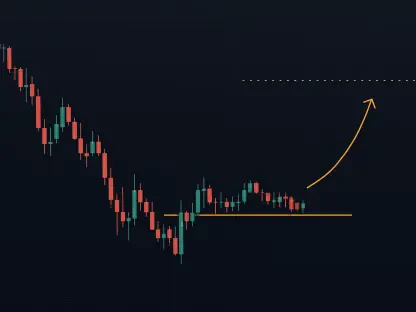

Drawing from decades of strategic insight and a deep understanding of market mechanics, Marco Gaietti offers a masterclass in navigating the complexities of Injective’s current market position. In this discussion, we explore the intricate dance between oversold technical indicators and the looming resistance levels that define INJ’s path forward. Gaietti breaks down the significance of momentum shifts, the necessity of disciplined risk management near psychological support zones, and the precise metrics required to validate a true trend reversal in a volatile landscape.
The $2.98 level is widely viewed as a critical pivot point for Injective. What specific volume patterns should traders watch for to confirm a genuine breakout at this price, and how would reaching this threshold shift the immediate technical target toward $3.26?
To confirm a genuine breakout at $2.98, traders must first see a definitive spike in buying pressure that exceeds the current 24-hour average volume of $1.27 million. When the price hits this threshold, it’s not just about the number; it’s about the intensity of the move, as reclaiming the 20-day SMA at $2.97 provides the necessary structural support for further gains. Once $2.98 is cleared, the momentum shift becomes tangible because it opens a clear path through a historical resistance vacuum, moving the target toward the $3.26 level. This transition represents a 12.4% to 16% upside potential, where the price begins to gravitate toward the Bollinger Band upper limit of $3.28. It is a step-by-step reclamation of territory where short-term sentiment flips from defensive to offensive as the previous ceiling becomes the new floor.
With Stochastic levels currently near 20.00 and the price sitting at 0.23 within the Bollinger Bands, conditions suggest potential mean reversion. How do these oversold metrics interact with a neutral RSI to signal a reversal, and what historical metrics usually precede a bounce from the $2.81 range?
The interaction between a neutral RSI of 40.82 and Stochastic indicators—specifically the %K at 20.00 and %D at 16.00—creates a “coiled spring” effect where the selling pressure has likely exhausted itself. While the RSI shows there is still room to move in either direction without being “overbought,” the low Stochastic levels suggest that the immediate downward momentum is overstretched. Historically, a bounce from the $2.81 range is preceded by the price hugging the lower Bollinger Band at a %B of 0.23, which indicates that the asset is statistically cheap relative to its recent volatility. For a reversal to take hold, we typically look for these oversold signals to align with a flattening MACD, which we are currently seeing as it sits at 0.0000, signaling that the bears are losing their grip.
There is currently a significant gap between the current market price and the 200-day SMA of $5.91. If the critical support at $2.73 fails to hold, what specific risk management metrics should be prioritized to mitigate a drop toward $2.50, and how does this affect the long-term recovery timeline?
When an asset trades so far below its 200-day SMA of $5.91, it signals a dominant long-term bearish trend, making the $2.73 support level the final line of defense for bulls. If $2.73 fails, investors must immediately pivot to protecting capital by honoring stop-losses, as the next psychological floor sits at $2.50, and the Bollinger Band lower limit at $2.67 offers little cushion. Risk management in this scenario requires a strict cap on exposure, ideally keeping the position to no more than 2-3% of the total portfolio to survive the drawdown. A breach of these levels would significantly delay the recovery timeline, potentially pushing a return to the $3.00 range several months away as the market would need to build a completely new base of accumulation.
Given the current 13-day ATR of $0.13, daily volatility is roughly 4.6%. For an investor looking at a layered entry strategy, what specific metrics define a favorable risk-reward ratio right now, and how should position sizing be adjusted to account for the stalling MACD histogram?
A favorable risk-reward ratio of 1:5 can be achieved by entering near the $2.81 mark while placing a tight stop-loss just below the $2.73 support level. Because the 13-day ATR is $0.13, you have to expect daily swings of about 4.6%, meaning your position sizing must be conservative enough to withstand “noise” without getting liquidated or stopped out prematurely. Since the MACD histogram is stalling at 0.0000, it indicates a lack of clear directional conviction, which justifies a “layered” approach: buying a small portion now and adding only after $2.89 is reclaimed. This ensures that you aren’t over-leveraged while the trend is still sideways, allowing the volatility to work for you rather than against you.
What is your forecast for Injective?
My forecast for Injective is one of cautious optimism, specifically looking for a move into the $3.00 to $3.26 range within the next month, provided the $2.98 pivot is broken with volume. While the immediate focus is on a potential 16% rally from the $2.81 support, the shadow of the $5.91 200-day SMA means this is a recovery play rather than a new bull market. In the short term—meaning the next seven days—I expect the price to gravitate toward the $2.98 resistance as the oversold Stochastic conditions mean-revert. However, if we do not see a positive MACD crossover soon, the price will likely continue to consolidate between $2.73 and $2.89, requiring traders to remain extremely disciplined with their exit points.