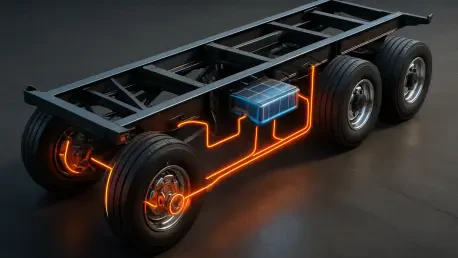

The global transportation sector currently consumes nearly thirty percent of total energy production, yet the standard semi-trailer has remained a largely passive component of this massive logistics machine for over a century. The industry is standing at a crossroads where the pressure to decarbonize meets the harsh reality of long-distance hauling requirements. For decades, the trailer has been viewed as a literal weight for the tractor to pull, contributing nothing to the movement itself. However, a groundbreaking pilot program is challenging this dynamic by introducing propelled semi-trailers designed for non-refrigerated transport. This initiative, a collaboration between TIP Group, Nivalis Energy Europe, and BPW, seeks to turn the trailer into an active partner in the propulsion process. By exploring “traction assistance,” the industry is looking beyond simple electrification and toward a future where every component of a truck contributes to its own movement.
Bridging the Gap in Heavy-Duty Transportation
Logistics companies are increasingly desperate for solutions that offer immediate returns on sustainability investments without requiring a total overhaul of the current refueling infrastructure. The recent initiative in Germany illustrates a shift in focus toward the trailer as a primary source of efficiency rather than a secondary consideration. This approach addresses the “last mile” of efficiency by making the largest part of the vehicle help solve the propulsion problem. By integrating self-assisting technology into existing fleets, operators can bypass the wait for a fully electric tractor market that still struggles with range and charging times. This article explores how these intelligent units can slash fuel consumption and carbon emissions while fitting seamlessly into existing supply chains.
Understanding the Legacy of Trailer Innovation
To appreciate the significance of propelled trailers, one must look at the historical trajectory of freight efficiency. Traditionally, innovation in trucking focused almost exclusively on the tractor—optimizing diesel engines, improving aerodynamics, and, more recently, experimenting with hydrogen or battery-electric trucks. When electrification did reach the trailer, it was primarily confined to “e-Reefers,” which use batteries to power cooling units rather than helping the truck move. This background is critical because it highlights a missed opportunity to address the mechanical inertia inherent in moving forty tons of cargo across a continent.
As fuel prices fluctuate and environmental regulations tighten, the shift from passive cargo boxes to self-assisting units represents a fundamental change in how logistics companies view their assets. The previous focus on the engine alone ignored the massive potential for energy recovery that exists in the trailer’s axles. By re-evaluating the role of the trailer, the industry is finally moving toward a holistic vehicle design. This legacy of isolation between the tractor and trailer is being dismantled in favor of an integrated powertrain that shares the workload of long-haul logistics.
The Mechanics and Economic Impact of Electrified Trailers
Innovative Power Systems and Energy Recovery
The core of the current pilot program is the Nivalis Powered Trailer Kit, which replaces a standard axle with a specialized e-axle. This system doesn’t just draw power; it manages it through a sophisticated tri-modal energy cycle. First, it utilizes regenerative braking to capture kinetic energy that would otherwise be lost as heat, storing it in high-voltage lithium-ion batteries. Second, the trailer roof is transformed into a moving power plant, covered in photovoltaic solar panels capable of generating up to 3.7kWp. Finally, the system can be plugged into the grid during downtime. This data-driven approach ensures that the trailer has a continuous supply of green electricity to provide traction assistance during the most fuel-intensive parts of a journey.
Maintaining Operational Efficiency and Driver Focus
A major hurdle for any new technology in logistics is the driver burden. If a system requires extensive training or changes to driving habits, adoption remains low. The propelled trailer addresses this by operating as a self-assisting unit. An onboard Energy Management Unit monitors the vehicle’s movement and provides power automatically without manual input from the driver. To ensure safety and transparency, a simple interface is placed where it can be seen in the cab’s side mirror, showing battery levels and system health in real-time. This integration ensures that the technology supports the driver rather than distracting them, while telematics allows fleet managers to monitor performance remotely.
Overcoming Weight Constraints and Regional Standards
Historically, the weight of large battery packs has been a deterrent for electric trailers, as every pound of battery is a pound of lost payload. The current pilot employs a down-scaling philosophy, using smaller, optimized battery packs to keep the added weight to a minimum. This ensures the vehicle remains within legal weight limits while protecting its stability during cornering and braking. Furthermore, the technology has already cleared the hurdle of European homologation, meaning it is fully approved for use across the EU and EFTA. By addressing these practical concerns—weight, safety standards, and regulatory compliance—the partnership has moved the concept of the propelled trailer from a theoretical prototype to a market-ready solution.
Technological Shifts and Regulatory Evolution
Looking forward, the success of propelled trailers will likely trigger a broader shift in how regulatory bodies and manufacturers approach vehicle efficiency. We are moving toward a landscape where traction energy is measured at the fleet level rather than just at the tailpipe. Experts predict that as carbon taxes increase, the economic incentive to save 7,000 liters of diesel per year—the projected savings for a single unit in this pilot—will become an operational necessity. We may see future regulations that offer credits for solar-harvesting trailers or mandate regenerative axles for heavy-duty long-haul routes. As the technology scales, the reliance on a massive, centralized charging infrastructure may even decrease.
Actionable Insights for Modern Fleet Management
For businesses looking to integrate these innovations, the transition should be strategic rather than impulsive. The primary takeaway from the pilot is that electrified trailers are most effective on high-utilization routes where regenerative braking and solar exposure are maximized. Fleet managers should prioritize telematics-ready units to ensure they can track the real-world return on investment of fuel savings, which can reach 18 tons of carbon reduction per year. Best practices include integrating these trailers into existing maintenance schedules, as systems are designed to be plug-and-play with standard chassis. By focusing on down-scaled battery solutions, companies can enjoy the benefits of electrification without sacrificing payload capacity.
Redefining the Future of Sustainable Road Freight
The propelled semi-trailer represented a significant mechanical upgrade that successfully reimagined the logistics ecosystem. By turning the trailer into an active participant in propulsion, the industry achieved significant fuel savings and emission reductions without waiting for a total overhaul of the power grid. This technology bridged the gap between the diesel-heavy present and a fully electric future. The pilot programs proved that the path to sustainable long-haul logistics lay in intelligent, self-assisting technology that worked in harmony with the equipment used daily. Stakeholders found that the most effective way to modernize a fleet was to enhance the components already in rotation. Operators who adopted these systems early gained a competitive advantage in an increasingly regulated market. Ultimately, the transition toward active trailers redefined the standard for efficiency in the transport sector.