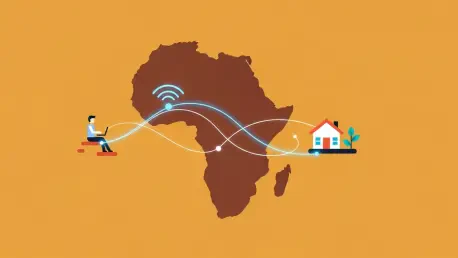

For millions across Africa, sending money home is not just a transaction but a lifeline burdened by exorbitant fees and agonizing delays, prompting the question of whether the solution is a better bank or a digital dollar that bypasses the system entirely. The continent’s financial landscape is defined by this paradox: a burgeoning digital economy shackled by an outdated and inaccessible banking infrastructure. This gap creates significant friction for immigrants, remote workers, and small businesses, where every percentage point lost in fees and every day lost in transit has a tangible impact on livelihoods. Now, a new model leveraging stablecoins like USD Coin (USDC) is emerging, promising to dismantle these barriers and forge direct, efficient pathways for capital to flow where it is needed most.
The Lifeline Burdened by Legacy Systems
The act of sending money across African borders often feels more like an obstacle course than a simple transfer. Traditional remittance channels are plagued by high commission rates that can consume a significant slice of the funds, coupled with unfavorable exchange rates that further erode the value. For those working abroad to support their families, this systemic inefficiency means that their hard-earned money does not go as far as it should, with intermediaries capturing value that is desperately needed on the ground.
Beyond the cost, agonizing delays are the norm for many. Funds can take days to clear through a complex web of correspondent banks, leaving recipients in a state of uncertainty and preventing the timely payment of critical expenses like rent, school fees, or medical bills. This sluggish pace is a direct consequence of a legacy financial system that was not designed for the speed and interconnectedness of the modern global economy, creating a constant source of stress for families who depend on these financial lifelines.
Financial Friction and the Access Gap
At the heart of the problem is a severe access gap. A substantial portion of the continent’s population remains unbanked, lacking the formal documentation, proof of address, or proximity to a physical bank branch necessary to participate in the formal financial system. This exclusion effectively locks individuals out of opportunities in the global digital economy, making it nearly impossible to build a credit history, secure a loan, or access a range of other essential financial services.
The real-world consequences of this friction are profound. Freelancers struggle to receive payments from international clients, small businesses face immense hurdles in cross-border trade, and families are forced to rely on informal, often less secure, methods to receive support. This systemic inefficiency stifles economic growth and perpetuates cycles of financial instability for millions, creating a barrier that ambition and hard work alone cannot overcome.
A New Digital Architecture for Empowerment
In response, neobanks like Lipaworld are pioneering a new approach built on a different technological foundation. By leveraging the power of USD Coin (USDC), a regulated, fully-backed stablecoin, Lipaworld offers a potent alternative that operates outside the confines of traditional banking rails. This enables secure, low-cost international transactions that settle in near real-time, providing a reliable bridge for funds to cross borders with minimal friction.
The platform’s mission is deeply rooted in personal experience. Founder Jonathan Katende, having faced the challenges of being an unbanked immigrant himself, designed Lipaworld to be more than just a money transfer service. It is a comprehensive tool for financial empowerment, providing tangible solutions for managing finances, paying utility bills, and even purchasing groceries remotely for loved ones, all without requiring a traditional bank account. Its intuitive design has successfully bridged generational divides, attracting a diverse user base that includes individuals over 70.
The Bedrock of Belief in Stablecoin Technology
For this new model to succeed, trust is non-negotiable. Lipaworld’s decision to build its infrastructure on USDC reflects a commitment to security and reliability. Katende describes the services from Circle, whose affiliates issue USDC, as the “Rolls-Royce” standard, underscoring the necessity of a stable and trustworthy digital asset to serve a user base that has been historically underserved and may be wary of new financial technologies.
This perspective is shared by industry experts like Circle’s Elisabeth Carpenter, who emphasizes that a dependable payment solution like USDC allows platforms to empower local merchants and communities directly. A grocery delivery service in Zimbabwe, for instance, utilizes the platform to accept USDC payments, thereby reducing the risks of holding cash and overcoming local currency volatility. This simple integration strengthens local commerce by connecting it seamlessly with a global customer base, turning a digital currency into food on the table.
A Replicable Blueprint for Inclusive Growth
The Lipaworld strategy provides a powerful and replicable blueprint for fostering financial inclusion. Its success is built on a few core principles: a solid foundation on a regulated stablecoin for global settlement, an intuitive user interface that prioritizes accessibility over technical complexity, and the integration of essential, real-world services that solve immediate problems for users and their families. This combination transforms a digital currency from an abstract asset into a practical daily tool.
This approach is indicative of a broader trend where financial technology is being leveraged for direct economic benefit, rather than just optimizing existing systems. By creating a scalable solution to long-standing financial barriers, this model showcases how blockchain technology can serve as foundational infrastructure for a more equitable and interconnected global economy. It is a powerful example of technology being deployed not just for its own sake, but for the direct betterment of people and their communities.
The emergence of stablecoin-powered platforms offered a tangible solution to the long-standing barriers of financial exclusion across Africa. By combining the stability of the U.S. dollar with the efficiency of blockchain technology, this new wave of financial innovation demonstrated a clear path toward empowering the unbanked. The success of models like Lipaworld underscored a fundamental shift, proving that financial access could be decoupled from traditional institutions. These developments provided not just a new way to transfer money, but a foundational layer for building more resilient and inclusive local economies.