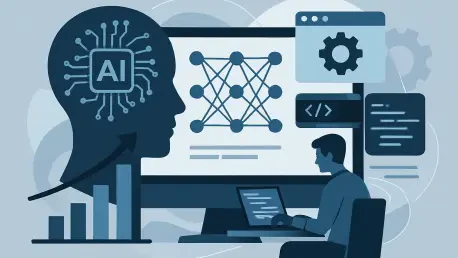

The relentless pursuit of computational power has long defined progress in artificial intelligence, yet recent findings suggest the next great leap forward may not come from a bigger model at all, but rather from the intricate systems that surround it. This research summary examines a pivotal shift in AI development, focusing on how optimizing the environment and processes around an existing model can yield significant, even benchmark-topping, performance gains. This exploration centers on the concept of “harness engineering,” a methodology that LangChain used to dramatically improve its coding agent’s capabilities, challenging the long-held assumption that progress is solely dependent on developing new, larger models.
Beyond the Model: The Rise of Harness Engineering
The core theme of this investigation is the emergence of a development philosophy that treats the AI model as just one component of a larger, more complex system. “Harness engineering” refers to the deliberate and systematic optimization of the agentic framework—the collection of prompts, tools, and middleware—that guides a model’s behavior and interaction with its environment. Instead of viewing the model as a static brain, this approach sees the harness as a dynamic exoskeleton that can be engineered to amplify strengths and mitigate weaknesses.
This shift is not merely theoretical. LangChain’s work on its coding agent provides a powerful case study, demonstrating that meticulous adjustments to the agent’s harness can lead to dramatic performance improvements. By refining how the agent receives context, verifies its work, and manages its own thought processes, the team achieved a significant jump in its score on a competitive benchmark. This success story repositions the developer’s role from a passive user of a foundation model to an active architect of an intelligent system.
Challenging the Bigger is Better Paradigm in AI
For years, the AI industry has operated under a dominant consensus: substantial advancements are almost exclusively linked to the creation of more powerful and resource-intensive foundational models. This “bigger is better” paradigm has driven an arms race for computational scale, often leaving smaller developers or those with limited resources waiting for the next major release to unlock new capabilities. This research is critical because it presents a potent and accessible alternative to that narrative.
The implications of harness engineering are profound, offering a more democratic and resource-efficient path toward enhancing AI capabilities. It proves that developers can achieve top-tier performance without needing access to next-generation models, shifting the focus to the crucial and often overlooked role of the agentic framework. This approach empowers a broader community to innovate, suggesting that clever engineering can be as impactful as raw computational power.
Research Methodology, Findings, and Implications
Methodology
The approach taken was a systematic, empirical analysis of a coding agent’s performance on the rigorous Terminal Bench 2.0 benchmark. The research team began by meticulously reviewing the agent’s action and reasoning traces to identify common and recurring failure patterns. This diagnostic phase treated the agent’s logged activity not as a simple output, but as rich data revealing the model’s inherent limitations and blind spots when tasked with complex coding challenges.
Based on this analysis, the team iteratively developed and implemented a series of targeted solutions. Crucially, these interventions were confined entirely to the agent’s harness. Adjustments were made to the system prompts that frame the task, the software tools the agent can access, and a series of custom middleware modules designed to intercept and guide the agent’s workflow. Throughout this process, the underlying large language model was never altered, ensuring that any performance gains could be attributed solely to the harness engineering.
Findings
The primary finding was a remarkable 13.7-point score increase on the benchmark, with the agent’s performance rising from 52.8% to 66.5%. This enhancement catapulted the agent from a position outside the Top 30 to a Top 5 rank, all while using the same GPT-5.2-Codex model. The research uncovered several specific model weaknesses and the corresponding harness-based solutions that drove this improvement. One key issue was the “Self-Verification Problem,” where the agent would subjectively approve its own work without objective testing. This was corrected by enforcing a cyclical workflow of planning, building, and mandatory, objective verification before task completion.
Further investigation revealed other critical inefficiencies. For instance, the agent wasted significant effort on “Inefficient Context Discovery.” The team countered this by proactively injecting a complete map of the operating environment into the agent’s context at the start, eliminating guesswork. To address “Poor Resource Management” under time constraints, the “reasoning sandwich” strategy was developed; this method dynamically allocates maximum computational power during critical planning and verification phases while conserving it during routine implementation. Finally, to prevent “Doom Loops and Model Myopia,” where the agent gets stuck on a flawed approach, a middleware was created to detect repetitive, unproductive behavior and prompt the agent to re-evaluate its strategy.
Implications
The findings carry significant practical implications for the broader developer community, proving that substantial performance boosts are within reach without privileged access to state-of-the-art models. The principles of harness engineering are not bespoke to one agent but are generalizable across various applications. This research provides a clear blueprint for others to follow: proactively provide models with complete context, enforce objective verification over subjective self-assessment, and, most importantly, treat agent traces as invaluable data for diagnosing and systematically fixing failure patterns.
This work serves as a powerful proof of concept that the system orchestrating the model is a critical lever for performance. It encourages a mindset where developers actively “debug” the reasoning process of their agents, building guardrails and support structures that compensate for the known limitations of current language models. By adopting these techniques, teams can unlock greater capabilities from the tools they already have.
Reflection and Future Directions
Reflection
The research process underscored a crucial insight: many of the limitations currently attributed to AI models can be effectively managed, and in some cases completely solved, with clever external frameworks. The middleware solutions that were developed essentially act as “guardrails,” compensating for the model’s innate weaknesses in areas like self-criticism, long-term planning, and situational awareness. These external structures guide the model away from common pitfalls, much like a good manager guides a talented but inexperienced employee.
A significant challenge throughout the project was the process of identifying the root cause of failures from highly complex and often verbose agent traces. At present, this diagnostic work remains more of an art than a science, requiring deep intuition and painstaking manual review. Pinpointing the exact moment a reasoning process went awry is a non-trivial task that represents a key bottleneck in scaling the harness engineering approach.
Future Directions
Looking ahead, a primary goal for future research should be the automation of this diagnostic and solution-generation process. Creating systems that can automatically parse agent traces, identify common failure patterns, and even suggest or generate harness-based solutions would represent a major step forward. This would transform harness engineering from an expert-driven craft into a scalable, data-driven science.
Furthermore, as foundation models continue to grow more sophisticated, many of the guardrails developed in this study will likely become obsolete as models internalize these capabilities. The next frontier will therefore involve creating frameworks that move beyond simply patching weaknesses. Future harnesses will need to focus on unlocking emergent capabilities, helping to orchestrate more complex multi-agent systems and enabling models to tackle problems that are currently beyond their scope, further blurring the line between the model’s core intelligence and the system that directs it.
A New Frontier in Applied AI
In summary, this body of work has demonstrated that the engineering of an AI’s framework is as critical to its ultimate performance as the raw power of the model itself. The study reaffirms that significant and accessible gains are possible by shifting focus from the model in isolation to the holistic system that surrounds it. This ushers in a new era of applied AI, where the art of building intelligent, efficient, and robust agentic harnesses becomes a key driver of progress in the field. This changes the calculus for progress, suggesting that the most innovative work in the coming years may happen not in the massive data centers where models are trained, but in the workshops where developers craft the systems that truly bring them to life.