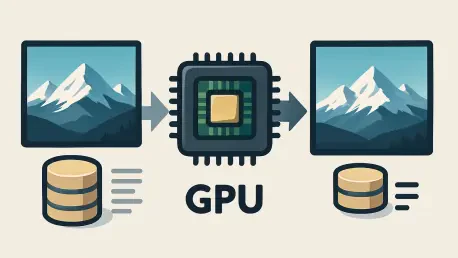

The relentless expansion of artificial intelligence training clusters has exposed a critical inefficiency where multi-million dollar hardware remains idle during the frequent and essential process of data checkpointing. This “checkpointing bottleneck” arises because traditional data reduction methods rely heavily on the CPU, creating a massive imbalance between computational speed and storage throughput. As model sizes swell into the trillions of parameters, the economic consequences of these idle periods have forced a radical shift toward offloading compression tasks directly onto the GPU. This review examines how this transition transforms storage management from a passive hindrance into a streamlined computational asset.
Introduction to GPU-Accelerated Data Reduction
The shift from CPU-bound compression to massive parallel processing on the GPU represents a fundamental change in how data integrity is maintained in high-performance environments. Historically, storage operations were seen as a necessary pause in computation, a synchronous wait time that grew longer as datasets expanded. However, modern workflows now prioritize bit-for-bit data integrity while maximizing the utilization of the high-bandwidth memory already present on the GPU. By treating compression as a parallel workload, organizations can finally align their storage speeds with the raw processing power of modern silicon.
This architectural pivot is primarily driven by the need to optimize the “Total Cost of Ownership” for AI infrastructure. When a 256-GPU cluster pauses to save its state, every second of delay translates into lost productivity and wasted capital. Lossless compression ensures that these saves are not only faster but also consume less space on expensive high-speed flash arrays. The objective is no longer just saving disk space; it is about reclaiming the computational time previously lost to I/O wait cycles.
Key Architectural Components and Algorithms
The nvCOMP Library and Software Stack
NVIDIA’s nvCOMP library serves as the foundational framework for this high-speed data reduction, specifically engineered to bypass the traditional CPU overhead. By utilizing direct GPU memory access, the library allows data to be compressed and decompressed without ever leaving the high-bandwidth environment of the accelerator. This approach eliminates the latency-heavy transfers between the host system and the device, which frequently acted as the primary speed limit for older compression tools.
Integration into existing AI workflows has been simplified to ensure that researchers do not need to rewrite their entire codebase. Transitioning from standard PyTorch saving functions to accelerated modules typically requires minimal code changes, making the technology accessible to teams without deep systems engineering expertise. This ease of adoption is critical for a software stack that aims to be the industry standard for distributed training.
High-Throughput gANS Compression: Maximum Speed
For environments where raw speed is the primary requirement, the GPU-accelerated Asymmetric Numeral Systems (gANS) algorithm provides a compelling solution. Achieving peak throughput speeds of up to 190 GB/s, gANS is designed to keep pace with GPUDirect Storage configurations. In these high-performance setups, the compression ratio is often secondary to the need to clear the memory buffers as quickly as possible to resume active training.
The unique advantage of gANS lies in its ability to scale across thousands of GPU cores simultaneously. While traditional algorithms struggle with the branching logic required for compression, gANS maps efficiently to the SIMT (Single Instruction, Multiple Threads) architecture of modern GPUs. This allows for a level of performance that renders traditional storage bottlenecks nearly obsolete in a local cluster environment.
High-Efficiency ZSTD Implementation: Balanced Performance
In contrast to the raw velocity of gANS, the GPU-offloaded ZSTD implementation offers a more balanced approach for standard network storage. It focuses on achieving higher compression density, often resulting in a 25% to 40% reduction in file sizes. This is particularly valuable for organizations relying on cloud-based object storage or shared network drives where bandwidth is more restricted than local NVMe speeds.
By moving ZSTD to the GPU cores, the system maintains a respectable throughput while significantly lowering the storage footprint. This dual-algorithm strategy allows users to choose between maximum speed and maximum efficiency based on their specific infrastructure constraints. Consequently, the technology remains versatile across both elite on-premise supercomputers and more standard cloud-based training environments.
Emerging Trends in Model Architecture and Sparsity
The evolution of model design, specifically the transition from dense Transformers to Mixture-of-Experts (MoE) architectures like DeepSeek-V3, has had a surprising impact on compression efficiency. MoE models naturally exhibit higher degrees of sparsity, which GPU-accelerated compressors can exploit to achieve higher ratios, sometimes reaching up to 1.40x. This relationship suggests that as AI models become more complex and modular, the benefits of lossless compression will only grow.
Furthermore, the primary target for these data reduction techniques is the optimizer state, such as those found in AdamW. Because these states are often four times larger than the actual model weights, they represent the largest portion of a checkpoint file. Optimizing the storage of these massive footprints is essential for maintaining the agility of large-scale distributed training systems.
Real-World Applications and Economic Impact
Financial optimization in large-scale AI clusters is the most immediate benefit of this technology. By reclaiming idle GPU time, organizations can see a massive reduction in the cost of training. For a 256-GPU cluster, the monthly savings can reach over $222,000, which significantly alters the ROI calculation for high-end B200 infrastructure. These savings allow research teams to allocate more budget toward actual experimentation rather than infrastructure overhead.
Beyond mere cost-cutting, GPU-accelerated compression facilitates more robust fault-tolerant systems. Rapid checkpointing allows for more frequent saves without penalizing performance, which means that in the event of a hardware failure, the system can recover from a very recent state. This reliability is indispensable for long-running training jobs that span weeks or months.
Technical Challenges and Implementation Barriers
Despite the clear advantages, hardware-specific dependencies remain a significant barrier to universal adoption. Modern GPU architectures are required to run these libraries effectively, which may leave older data centers unable to utilize the latest performance gains. Furthermore, there is a constant trade-off between the GPU cycles used for compression and those used for training, requiring a delicate balance to ensure that the compression itself does not become a new source of delay.
There are also inherent limitations in how certain data types react to compression. While optimizer states and gradients offer high reduction potential, raw model weights are often less compressible. Ongoing development is currently focused on standardizing these tools across heterogeneous computing environments to ensure that vendor lock-in does not prevent the broader industry from benefiting from these efficiencies.
Future Outlook and Technological Evolution
The next stage of this evolution involves the integration of AI-driven adaptive compression. Future systems will likely use lightweight machine learning models to analyze data entropy in real-time, choosing the optimal algorithm (gANS or ZSTD) based on the specific characteristics of the data block. This level of automation would remove the guesswork for developers and ensure maximum efficiency regardless of the model architecture being used.
Looking further ahead, we may see hardware-level compression engines built directly into next-generation silicon, further reducing the computational load on the primary GPU cores. This advancement would contribute significantly to sustainable AI practices by reducing the energy and storage requirements of massive data centers. As edge computing and real-time streaming become more prevalent, the ability to compress data at the source with minimal latency will be a defining feature of the next technological era.
Summary and Final Assessment
The implementation of GPU-accelerated lossless compression successfully addressed the most persistent bottlenecks in high-performance computing. By utilizing the nvCOMP framework, organizations converted passive storage delays into active productivity, proving that high-speed data reduction is essential for modern AI. The technology demonstrated that the economic viability of trillion-parameter models depended as much on storage efficiency as it did on raw floating-point performance. Ultimately, this shift toward parallelized compression became a cornerstone of sustainable and cost-effective infrastructure management in the intelligence era.