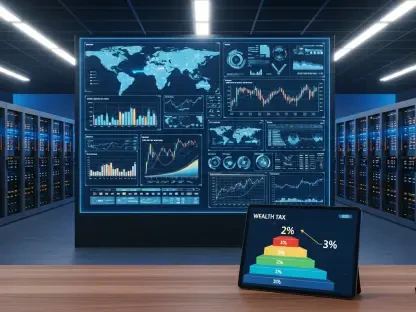

The race for microsecond advantages in modern financial markets has reached a fever pitch as high-frequency trading firms abandon traditional methods for sophisticated neural network architectures. In this high-stakes environment, the choice between general-purpose hardware and specialized silicon determines who wins the execution race and who is left with stale prices. While Field Programmable Gate Arrays (FPGAs) have long reigned supreme due to their “hard-wired” speed, the emergence of the NVIDIA G##00 Grace Hopper Superchip has fundamentally altered the competitive landscape. This shift is largely driven by the increasing reliance on Long Short-Term Memory (LSTM) neural networks, which are now essential for accurate time-series forecasting and complex automated hedging strategies across traditional exchanges and decentralized finance platforms.
Modern infrastructure now centers on a sophisticated interplay between raw speed and architectural flexibility. Industry benchmarks from the Strategic Technology Analysis Center (STAC-ML) recently showcased the Supermicro ARS-111GL-NHR server, which leverages the G##00 to push the boundaries of what was once considered impossible for non-specialized hardware. This evolution reflects a broader trend where the historical dominance of ASICs and FPGAs is being challenged by GPUs that can finally handle the rigorous demands of execution priority in capital markets.
Performance Benchmarks and Architectural Advantages
Latency Breakthroughs and Predictive Consistency: The New Standard
The most striking development in recent trading history is the NVIDIA G##00’s achievement of a 4.61-microsecond latency at the 99th percentile. By breaching the single-digit microsecond barrier, this hardware has effectively neutralized the primary advantage that once made FPGAs the only viable choice for top-tier HFT firms. This metric is not just a peak performance figure; it represents a fundamental shift in how predictive models interact with live market data, ensuring that price predictions are calculated and acted upon before the competition can react.
Consistency is often more valuable than raw speed on a volatile trading desk, and the G##00 demonstrates remarkable stability. Performance remains tightly clustered between 4.61 and 4.70 microseconds, even when the system is managing multiple concurrent model instances. In contrast, while FPGAs offer deterministic performance, they often struggle with the overhead of complex neural networks. This predictable GPU behavior allows traders to maintain a precise order of trade execution, which is the difference between a profitable arbitrage and a costly slippage.
Hardware Partitioning and Memory Management: Beyond Logic Gates
One of the key technical differentiators favoring modern GPU architectures is the implementation of “green contexts.” This feature allows for hardware-level partitioning, enabling a single G##00 to run independent inference workloads simultaneously without a performance penalty. This effectively mimics the parallel nature of FPGAs but provides a much more flexible environment for managing various trading signals. Such architectural ingenuity ensures that a high-load environment does not lead to the dreaded “jitter” that can plague less sophisticated hardware setups.
To further close the gap with hardware-level programming, the “dl-lowlat-infer” open-source repository has become a vital tool for developers. By using persistent CUDA kernels, this approach keeps model weights directly in shared memory, successfully bypassing the initialization delays that typically hinder general-purpose processors. While FPGA engineers must manually route logic gates to achieve low latency, GPU users can now leverage these software-defined optimizations to achieve near-instantaneous response times with a fraction of the engineering overhead.
Scalability Across Diverse Model Architectures: Flexibility as a Feature
Flexibility remains the primary battleground when comparing these two technologies. GPUs excel at handling varying model sizes, scaling from small configurations to medium models at 6.88 microseconds, and even very large neural networks at 15.80 microseconds. An FPGA, by its very nature, is a rigid environment where changing a model often requires a complete “re-spinning” of the hardware logic, a process that can take weeks or months. In the fast-moving world of crypto and DeFi, this delay is unacceptable.
The ability to iterate rapidly on GPU hardware allows quantitative firms to deploy new strategies as fast as they can write the code. This agility is crucial when market conditions shift or when new data sources become available. While FPGAs are still preferred for the most basic, static tasks, the diverse range of strategies required in modern finance—from liquidity provision to complex trend following—makes the versatile GPU a more practical backbone for an evolving trading stack.
Engineering Constraints and Regulatory Compliance
The “infrastructure calculus” for a trading firm involves more than just speed; it encompasses the immense difficulty of finding and retaining FPGA engineering talent. Programming at the hardware description language level is notoriously complex and time-consuming. In contrast, the GPU ecosystem thrives on widely used languages and frameworks, making it easier for firms to build and maintain their systems. This human element often tips the scale toward NVIDIA and Supermicro solutions, as the time-to-market for a new trading strategy can be significantly shorter.
Furthermore, global regulatory bodies are tightening their grip on automated systems, with India’s SEBI Order-to-Trade Ratio framework serving as a prime example. These regulations demand high levels of transparency and auditability in machine learning infrastructure. High-density solutions like the Supermicro ARS-111GL-NHR not only provide the necessary performance but also fit into standard data center power and cooling profiles more easily than many custom-built FPGA arrays, simplifying the compliance and operational burden for global firms.
Future Outlook and Infrastructure Recommendations
The comparative analysis showed that the NVIDIA G##00 effectively challenged the specialized lead of FPGAs and ASICs by offering a combination of microsecond speed and software flexibility. Quantitative trading firms were encouraged to evaluate their current infrastructure, as the shift from fixed hardware logic to GPU-based deep learning models became increasingly viable for even the most latency-sensitive strategies. Firms prioritized the ease of model iteration to stay ahead of market shifts, using tools like the “dl-lowlat-infer” repository to streamline their deployment pipelines.
Looking ahead, the integration of high-speed inference with accessible programming environments will likely redefine the standard for capital market infrastructure. Decision-makers should focus on building hybrid systems that leverage GPUs for complex predictive modeling while retaining specialized hardware only for the simplest, most static execution tasks. This balanced approach will ensure that firms remain resilient against both technological disruptions and evolving regulatory demands in an increasingly automated global economy.