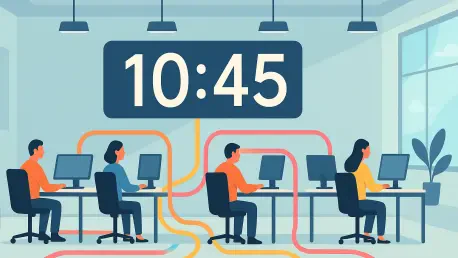

The ticking clock on the wall of a modern office no longer measures time in mere hours or minutes, but rather in the agonizing intervals between an employee’s urgent request and a manager’s eventual manual approval. For decades, the pace of productivity has been tethered to the limitations of human coordination, where progress frequently stalls while waiting for a Tuesday morning sync or a cross-departmental email chain. As Artificial Intelligence begins to shoulder the burden of complex coordination and translation, the rigid, slow-moving structures of the corporate world are facing an existential crisis. The central challenge for the current year is not whether a specific task can be automated, but whether the very architecture of organizations can survive in a landscape where work moves at the speed of digital thought.
The reality of the modern workplace reveals that traditional hierarchies were designed for a world of information scarcity and slow communication. Because humans cannot process thousands of data points or coordinate across ten departments instantly, companies built “queues” into every process to maintain order. However, these queues have become the primary source of organizational friction. As AI agents begin to handle the heavy lifting of routing requests and validating information in real-time, the need for these stagnant waiting periods is disappearing. Organizations are finding that to remain competitive, they must move away from a model of sequential approvals and toward a system of continuous, parallel execution.
The End of the Weekly Meeting: Why HR is Moving Beyond the Queue
The traditional corporate rhythm, once defined by the weekly status update and the manual sign-off, is increasingly viewed as an obsolete bottleneck. In the past, managers and Human Resources professionals acted as the primary conduits for information, filtering data up and down the chain of command. This manual intervention was necessary because there was no other way to ensure that disparate teams remained aligned. Today, the integration of intelligent systems allows for a persistent flow of data that keeps all stakeholders informed without the need for a formal meeting. This shift effectively eliminates the “queue” that once defined the life cycle of a project, allowing work to advance as soon as a requirement is met.
This structural evolution demands a radical rethinking of governance and oversight within the enterprise. When work is no longer batched into weekly intervals, the role of HR shifts from monitoring attendance and task completion to ensuring the health of the organizational flow. Instead of rigid checkpoints, companies are implementing real-time governance frameworks where AI monitors compliance and policy alignment in the background. This allows employees to move faster without sacrificing safety or standards. The goal is to create a frictionless environment where the “architecture of the queue” is replaced by an architecture of immediate action, ensuring that human creativity is never sidelined by administrative inertia.
The Economic Collapse of Information Barriers
Historically, the division of a company into silos—such as Finance, IT, and HR—was a rational response to the high cost of moving and translating information. It was difficult for a specialized recruiter to understand the technical nuances of a software engineering role without significant human intervention, so companies created departmental boundaries to manage this complexity. These silos served as a stabilizing force, but they also introduced significant fragmentation. As AI technology matures, it acts as a universal translator, capable of maintaining context and expertise across functional boundaries. The economic justification for keeping these departments in isolated silos is rapidly evaporating as the cost of cross-departmental coordination drops toward zero.
As these information barriers collapse, the enterprise is moving away from a “standardized” model where every employee is treated as a generic unit within a department. Instead, AI allows for a level of hyper-personalization in management and operations that was previously unaffordably expensive. High-level strategic expertise can now be delivered directly to a junior employee at the exact moment they need it, bypassing the traditional chain of command. This democratization of knowledge means that the rigid hierarchy is no longer the most efficient way to scale a business. The focus is shifting from protecting departmental territory to fostering an environment where information flows freely to wherever it can create the most value.
Dismantling the Silos: Reorganizing Around Value Flow
To capitalize on the speed of AI, organizations must pivot their focus from individual departmental tasks to holistic end-to-end journeys. A classic example is the “hire-to-productivity” process, which has traditionally been carved into pieces owned by Talent Acquisition, IT, and specific line managers. When these pieces are disconnected, the new hire often experiences a fragmented onboarding process that delays their ability to contribute. AI agents can now bridge these gaps by carrying the context of the initial interview through to the technical setup and initial training phases. This ensures that the transition is seamless and that the “value flow” is never interrupted by a handoff between departments.
This reorganization also marks a departure from the “deploy and freeze” mindset that governed technology rollouts for decades. Because AI capabilities are in a state of constant evolution, the architecture of the organization must remain equally fluid. HR leaders are moving away from the search for a static “final state” and are instead building systems designed for continuous experimentation. Success in this new era depends on a cycle of “hypothesis, test, and adapt,” where the company remains in a permanent state of evolution. By removing the operational bottlenecks that once slowed down change, the organization can respond to market shifts or technological breakthroughs in real-time rather than waiting for the next fiscal year.
Capturing the Ghost in the Machine: Expert Insights on Institutional Memory
One of the most significant challenges facing modern firms is the “brain drain” that occurs when experienced employees depart, taking their undocumented expertise with them. Research into enterprise intelligence suggests that the most valuable asset of a company is the collective knowledge trapped in the minds of its workforce. Industry experts argue that the shift from generic AI tools to proprietary reasoning systems is the key to solving this issue. By grounding AI in a company’s specific data, policies, and historical successes, organizations create a “capable colleague” that remembers everything. This system doesn’t just store data; it learns from every human correction and decision, becoming a permanent repository of the organization’s “memory.”
This evolution turns every employee interaction into a contribution to the company’s long-term intelligence. When a human expert refines an AI-generated strategy or corrects a technical draft, the system captures that nuance, ensuring that the next iteration is more accurate. Over time, this creates a robust institutional intelligence that grows more sophisticated with every passing month. Instead of starting from scratch every time a key team member leaves, the organization retains the “ghost in the machine”—the unique perspective and expertise that define its competitive advantage. This transformation ensures that institutional knowledge becomes a cumulative asset rather than a volatile one that fluctuates with employee turnover.
Strategies for Achieving Cognitive Lift
Achieving true transformation requires HR leaders to prioritize the “cognitive lift” of their workforce over mere operational efficiency. This begins by identifying the “blank page tax”—the mental energy wasted on starting tasks, gathering initial data, or summarizing long documents. AI is uniquely positioned to handle this initial heavy lifting, providing employees with a solid foundation from which they can apply their high-value judgment. When the machine handles the routine and the repetitive, human energy is redirected toward empathy, ethics, and high-stakes problem-solving. This shift ensures that the technology amplifies human potential rather than merely replacing human labor.
Furthermore, success must be measured by outcomes rather than activity metrics. Traditional tracking of how many hours an employee works or how many prompts they write is becoming irrelevant. Instead, organizations are focusing on the reduction in time-to-productivity and the overall improvement in cross-departmental flow. Fostering a “feedback-first” culture is essential, as it encourages employees to treat AI as an apprentice that requires guidance. Every correction made by a human is an investment in the collective intelligence of the firm. By focusing on scaling high-value judgment, companies ensure that their entire workforce is elevated, allowing the organization to achieve goals that were previously considered out of reach.
The transition toward a fluid, AI-integrated architecture demanded a total departure from the rigid structures of the early twenty-first century. It was found that the organizations which thrived were those that viewed AI not as a tool for today’s tasks, but as a foundation for a new way of working. Leadership teams moved away from the departmental silos that characterized the old economy and instead embraced a model focused on the continuous flow of value. It became clear that the preservation of institutional memory and the pursuit of cognitive lift were the defining factors of long-term success. By the time the transition was complete, the architecture of Human Resources had evolved from a system of administrative oversight into a dynamic engine of enterprise-wide intelligence. Actionable strategies were implemented to ensure that human judgment remained the ultimate authority, even as the speed of execution reached unprecedented levels.