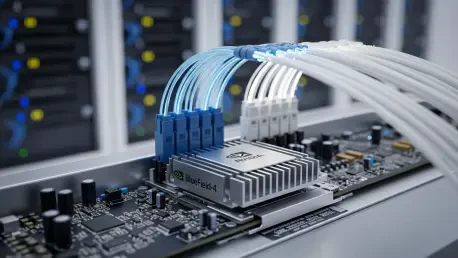

The relentless escalation of artificial intelligence workloads, pushing the boundaries of what trillion-parameter models and high-volume inference processing can achieve, has placed an unprecedented strain on the foundational architecture of modern data centers. As these complex computations become the lifeblood of enterprise innovation, the underlying infrastructure faces immense pressure to deliver not only raw performance but also robust security, seamless manageability, and efficient scalability. This challenge is particularly acute in multi-tenant cloud environments where isolating workloads and ensuring predictable performance are paramount. In response to these industry-wide demands, NVIDIA’s announcement of BlueField Astra at CES 2026 marks a pivotal moment, introducing a comprehensive system engineered to redefine the security posture of AI clouds. By integrating the formidable capabilities of its BlueField-4 Data Processing Units (DPUs) and ConnectX-9 SuperNICs, Astra offers service providers a groundbreaking solution to manage and secure the next generation of AI infrastructure.
A Redefined Architecture for Multi-Tenant Security
At the heart of BlueField Astra lies a fundamental reimagining of data center architecture, specifically designed to address the unique complexities of multi-tenant AI operations. The system introduces a new system-level framework that establishes a unified control plane, extending sophisticated management, provisioning, and policy enforcement directly into the East-West (E-W) compute fabric—the critical network connecting the AI processing nodes. A cornerstone of this design is the strict isolation of the SuperNIC control plane from the host operating system, a critical separation that prevents tenant workloads from ever interfering with core network functions. This architectural choice is essential for delivering secure, bare-metal GPU instances with the performance and isolation that providers demand. Deeply integrated into the NVIDIA Vera Rubin NVL72 compute platform, the BlueField-4 DPU connects directly to the ConnectX-9 SuperNICs, creating a dedicated, out-of-band control path that consolidates both North-South (N-S) and E-W network domains under a single, trusted point of management.
This innovative integration goes beyond physical connectivity by fundamentally shifting the software-defined intelligence of the network. By migrating the entire NVIDIA DOCA software stack from the host CPU onto the powerful Arm cores of the BlueField DPU, the BlueField Astra system effectively endows the AI compute fabric with its own robust, cloud-aligned security perimeter. This strategic move inherently strengthens tenant isolation, as the infrastructure management layer is now air-gapped from the tenant’s execution environment. It provides a powerful defense against lateral movement between compromised nodes, a significant threat in large-scale, shared environments. Furthermore, this design directly mitigates the risk of configuration drift, where unauthorized or accidental changes to the host can degrade security and performance. With the control plane securely anchored on the DPU, the AI cloud’s configuration remains stable, predictable, and shielded from the volatile nature of the workloads it supports, creating a more resilient and trustworthy foundation for AI services.
Streamlining Operations and Enhancing Compliance
For Cloud Service Providers (CSPs), the introduction of BlueField Astra provided a clear pathway to operational consistency and heightened compliance across their expanding AI fleets. By extending the same DOCA-based management tools from the data center’s front end deep into the core E-W fabric, the system eliminated operational silos and created a unified, end-to-end management experience. This consistency allowed policies to be enforced directly in the SuperNIC hardware, enabling granular, tenant-aware provisioning and security enforcement at line rate, without imposing a performance tax on the GPUs. This architecture also brought significant advantages for governance and compliance, as all network configurations and security policies resided on the DPU, leading to clearer, more tamper-resistant audit trails that simplified adherence to stringent industry regulations. In essence, the launch of BlueField Astra was a defining moment that offered more than just components; it established a secure, high-performance, and efficiently managed blueprint for the AI clouds of tomorrow.