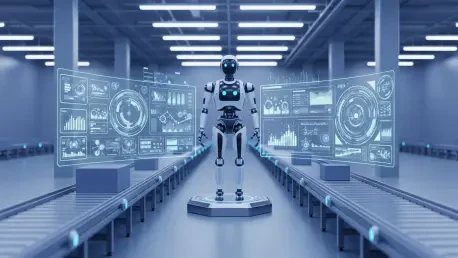

The sight of a bipedal robot gracefully lifting a carton in a promotional video often masks the grueling technical and economic reality that these machines face on the warehouse floor. As the logistics industry grapples with a persistent global labor shortage and the relentless pressure of e-commerce demands, the allure of the anthropomorphic form has never been stronger. These machines represent a peak of mechanical engineering, designed to operate within environments originally built for people, yet they sit at a precarious crossroads between being high-tech spectacles and viable industrial tools. The central tension lies in whether a robot should look like a human to do a human’s job, or if the future of automation belongs to specialized forms that prioritize throughput over anatomy.
Introduction to Humanoid Robotics in Logistics
The core principle behind humanoid logistics robots is the replication of human physical versatility through anthropomorphic design and complex sensor integration. By utilizing a bipedal stance and articulated limbs, these machines are theoretically capable of navigating stairs, narrow aisles, and uneven surfaces that would stop a wheeled robot in its tracks. This design philosophy stems from the need to automate “brownfield” sites—existing facilities where the infrastructure cannot be easily modified to accommodate traditional, fixed automation. In these settings, the robot must adapt to the world, rather than the world adapting to the robot.
However, there is an undeniable magnetism to the humanoid form that often clouds objective performance analysis. While traditional automated guided vehicles and cobots have dominated the market by performing singular tasks with high efficiency, humanoids promise a “general purpose” utility. This promise is particularly relevant as demographic shifts in regions like Japan and Europe reduce the available workforce. The challenge remains for developers to prove that this aesthetic mimicry provides a functional advantage that justifies the significantly higher cost and mechanical complexity compared to purpose-built, non-humanoid alternatives.
Core Components and Functional Features
Anthropomorphic Mechanics and Physical AI
The engineering of a humanoid robot involves a sophisticated blend of high-torque actuators and “Physical AI,” which allows the machine to translate digital intent into fluid, balanced movement. Unlike standard industrial arms bolted to a floor, a humanoid must constantly calculate its center of gravity while interacting with heavy objects. This requires a level of sensor fusion—combining inputs from LiDAR, depth cameras, and tactile sensors—that enables the machine to “feel” its way through a task. The goal is to achieve a level of limb articulation that matches the reach and flexibility of a human worker, allowing the robot to pick from bottom shelves or overhead bins with equal ease.
The Software Orchestration Layer
Physical capability is effectively useless in a modern warehouse without deep integration into the digital nervous system of the facility. The software orchestration layer acts as the bridge between the robot’s physical actions and the Warehouse Management System (WMS) or Enterprise Resource Planning (ERP) platform. This integration ensures that the robot is not just moving boxes in a vacuum but is responding to real-time order priorities and inventory shifts. For a humanoid to be effective, it must be “software-defined,” meaning its behavior can be updated and optimized remotely as the warehouse’s operational needs evolve over time.
Emerging Trends and Market Shifts
The industry is currently transitioning from “heroic” demonstrations of individual robots to the management of entire autonomous fleets. This shift is driven by the rise of “Agentic AI,” where robots are no longer just following pre-programmed paths but are making autonomous decisions based on environmental changes. In a busy logistics hub, a robot might encounter a spilled pallet or a human coworker; Agentic AI allows it to recalculate its route or task priority without human intervention. This move toward decentralized decision-making is critical for moving beyond small-scale pilots into full-scale operational deployments.
Furthermore, the focus has shifted toward brownfield integration, where technology must prove its worth in “messy” existing environments. In the past, automation was often reserved for “greenfield” sites—pristine, custom-built warehouses designed specifically for machines. Today, the commercial pressure lies in making humanoids work in the crowded, unpredictable spaces of older facilities. This requires a level of spatial awareness and adaptability that traditional robotics lacked, pushing the boundaries of how machines interpret and interact with stochastic human spaces.
Real-World Applications and Use Cases
Current implementations are most visible in the third-party logistics (3PL) and e-commerce sectors, where the variety of items and the speed of turnover demand high flexibility. “Robots-to-Goods” workflows are being tested where humanoid prototypes assist in picking and sorting operations alongside human staff. These robots are particularly valuable for tasks that are ergonomically taxing or repetitive, such as unloading trailers or palletizing heavy cartons. By taking over these “dull, dirty, and dangerous” jobs, humanoids allow human workers to focus on more complex supervisory roles.
Geographically, Japan has emerged as a primary laboratory for these applications due to its unique demographic pressures. The cultural acceptance of robotics combined with a shrinking labor pool has led to early adoption in retail fulfillment centers. These use cases provide vital data on how humanoids handle real-world volatility, such as varying box weights and fragile packaging. The data gathered from these early adopters is essential for refining the “Physical AI” models that will eventually power broader global deployments in more price-sensitive markets.
Technical Hurdles and Commercial Obstacles
Despite the technological marvels on display, the sector faces a significant reality check regarding its Return on Investment (ROI). The mechanical complexity of a bipedal robot makes it inherently more expensive to manufacture and maintain than a wheeled counterpart. For many warehouse operators, the math simply does not yet add up when compared to simpler, specialized automation. There is a persistent technical gap between the controlled environment of a laboratory simulation and the chaotic reality of a working warehouse, where dust, lighting changes, and unexpected obstacles can degrade sensor performance.
Safety and regulatory hurdles also present a major barrier to widespread adoption. Having a 300-pound humanoid machine operating in close proximity to human personnel requires rigorous safety protocols and “fail-safe” mechanisms that are still being standardized. If a humanoid loses balance or miscalculates a movement, the risk of injury is higher than with smaller, floor-bound robots. Solving these safety challenges while maintaining the speed and agility required for high-volume logistics remains one of the most difficult obstacles for the industry to clear.
Future Outlook and Market Consolidation
As the initial hype begins to settle, the market is moving toward a period of significant consolidation. Investors are increasingly demanding commercial results over research milestones, which will likely lead to a shakeout where only the most operationally viable companies survive. The long-term vision remains ambitious, with projections suggesting a massive global market by 2050, but the immediate future will be defined by “Software-Defined” robotics that can prove their value in the short term. The goal is no longer just to build a machine that looks like a person, but to build a system that works with the reliability of a utility.
Future developments will likely focus on achieving a better ratio of robots to human supervisors, aiming for a “one-to-ten” balance where a single technician can manage a fleet of autonomous humanoids. This will require even greater strides in autonomous error recovery and fleet management software. As the technology matures, we may see the emergence of “Robotics-as-a-Service” (RaaS) models, which could lower the barrier to entry for smaller logistics firms and accelerate the displacement of traditional manual labor in standardized tasks.
Assessment of Current State and Conclusion
The evaluation of humanoid robotics in the warehouse revealed a profound gap between engineering sophistication and commercial readiness. While the ability of these machines to mimic human movement was impressive, their success depended less on their physical form and more on the software orchestration layers that managed them. The industry transitioned from being enamored with the novelty of bipedal movement toward a disciplined focus on throughput and integration. It became clear that the humanoid form was not a silver bullet, but rather one tool in a broader arsenal of automated solutions.
Moving forward, logistics leaders should prioritize modularity and software compatibility when evaluating robotic investments. The focus must shift toward creating hybrid environments where purpose-built machines and general-purpose humanoids can communicate through a unified digital framework. Future research ought to target the reduction of mechanical complexity to lower maintenance costs and improve the reliability of these systems in harsh industrial settings. Ultimately, the survival of the humanoid platform in logistics will be determined by its ability to fade into the background of a warehouse, performing tasks with the quiet, boring reliability of a conveyor belt rather than the cinematic flair of a prototype.