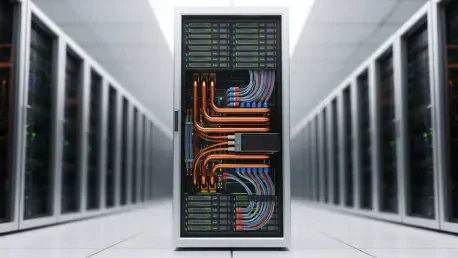

Marco Gaietti, a veteran in strategic management with decades of experience navigating the complexities of industrial operations and high-stakes customer relations, joins us to discuss the monumental shift in the technological landscape following NVIDIA’s unveiling of the Vera Rubin platform. As global industries pivot toward an era where computational power defines national and corporate sovereignty, Gaietti provides a deep dive into how this new architecture serves as the backbone for the next generation of “AI factories.” We explore the convergence of traditional high-precision simulation and modern generative AI, the strategic implications of liquid-cooled density, and why the world’s leading research institutions are racing to integrate this 7-exaflop powerhouse into their infrastructure.
The Vera Rubin platform delivers 7 exaflops of AI performance and 5 petaflops of FP64 precision in a single rack; how do these staggering technical specifications fundamentally alter the way research centers tackle “grand challenge” problems like climate modeling or high-energy physics?
These numbers represent a massive leap forward that effectively removes the computational ceiling that has stifled scientific discovery for years. When you look at 7 exaflops of AI performance, you aren’t just talking about a faster computer; you are talking about the ability to run models that can predict weather patterns or simulate molecular interactions with a level of granularity that was previously impossible. The 5 petaflops of native FP64 precision are equally vital because traditional high-energy physics and quantum chemistry still rely on that rigid mathematical accuracy to ensure simulations don’t drift into error. There is a palpable sense of urgency in the air at places like the Lawrence Berkeley National Laboratory, where researchers feel they are finally gaining a tool that can keep pace with the sheer complexity of the natural world. This isn’t just a technical upgrade; it’s an emotional breakthrough for scientists who have spent decades waiting for the hardware to catch up to their theoretical ambitions.
With the Leibniz Supercomputing Centre projecting its new “Blue Lion” system will offer 30 times the computing power of its predecessor by 2027, what are the strategic management implications of such a radical jump in infrastructure density?
A 30-fold increase in power within a single generational cycle is almost unheard of in traditional enterprise management, and it forces a complete rethink of data center logistics. By packing up to 144 GPUs into a single rack using the NVL72 variant, NVIDIA is demanding that facilities managers move away from air-cooled systems and embrace the silent, rhythmic flow of direct liquid-cooled architectures. This shift is not just about heat; it’s about the strategic footprint of innovation, allowing a research center to achieve massive results without building a new zip code’s worth of real estate. When I look at partners like HPE, Dell Technologies, and Supermicro preparing these systems for a Q4 2026 rollout, I see a supply chain that is finally maturing to handle the immense density required for true AI factories. It is a high-stakes game where the physical constraints of power and cooling are the only things standing between a company and a market-defining discovery.
NVIDIA’s stock is trading at $211.50 with a market capitalization exceeding $5.14 trillion, largely driven by the momentum of its AI and HPC roadmaps. From a consultancy perspective, how does the transition from the Blackwell architecture to the Vera Rubin platform reinforce their competitive moat?
The move to Vera Rubin, which ramped into full production on June 1, 2026, signals that NVIDIA is not resting on the laurels of its previous successes but is instead accelerating its release cadence to maintain a dominant lead. This platform is a masterclass in full-stack integration, weaving together Vera CPUs, Rubin GPUs, and BlueField DPUs into a unified ecosystem that is incredibly difficult for competitors to displace once it is embedded in a laboratory’s workflow. Investors are watching that $5.14 trillion market cap because they recognize that the Vera Rubin platform is becoming the standardized “operating system” for the world’s most critical research. For a management team, the “NVLink-C2C” connectivity and the transition to liquid-cooled racks create a “sticky” environment where the cost of switching to another provider becomes prohibitively high. There is a certain confidence, almost a swagger, in how this architecture has been rolled out to meet the burgeoning demand for infrastructure that can handle both legacy simulations and the newest AI workloads.
Institutions like Los Alamos National Laboratory are deploying this hardware for national security and advanced research; what role does this high-end hardware play in the broader race for technological sovereignty among global powers?
When you see a flagship system like the “Doudna” supercomputer being built at the U.S. Department of Energy, you realize that supercomputing has become the ultimate “force multiplier” for national interests. These systems are being used for everything from drug discovery to national security simulations, where the speed of processing data directly correlates to a nation’s ability to respond to emerging threats or pandemics. The ability of the Vera Rubin platform to bridge the gap between traditional HPC and modern AI means that these labs no longer have to choose between high-precision math and neural network training; they can do both on a single, dense rack. This creates a sensory environment of high-velocity innovation where the time-to-discovery is slashed, giving the early adopters a massive head start in the global intellectual property race. It is a pivot point in history where the strength of a nation’s research is increasingly measured by the exaflops it can deploy at a moment’s notice.
What is your forecast for the AI supercomputing market as we approach the general availability of these systems in late 2026?
I anticipate a massive wave of “infrastructure FOMO” hitting both the public and private sectors as the Q4 2026 availability date nears, leading to a significant backlog for system manufacturers like Dell and HPE. The success of the Vera Rubin platform will likely trigger a secondary boom in specialized data center construction, specifically those designed for liquid cooling, as enterprises realize that air-cooled legacy systems simply cannot sustain the 7 exaflops of performance required to stay competitive. We are going to see a democratization of supercomputing power where a single rack can now outperform the massive, room-sized clusters of the previous decade. This will lead to a surge in localized “AI factories” owned by individual corporations, forever changing the landscape of industrial innovation and making the $211.50 stock price we see today look like just the beginning of a much larger era of computational expansion.