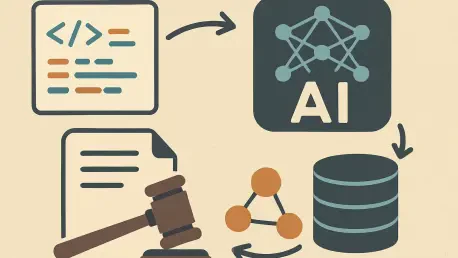

The legal distinction between a few lines of human-readable code and a trillion-parameter neural network is no longer just a theoretical debate for academics but a multibillion-dollar liability for the modern enterprise. This technological review examines the rapid evolution of AI licensing frameworks, which has become a primary driver of industry stability. As generative models have transitioned from laboratory experiments to the foundational infrastructure of global business, the legal mechanisms governing their use have struggled to keep pace. This review explores how the current landscape is moving away from traditional software paradigms to embrace a specialized architecture for model weights and training data. By analyzing the latest standards and industry adoptions, this assessment provides a comprehensive look at how legal clarity is now as essential as architectural performance in the AI sector.
Foundations of AI Licensing and the Software Paradigm Shift
Traditional open source licensing, such as the Apache 2.0 or MIT frameworks, was designed for a world where value resided in human-written instructions. In that era, the source code was the ultimate artifact, and copyright law protected the creative expression of the logic. However, artificial intelligence operates on a different fundamental principle. An AI model is essentially a collection of weights and parameters—numerical representations generated through massive computational processes rather than manual programming. This shift creates a legal vacuum because weights are often viewed as data rather than creative works, making the protections of standard software licenses ill-suited for the unique complexities of model weights.
The relevance of licensing in today’s technological landscape cannot be overstated, as legal uncertainty remains one of the largest hurdles to enterprise-wide AI integration. Corporate legal departments are often hesitant to deploy models that lack clear definitions regarding usage rights, patent indemnity, and data provenance. When a license does not explicitly address the “weights” or the “training data,” a company risks losing its intellectual property or facing litigation for copyright infringement. Consequently, the emergence of specific AI licensing is a direct response to the need for a predictable environment where developers can innovate without the shadow of ambiguous legal claims.
Core Frameworks and Standardizing AI Openness
The Open Model, Data, and Weights (OpenMDW) 1.1 License
The release of the OpenMDW 1.1 framework represents a pivotal attempt to bridge the gap between software and data-driven models. Developed through a collaboration involving the Linux Foundation and several industry leaders, OpenMDW functions as a consolidated solution that grants copyright, patent, and trade secret rights within a single, unified file. This is unique because it addresses the multi-layered nature of a model package, which often includes the inference code, the model architecture, and the actual weights. By streamlining these rights, the license eliminates the need for organizations to manage multiple, sometimes conflicting, legal documents for a single deployment.
As a permissive license, OpenMDW 1.1 prioritizes the freedom to redistribute and modify the model without the burden of copyleft requirements. This makes it particularly attractive for commercial enterprises that wish to build proprietary solutions on top of foundational models. Its significance lies in its ability to cover the full spectrum of intellectual property that applies to modern AI, providing a level of protection that generic software licenses simply cannot offer. This comprehensive approach ensures that both the “math” of the model and the “instructions” for running it are covered under a consistent set of terms.
The G7 Four-Tier Typology and the Spectrum of Openness
Recognizing that the terms “open” and “closed” are no longer sufficient to describe the current state of the market, the G7 Digital and Technology Ministers introduced a four-tier typology to classify models. This framework moves beyond a binary distinction, offering a technical classification into four categories: Open Data, Open Source, Open Weights, and Weights Available. This typology serves as a practical map for industry leaders, allowing them to assess at a glance whether a model provides the full training set or merely the final parameter file. It brings much-needed nuance to a field where marketing terminology has often obscured technical realities.
The performance of this typology in the current market has been transformative, as it forces model publishers to be more honest about their level of transparency. For example, a model categorized as “Weights Available” clearly signals that while the model is free to download, it may come with restrictive commercial usage terms. This transparency allows procurement teams to make informed decisions based on their specific risk tolerance and operational needs. By standardizing these definitions, the G7 framework has replaced confusion with a structured hierarchy that helps organizations navigate the complexities of AI transparency.
The Open Source AI Definition (OSAID)
The technical aspects of the Open Source AI Definition focus on the specific artifacts required to truly understand and replicate a model’s behavior. A major challenge in this area has been the availability of training data, which is often proprietary or sensitive. The OSAID standard addresses this by requiring thorough documentation of the training data when the data itself cannot be shared due to privacy or legal constraints. This requirement ensures that even if a developer cannot access the raw datasets, they have enough information regarding the data’s composition and biases to conduct a proper safety and performance audit.
Recent Milestones in Licensing Regulation and Industry Adoption
The landscape of AI licensing reached a significant milestone in May 2026 with the debut of the OpenMDW 1.1 framework, followed closely by the G7 framework’s formal publication. These developments signaled a global shift toward a shared language for AI openness, moving the industry away from the fragmented approach of previous years. Industry giants like Nvidia have already begun adopting these standard frameworks, a move that streamlines model distribution and significantly reduces the volume of legal inquiries from potential users. By aligning with recognized standards, major players are effectively lowering the barriers to entry for their technologies, allowing for faster integration across various sectors.
This shift in industry behavior has also solidified “open weights” as the dominant terminology for enterprise AI development. Unlike earlier periods when “open source” was used loosely to describe any public model, the current standard requires a more precise description of what is actually being shared. Organizations now recognize that an open weights model offers a practical middle ground, providing the flexibility to host and fine-tune models internally while acknowledging that the underlying training data may remain a corporate secret. This maturation of language reflects a deeper understanding of the technical and commercial realities of building large-scale AI.
Real-World Applications and Enterprise Implementation
In practical terms, licensed AI models are currently being deployed in industries ranging from finance to healthcare, where proprietary fine-tuning is a necessity. For instance, developers frequently use “Open Weights” models as a base, layering their own confidential data on top to create specialized tools for market analysis or medical diagnostics. By using models with clear licensing terms like OpenMDW, these organizations can ensure that their modifications remain their own property while benefiting from the massive pre-training efforts of larger labs. This collaborative model has become the engine for innovation in the private sector.
Notable implementations, such as Meta’s Llama series or the more recent DeepSeek models, highlight how specific licensing terms dictate the path of innovation. While Llama’s custom license includes commercial thresholds that might affect massive service providers, its permissive nature for smaller firms has fostered a vibrant ecosystem of specialized versions. In contrast, models released under standard MIT or OpenMDW terms allow for even broader usage, often becoming the default choice for developers seeking a friction-less implementation. Organizations are increasingly using these frameworks to perform internal audits, creating model inventories that track compliance across every department to prevent legal liability.
Critical Challenges and Legal Vulnerabilities
Despite the progress made, the industry still faces significant hurdles, most notably the phenomenon of “open washing.” This occurs when publishers label a model as “open” to gain community support while withholding critical components like training recipes or specific weights. This deceptive practice undermines the trust necessary for a healthy ecosystem and creates a “shadow IT” problem where developers use models they incorrectly believe to be unrestricted. Addressing these technical and regulatory gaps is essential for ensuring that the term “open source” retains its value and integrity in the age of intelligence.
Furthermore, legal risks remain high for models governed by bespoke or “pseudo-open” licenses that include unusual commercial thresholds or geographic limitations. These licenses often contain termination clauses that can be triggered during intellectual property litigation, potentially causing a company to lose its rights to a core piece of its infrastructure overnight. Such “poison pills” in license agreements represent a significant vulnerability for enterprise users, who must balance the performance benefits of a specific model against the long-term stability of its legal foundation.
The Path Toward Global Legal Standardization for AI
Looking ahead, the movement toward a universal licensing standard for AI appears inevitable as the industry seeks to balance transparency with data privacy. Future developments will likely focus on how copyright law interprets non-creative model weights, potentially leading to new legislation that provides a clearer status for these digital artifacts. Such a breakthrough would provide the ultimate legal bedrock for the industry, allowing for a more democratized distribution of high-performance AI. Collaborative innovation thrives on predictability, and a global standard would allow developers in different jurisdictions to work on the same models with total confidence in their legal standing.
Standardization will also play a crucial role in the safety and ethics of AI deployment. By mandating documentation and transparency through license requirements, the industry can create a self-regulating environment where unsafe or biased models are easily identified and avoided. This long-term impact will foster a culture of accountability, ensuring that the benefits of artificial intelligence are distributed fairly and safely across global sectors. As high-performance AI becomes a public utility, the frameworks that govern its use will be as important as the code that brings it to life.
Summary of the AI Licensing Ecosystem
The transition from software-centric to model-specific legal frameworks marked a fundamental shift in how the technology sector approached intellectual property. This review established that the emergence of frameworks like OpenMDW 1.1 and the G7 typology successfully replaced ambiguous binary definitions with a more nuanced, practical spectrum. These advancements provided the clarity necessary for enterprises to move beyond experimental phases and into full-scale production. By addressing the unique nature of model weights and documentation, the new licensing landscape significantly reduced the legal friction that previously characterized the industry.
Ultimately, the standardized licensing developments of this year played a critical role in increasing the speed and safety of AI deployment. The industry moved toward a consensus where “open weights” served as the primary vehicle for collaborative innovation, while “Weights Available” models provided a clear warning for more restricted use cases. These legal structures acted as the necessary guardrails for a rapidly accelerating field, ensuring that the democratization of AI was backed by robust and enforceable rules. The efforts to combat open washing and simplify compliance terms successfully created a more transparent and stable environment for all participants in the global digital economy.