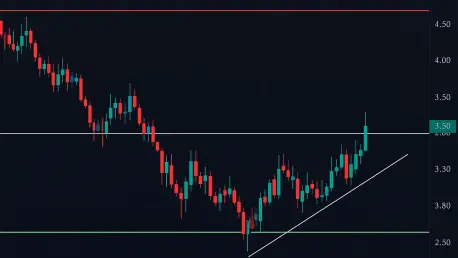

The decentralized finance sector currently experiences a defining moment as Uniswap navigates a complex web of technical resistances and support levels that will dictate its trajectory for the remainder of the quarter. Trading at approximately $3.81, the token has demonstrated a notable resilience with a 24-hour gain exceeding 5%, signaling a potential shift in investor sentiment. This analysis explores the intricate dynamics between short-term price movements and the broader structural trends that define the current decentralized exchange (DEX) landscape. By examining the token’s immediate technical health, this report provides a comprehensive roadmap for market participants who are currently evaluating the potential for a sustained recovery in a volatile environment.
The importance of this technical juncture cannot be overstated, as the market currently seeks a definitive direction amidst mixed signals from various momentum indicators. While the recent price action provides a glimmer of optimism for bullish traders, the path toward a long-term reversal is obstructed by significant historical barriers. Understanding these levels is essential for anyone looking to understand the underlying forces that drive the valuation of the industry’s leading automated market maker. Consequently, this study dissects the current market patterns to offer a detailed projection of potential price trajectories as the month progresses.
Historical Context: The Evolution of Market Dominance
The historical journey of Uniswap has been marked by its role as a primary indicator for the health of the decentralized ecosystem, often reflecting broader shifts in liquidity and trading volume. Over recent months, the token has grappled with a persistent bearish trend that has kept the price action constrained within a relatively narrow range compared to its previous highs. This background is vital for contextualizing the current price level, as the struggle to maintain support reflects the ongoing competition between established protocols and newer, high-speed alternatives that challenge the market share of legacy platforms.
As the industry matures, the factors influencing price action have shifted from speculative hype toward fundamental utility and protocol efficiency. The current consolidation period represents an attempt to establish a new floor after a prolonged period of downward pressure. This historical context suggests that any significant breakout will require more than just short-term buying pressure; it will likely necessitate a broader shift in the DeFi sector’s overarching narrative. By observing these long-term cycles, it becomes clear that the current technical levels are the product of multiple quarters of market adjustment and protocol refinement.
Technical Indicators: A Comprehensive Analysis of Market Health
Short-Term Momentum vs. Long-Term Resistance
A detailed examination of the moving averages highlights a significant divergence between different time horizons. In the short term, Uniswap has successfully maintained its position above the 7-day Simple Moving Average (SMA) of $3.71 and the 20-day SMA of $3.55. This alignment suggests that short-term buyers have established a temporary foothold, providing a base for the current upward momentum. However, the broader trend remains decidedly cautious, as the price stays well below the 50-day SMA of $4.16 and the critical 200-day SMA, which currently sits at $6.53.
The gap between the current price and these longer-term moving averages serves as a psychological ceiling that historically requires significant volume to breach. Until the token can reclaim the 50-day SMA, the prevailing sentiment will likely remain tethered to the bearish trend that has characterized the market for several months. For a genuine trend reversal to be confirmed, the market must witness a sustained close above these resistance points, which currently act as a deterrent to more conservative institutional investors.
Momentum Oscillators: The Neutrality Trap
The Relative Strength Index (RSI) currently provides a neutral reading of 51.01, placing the market in a state of equilibrium where neither buyers nor sellers hold a decisive advantage. This level, often referred to as a “no man’s land,” indicates that there is significant room for movement in either direction without the token becoming technically overbought or oversold. Complementing this is the Moving Average Convergence Divergence (MACD), which shows a distinct lack of aggressive conviction. With the signal line hovering just above the MACD line, the momentum appears to be stalled, awaiting a fundamental catalyst to spark a breakout.
This lack of momentum suggests that the current 5% gain might be a localized fluctuation rather than the start of a massive rally. Traders should be wary of entering positions without a corresponding increase in trading volume to validate the move. Without such confirmation, the token risks sliding into a period of sideways consolidation as it tests the boundaries of its current trading range. The neutrality of these oscillators underscores the importance of monitoring external market events that could serve as the necessary impetus for a more pronounced price shift.
Volatility Constraints: Navigating Market Noise
Volatility, as measured by the Average True Range (ATR), remains relatively moderate at approximately $0.29. This suggests that while 7% to 8% daily swings are standard for this asset, the market is not currently experiencing the extreme turbulence often associated with major trend shifts. For market participants, this means that price movements within this range should be viewed as typical market noise. The challenge lies in distinguishing these standard fluctuations from a genuine breach of the $3.97 resistance level, which currently serves as the upper boundary of the Bollinger Bands.
As the price presses against this upper resistance, the probability of a temporary pullback increases unless there is a surge in liquidity. The Bollinger Bands analysis suggests that the token is currently at a critical pivot point where it must either break through the resistance or retreat toward the lower support levels. This sensitivity to specific price levels highlights the need for precision in setting entry and exit points, as the narrow volatility range provides little room for error during intraday trading.
Emerging Trends: The Future of Decentralized Finance Tokens
Looking ahead, the evolution of the DeFi sector will likely be shaped by the integration of Layer 2 scaling solutions and the potential for increased regulatory clarity. These developments could provide the necessary structural support for Uniswap to bridge the gap toward its 200-day SMA. Furthermore, as decentralized trading protocols become more efficient and user-friendly, the demand for utility tokens like UNI may see a resurgence. This potential decoupling from broader market volatility could allow established protocols to maintain their value even during periods of general market uncertainty.
Technological advancements in automated market making are also expected to play a crucial role in the token’s valuation. Innovations that reduce slippage and improve capital efficiency are essential for maintaining a competitive edge in an increasingly crowded market. If these trends continue to gain traction, the fundamental value of the protocol will likely provide a stronger support floor for the price. Consequently, the long-term outlook remains contingent on the protocol’s ability to adapt to a rapidly changing technological landscape while maintaining its status as a liquid and secure trading venue.
Strategic Takeaways: Navigating Key Price Levels
To effectively manage the risks associated with the current technical landscape, market participants should adopt a disciplined strategy based on confirmed price levels. For conservative traders, the $3.57 support level represents a potential entry point, provided that a clear exit strategy is maintained if the price falls below $3.34. This approach prioritizes capital preservation while allowing for participation in any potential upside. Conversely, momentum-focused traders may choose to wait for a confirmed daily close above $4.01 before targeting the $4.21 to $4.50 range, as this would signal a breakout from the current resistance.
Risk management remains the most critical component of any strategy in the current environment. Given the long-term bearish trend that has yet to be fully invalidated, maintaining limited position sizes and utilizing stop-loss orders is essential. The potential for a sudden shift in market sentiment means that participants must remain vigilant, constantly reassessing their positions as new data becomes available. By focusing on volume confirmation and the $4.21 resistance level as primary indicators, traders can better navigate the complexities of the current DEX market.
Conclusion: Summary and Strategic Outlook
The analysis of Uniswap’s technical performance throughout the early part of March revealed a market at a significant crossroads, characterized by a struggle between short-term momentum and long-term resistance. The token’s ability to maintain its position above immediate support levels provided a degree of optimism, yet the absence of strong momentum signals indicated that a broader recovery was not yet assured. Throughout the period, the neutrality of key oscillators suggested that the market was waiting for a decisive catalyst, highlighting the importance of patience and precision in strategic decision-making.
Moving forward, the primary focus for market participants should be the interaction between price action and the 50-day SMA, which serves as a gateway to higher valuations. Monitoring institutional adoption trends and the implementation of protocol upgrades will offer new insights into the token’s long-term sustainability. The emphasis must remain on maintaining flexibility and adapting to emerging market conditions, as the path to a $6.00 valuation remained obstructed by significant technical hurdles. Ensuring a diversified approach and prioritizing capital preservation were the most effective ways to navigate the evolving complexities of the decentralized finance landscape during this period.