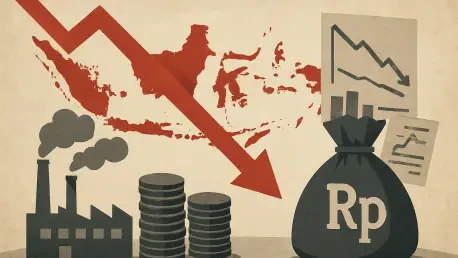

The Indonesian rupiah reached a weakened position of Rp 18,255 per US dollar on November 19, marking a significant year-to-date depreciation of over eight percent. This sharp decline has placed the nation’s monetary authorities on high alert, as the ripple effects of a global shift in capital flow begin to weigh heavily on Southeast Asia’s largest economy. Throughout the third week of November, the financial landscape has been defined by a necessary but painful pivot toward defensive stability, a move catalyzed by high interest rates in the United States and escalating geopolitical friction in the Middle East. While the primary objective is to anchor the currency and prevent further capital flight, the cost of this protection is becoming increasingly apparent in the domestic sector. Tightening credit conditions and a general contraction in liquidity have started to dampen consumer confidence, creating a challenging environment for both large-scale investors and the millions of small business owners who form the backbone of the Indonesian market. As the fiscal year approaches its final weeks, the pressure to maintain macroeconomic balance while fostering internal growth has reached a critical juncture, leaving little room for error in policy execution.
Monetary and Currency Pressures
Strategic Shifts in Interest Rates
In a decisive response to the mounting pressure on the national currency, Bank Indonesia recently adjusted its benchmark BI Rate upward to 6 percent. This strategic intervention was designed to provide a much-needed buffer against the volatility of the rupiah, yet its immediate impact has sent waves of concern throughout the private sector. For many Indonesian households, the most direct consequence of this hike is the inevitable rise in the cost of borrowing, particularly for those with existing homeownership loans or vehicle financing under floating-rate arrangements. As interest rates climb, a larger portion of household income is redirected toward debt servicing, which naturally restricts discretionary spending and slows the velocity of money within the local economy. Corporate entities are also feeling the squeeze, as the higher cost of capital makes it more expensive to fund expansion projects or maintain inventory levels, leading many to adopt a “wait-and-see” approach that could potentially stall industrial output in the short term.
The tightening of monetary policy has created a particularly difficult set of circumstances for the “warung” economy, the vast network of micro and small enterprises that are essential to daily commerce across the archipelago. These businesses often operate on thin margins and rely on accessible credit to manage their day-to-day operations and stock their shelves. With the hike in the BI Rate, the cost of obtaining micro-loans has increased, while at the same time, their customer base is facing a reduction in purchasing power due to the broader economic cooling. This pincer movement threatens to undermine the resilience of local trade, as small-scale vendors must decide between absorbing higher costs or passing them on to consumers who are already price-sensitive. The central bank’s focus on currency stability is a necessary safeguard against a wider systemic collapse, but it undeniably places a heavy burden on the most vulnerable segments of the economic engine, highlighting the complex trade-offs required to navigate this period of imported instability.
Challenges in the Foreign Exchange Market
The ongoing struggle of the rupiah against a dominant US dollar continues to be a focal point for economic analysts and government officials alike. Despite repeated interventions and the recent interest rate hike, the currency remains in what experts describe as a “danger zone,” where it fluctuates between Rp 18,250 and Rp 18,300 per dollar. This persistent weakness is largely a product of external factors, specifically the hawkish monetary stance of the US Federal Reserve, which has made dollar-denominated assets increasingly attractive to global investors. Consequently, capital that might otherwise flow into emerging markets like Indonesia is being pulled back to Western financial centers, leaving the rupiah vulnerable to speculative pressure. For businesses that depend on the regular import of machinery, components, or raw materials, this lack of exchange rate stability complicates long-term financial planning and increases the risk of production delays, as the cost of doing business fluctuates unpredictably from week to week.
Geopolitical instability in the Middle East has further exacerbated the volatility in the foreign exchange market, casting a long shadow over investor sentiment and driving a flight to safety that typically favors the US dollar. This external shock has made it difficult for the rupiah to maintain any sustained momentum, even when domestic economic indicators remain relatively healthy. The resulting pressure on the currency has a direct impact on the national inflation rate, as the rising cost of imported goods—from electronics to essential food items—eventually filters down to the average consumer. To mitigate these risks, the government and the central bank have been working to promote the use of local currency settlement in international trade, aiming to reduce the economy’s overall dependence on the dollar. However, such structural shifts take time to implement, and in the immediate term, the focus must remain on managing the current liquidity crunch and ensuring that the rupiah does not slide into a deeper, more damaging cycle of depreciation.
Market Volatility and Asset Trends
Contraction of the Capital Markets
The Indonesia Stock Exchange recently endured one of its most grueling periods, with the Jakarta Composite Index plummeting by over three percent in a single week of trading. This contraction represents a massive erosion of market capitalization, totaling hundreds of trillions of rupiah, and reflects a broad-based retreat by both institutional and retail investors. The decline was fueled by a significant liquidity crisis, as evidenced by the fact that average daily transaction values nearly halved compared to the preceding weeks. This suggests that many market participants are choosing to move to the sidelines, liquidating their positions in favor of cash or more stable assets while they wait for the current economic storm to pass. For pension funds and individual retirement accounts that are heavily invested in domestic equities, this slump is more than just a statistical dip; it represents a tangible loss in wealth that can have long-lasting effects on consumer confidence and future investment appetite.
A major driver behind this market retreat is the persistent trend of foreign divestment, as international capital continues to flow out of Indonesian equities in search of safer havens. On a single Friday during this period, foreign investors recorded a net sell-off of nearly one trillion rupiah, contributing to a cumulative year-to-date exit that has now surpassed the hundred-trillion mark. This mass exodus of foreign capital underscores a deep-seated risk aversion regarding emerging market assets in the current global climate. Without the stabilizing presence of international institutional investors, the domestic stock market becomes more susceptible to localized volatility and lacks the depth needed to support large-scale capital raising. Policymakers are now faced with the task of restoring confidence in the Indonesia Stock Exchange, a process that will likely require not only a stabilization of the rupiah but also clear signals that the government is committed to maintaining a business-friendly environment despite the prevailing fiscal and monetary challenges.
Unexpected Correction in Gold Prices
In a surprising departure from historical norms, gold failed to act as a reliable safe-haven asset during the recent period of currency weakness, instead seeing a notable decline in value. Antam gold bars, a popular investment vehicle for many Indonesian households, experienced a steady price erosion over the week, dropping by several thousand rupiah per gram. This correction was particularly unexpected given the typical inverse relationship between currency strength and gold prices, suggesting that the current liquidity crunch is so pervasive that even conservative investors are liquidating their gold holdings to cover other financial obligations. For many Indonesians who view gold as their primary form of long-term savings, this dip in value represents a significant blow to their financial security, further dampening a consumer outlook that is already stressed by rising interest rates and the increased cost of living.
The decline in gold prices indicates a shift in investor preference toward high-yield savings accounts or other liquid assets that have become more attractive following the hike in the BI Rate. As the central bank increases interest rates, the opportunity cost of holding non-yielding assets like gold rises, prompting some investors to shift their capital into financial instruments that offer a guaranteed return. This trend highlights the far-reaching influence of monetary policy on every corner of the investment landscape, as even “safe” commodities are not immune to the shifts in the broader interest rate environment. For the remainder of the year, the performance of gold will likely serve as a barometer for general market sentiment; a recovery in prices would signal a return to defensive positioning, while continued weakness could suggest that the drive for liquidity and yield remains the dominant force among Indonesian investors and households alike.
Fiscal Constraints and Economic Outlook
Navigating the Looming Tax Shortfall
As the calendar year moves toward its conclusion, the Ministry of Finance is operating under extreme pressure to meet its ambitious revenue collection targets. The government is currently tasked with collecting hundreds of trillions of rupiah in taxes in just a few weeks to satisfy the requirements of the annual budget, a feat that is becoming increasingly difficult given the current economic backdrop. Original projections for the year set a tax growth target of 23 percent, but the reality of slowing corporate profits and dampened consumer spending has made this goal appear nearly impossible to reach. Businesses across various sectors are reporting lower earnings as they grapple with higher interest rates and increased operational costs, which in turn reduces the overall corporate tax base. Similarly, the contraction in public purchasing power has led to a slowdown in value-added tax collections, leaving the national treasury in a precarious position as it tries to fund essential services and infrastructure projects.
Adding to the fiscal challenge are the administrative bottlenecks associated with the implementation of the new “Coretax” system, which was intended to modernize and streamline tax collection across the country. While the long-term benefits of a digitized and integrated tax platform are clear, the transition period has been marked by technical hurdles that have inadvertently delayed the processing of payments and the enforcement of tax compliance. These delays have left the government with a massive “catch-up” requirement in the fourth quarter, forcing tax authorities to intensify their outreach and auditing efforts at a time when many businesses are already struggling. The successful navigation of this shortfall is critical, as a failure to meet revenue targets would force the government to reconsider its spending priorities for the coming year. Balancing the need for aggressive revenue collection with the necessity of supporting a fragile economic recovery remains one of the most significant challenges facing the Ministry of Finance.
Managing National Deficit Risks
The combination of a revenue shortfall and the rising cost of debt servicing has raised serious concerns about the stability of the state budget deficit. Economic analysts have warned that the deficit could widen to nearly 2.9 percent of the gross domestic product, a figure that is uncomfortably close to the 3 percent limit mandated by Indonesian law. A wider deficit would require the government to increase its borrowing at a time when interest rates are at their highest levels in several years, thereby increasing the future debt-servicing burden and limiting the fiscal “breathing room” for subsequent budgets. This situation creates a difficult environment for policymakers, as they must find ways to reduce spending without cutting the social safety nets or infrastructure investments that are necessary to maintain long-term competitiveness. The risk of breaching the deficit ceiling is not just a legal concern but a reputational one, as it could lead to credit rating downgrades and a further loss of investor confidence in the nation’s fiscal management.
In the final months of the year, the government’s ability to manage these fiscal headwinds was tested by the need to maintain essential public services while keeping debt levels under control. The Ministry of Finance implemented stricter oversight on government expenditures, prioritizing projects that provided the most immediate economic impact while deferring less critical spending to future cycles. This cautious approach helped to mitigate some of the risks associated with the widening deficit, but it also meant that some regional development goals had to be recalibrated. The experience of managing these fiscal pressures underscored the importance of building more diverse and resilient revenue streams that are less susceptible to the volatility of corporate profits and global interest rate shifts. Moving forward, the focus shifted toward ensuring that the national debt remained sustainable and that the state budget continued to serve as a tool for stability rather than a source of further economic risk.
Balancing Stability and Growth
The economic developments observed during the latter half of the year illustrated a nation caught in a complex cycle of imported instability, where domestic policy was forced to react to global catalysts. The decision by Bank Indonesia to prioritize the rupiah through higher interest rates was a necessary step to maintain macroeconomic order, but it also highlighted the inherent vulnerabilities of an economy that remains sensitive to the movements of the US dollar. Policymakers faced the difficult task of luring back foreign capital into the stock market while simultaneously ensuring that the rising costs of credit did not completely stifle the internal engines of growth. This period served as a stark reminder that in an interconnected global financial system, maintaining domestic prosperity requires a constant and delicate balancing act between protecting the currency and supporting the purchasing power of the general public.
In response to these challenges, the government sought to accelerate structural reforms aimed at strengthening the domestic market and reducing reliance on foreign financial trends. These efforts included enhancing the efficiency of the “Coretax” system to improve future revenue resilience and expanding local currency settlement agreements to insulate trade from dollar volatility. The lessons learned during the third week of November provided a foundation for a more cautious and strategic approach to fiscal planning, emphasizing the need for greater flexibility in the state budget to account for unforeseen external shocks. By focusing on building long-term resilience and maintaining a disciplined monetary stance, the authorities aimed to create a more stable environment for both domestic businesses and international investors. The path forward was defined by a commitment to navigating these fiscal risks with transparency and foresight, ensuring that the Indonesian economy remained on a sustainable trajectory despite the persistent pressures of the global landscape.