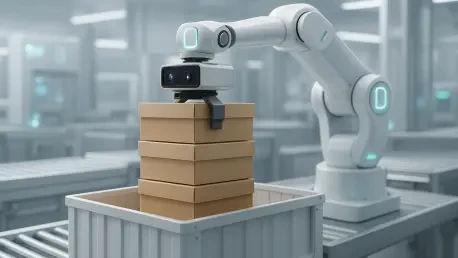

For decades, the precision of warehouse robotics has been humbled by the unassuming cardboard shoebox, a container that consistently resists the standardized grip of industrial machinery. This ubiquitous package, despite its simple geometry, represents a critical failure point in the drive toward total fulfillment automation. While robotic arms effortlessly sort rigid electronics and sealed bags, the fashion industry has struggled to bridge the gap between human dexterity and mechanical efficiency. The shoebox remained a stubborn outlier that traditional systems simply could not navigate.
The stakes for solving this puzzle are remarkably high. Approximately one-fifth of all merchandise moving through fashion e-commerce hubs is contained in these two-piece boxes. This volume makes the inability to automate shoebox picking a massive logistical hurdle, creating a lingering dependency on manual labor that slows down the entire supply chain. In an era where digital systems manage global inventories, the manual sorting of shoes has acted as a drag on warehouse productivity.
The 20 Percent Bottleneck: That Defied the Robotic Revolution
While high-tech warehouses seamlessly whisk standardized shipping crates across conveyor belts, the shoebox has remained a stubborn outlier in the world of automation. Accounting for nearly one-fifth of all fashion e-commerce merchandise, these containers represent a massive logistical hurdle that traditional robotics simply could not clear. The failure to automate this specific niche has long acted as a drag on global warehouse productivity, creating a manual labor dependency in an otherwise digital age.
This persistent bottleneck meant that even the most advanced fulfillment centers had to maintain large teams of human sorters specifically for footwear. This manual dependency created a ceiling for growth, as human speed and availability became the limiting factors during peak shopping seasons. The inability to integrate this massive product category into automated workflows hindered the return on investment for large-scale robotic deployments across the globe.
Why the Simple Shoebox Is a Roboticist’s Nightmare
The technical difficulty of handling shoeboxes stems from a fundamental design flaw: they are not a single unit, but two separate pieces held together only by gravity. Traditional robots struggle with the loose-fitting lids that shift, slide, or detach during transit, leading to spills and system errors. Most industrial grippers were designed for sealed cartons, not items that can literally fall apart if lifted incorrectly.
Adding to the complexity is the refusal of major fashion brands to allow elastic bands or tape, as these are seen as brand killers that ruin the premium unboxing experience. Brands prioritize the aesthetic appeal of the box, viewing any adhesive or binding as a detriment to customer satisfaction. Consequently, automation must solve for high-friction materials, varying dimensions, and structural instability without altering the packaging itself, forcing engineers to find a purely mechanical solution.
From Rigid Coding: To the Era of Physical AI
To overcome the limitations of fixed programming, the logistics industry is turning to Physical AI, which is a synthesis of 3D vision, reasoning, and real-time manipulation. Modern robots now use 3D sensors to create a spatial digital twin of the box, identifying its orientation and lid stability before the first touch. This allows the machine to perceive the object as a dynamic entity rather than a static coordinate in space.
Rather than following a set path, machine learning models evaluate the best gripping strategy for each unique box design. Advanced sensors act as a sense of touch, allowing the robot to verify a successful grasp and adjust pressure to prevent crushing or slipping. These systems learn from new packaging variations, ensuring that a change in a brand’s box design does not bring the entire assembly line to a halt, providing a layer of universal adaptability for the future.
Expert Perspectives: On the “Shoebox Picker” Breakthrough
Oscar Cutts and the team at Nomagic have demonstrated that the Physical AI approach yields tangible results through their specialized Shoebox Picker. By merging sophisticated perception with specialized end-of-arm tooling, this system can now master 98 percent of shoebox varieties found in the wild. This breakthrough moved the needle from experimental technology to a viable industrial tool.
Industry data indicates these robots achieve a picking rate of 450 units per hour, effectively matching human speed while eliminating the physical strain and errors associated with manual sorting. This shift proved that robots no longer need a controlled environment to function efficiently. They are finally ready to handle the unpredictability of real-world retail, transforming what was once a liability into a streamlined asset for the modern warehouse.
Strategies for Integrating Adaptive Automation: In Modern Fulfillment
For warehouse operators looking to transition from manual to AI-driven shoebox handling, success relied on a specific framework of implementation. They prioritized flexibility over raw speed, focusing on systems that handled a wide range of stock-keeping units rather than those that only excelled at a single box size. This strategic shift ensured that the technology remained relevant even as fashion trends and packaging styles changed.
Facility managers audited packaging variability to ensure AI models were trained on relevant data. They utilized modular grippers that switched between suction and mechanical pressure based on the material of the container. Ultimately, the adoption of a world-first mentality allowed these facilities to process un-banded merchandise without demanding that brands alter their iconic packaging. This transition marked a significant milestone where technology finally adapted to the existing state of merchandise, rather than forcing the world to conform to mechanical rules.