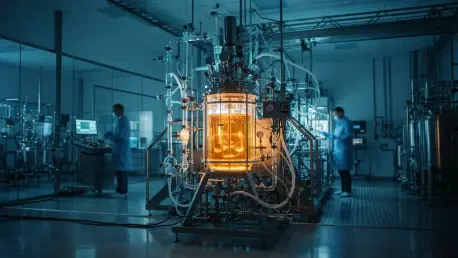

Sophisticated bioprocessing technologies are now required to manage the derivation of large-molecule drugs from living organisms, distinguishing them from simple chemical synthesis. This fundamental departure from traditional chemistry has necessitated a complete reimagining of the pharmaceutical factory, moving away from rigid pipes and toward living systems that must be nurtured and monitored with extreme precision. As the global healthcare landscape pivots toward addressing conditions that were previously considered untreatable, the manufacturing floor has become the new frontline of medical innovation. The sheer complexity of these large molecules, which are often hundreds of times larger than conventional aspirin, means that any minor fluctuation in temperature, acidity, or nutrient balance within a bioreactor can lead to a failed batch. Consequently, the industry has shifted its focus from merely discovering new compounds to mastering the intricate dance of cellular production, ensuring that these life-saving therapies can be produced reliably at a scale that meets the skyrocketing global demand.
Market Valuation and Global Growth Projections
Economic Expansion: The Path to a 2030 Valuation
The financial trajectory of the biologics manufacturing sector indicates a robust period of expansion that is reshaping the broader pharmaceutical economy. Current estimates suggest that the market will surpass a valuation of $102 billion by 2030, a figure that highlights the central role of biological drugs in modern therapy. To understand the scale of this growth, one must look at the total pharmaceutical market, which is expected to reach nearly $2.5 trillion by the same year. Biologics manufacturing alone will represent approximately 4% of this entire industry value, signaling a transition from a specialized niche into a dominant economic force. This growth is not merely a byproduct of increased pricing but is driven by a genuine increase in the volume of biological assets moving through clinical pipelines. Investors and pharmaceutical giants are funneling record amounts of capital into building new facilities, realizing that the bottleneck for future drug success is no longer just discovery, but the actual capacity to manufacture these complex molecules at scale.
This period of growth is characterized by a consistent compound annual growth rate of 19%, reflecting a systemic change in how healthcare systems prioritize treatment modalities. The shift is most visible in the way large pharmaceutical organizations are reallocating their research and development budgets. Instead of focusing on small-molecule generics, the focus has moved toward high-value biologics that offer better patient outcomes and longer periods of market exclusivity. This economic momentum is supported by massive investments in both internal manufacturing capabilities and strategic partnerships with external providers. By the time the industry reaches 2030, the infrastructure for biologics will have matured into a primary engine of healthcare innovation, providing the necessary foundation for the mass production of monoclonal antibodies and viral vectors that were once considered experimental. This financial surge ensures that the clinical pipeline, which is increasingly dominated by biologic modalities, has the production support necessary to reach patient populations across the globe.
Market Dynamics: Driving Growth Through Innovation
The underlying forces propelling this 19% growth rate are rooted in a combination of clinical necessity and technological advancement. As the global population ages, the prevalence of chronic conditions such as cancer and autoimmune diseases continues to rise, creating a sustained demand for targeted therapies. Biologics offer a level of specificity that traditional chemistry-based drugs simply cannot match, allowing clinicians to treat the root cause of a disease while minimizing damage to healthy tissue. This clinical efficacy is the primary reason why oncology remains a major driver of market expansion, with new immunotherapies requiring sophisticated bioprocessing techniques to reach the commercial stage. The industry is responding to this demand by expanding its manufacturing footprint, moving beyond traditional batch processing and toward more efficient, high-yield systems that can produce larger quantities of drug substance in smaller, more flexible facility designs.
Furthermore, the “patent cliff” affecting several blockbuster biologics is inviting a new wave of competition in the form of biosimilars. This development is forcing manufacturers to innovate in ways that prioritize cost-efficiency and high-volume production without compromising on the rigorous quality standards required for biological products. The emergence of these more affordable alternatives is essential for the sustainability of healthcare budgets, as it allows for broader patient access to life-saving treatments. This trend alone is expected to contribute significantly to the annual growth rate as companies race to capture market share in the post-patent era. The combination of high-end innovation in new modalities and the industrialization of established biologics creates a balanced market environment where both cutting-edge research and efficient mass production can thrive simultaneously, ensuring a steady supply of medicine for a diverse range of therapeutic needs.
Regional Leadership and the Rise of Outsourcing
North American Dominance: The Central Role of the U.S. Market
North America continues to hold its position as the geographic heart of the biologics manufacturing industry, with the United States leading the way through a combination of massive infrastructure and a favorable regulatory environment. Projections indicate that the North American regional market will grow from its $17 billion valuation in 2025 to a staggering $40 billion by 2030. Within this region, the United States alone is expected to account for $38 billion of that total, a testament to the country’s intensive investment in biotechnology hubs. This dominance is not accidental but is the result of a deliberate strategy to onshore production capabilities and ensure national drug security. By keeping manufacturing close to the research and development centers, U.S. firms can accelerate the feedback loop between discovery and production, allowing for faster iterations and more rapid commercialization of new therapies that emerge from the country’s robust venture capital ecosystem.
The leadership of the United States is also defined by the early and aggressive adoption of advanced bioprocessing technologies. Facilities across the country are pioneering the use of single-use bioreactors and perfusion systems, which allow for more frequent product changeovers and higher yields compared to traditional stainless-steel setups. This technological edge is complemented by a workforce that is highly specialized in the nuances of Good Manufacturing Practice (GMP) compliance for biological products. Furthermore, the proximity between biotech innovators and large-scale contract manufacturers in regions like Boston, San Francisco, and the Research Triangle Park creates a unique synergy that is difficult to replicate elsewhere. This geographic concentration of talent and capital ensures that the United States remains the premier destination for biologics manufacturing, setting the global standard for quality and innovation while providing a resilient domestic supply chain that is less vulnerable to international logistics disruptions.
The Rise of Outsourcing: The Dominance of the CDMO Model
A fundamental shift in the “make versus buy” decision-making process has led to the massive expansion of Contract Development and Manufacturing Organizations (CDMOs). By 2030, this outsourcing model is expected to dominate the market, accounting for 69% of the total valuation, or approximately $71 billion. This trend is driven by the reality that building and maintaining a biologics facility is an incredibly capital-intensive endeavor that carries significant financial risk. For small and mid-sized biotech companies, partnering with a CDMO is often the only viable path to commercialization, as it provides access to world-class manufacturing infrastructure without the need for hundreds of millions of dollars in upfront investment. These specialized partners offer a range of services, from early-stage cell line development to the final fill-finish process, allowing drug developers to focus their resources on clinical research rather than the complexities of industrial production.
Even for large pharmaceutical giants, the flexibility offered by the CDMO model is becoming indispensable. Modern drug portfolios are increasingly diverse, often requiring different types of manufacturing processes for various modalities such as monoclonal antibodies, vaccines, and gene therapies. Maintaining internal capacity for every single one of these technologies is often inefficient, leading companies to utilize contract manufacturers to handle fluctuating demand and to access niche expertise. The rise of multi-modal facilities, which are designed to switch between different production types with minimal downtime, has further solidified the role of the CDMO as the backbone of the global supply chain. This symbiotic relationship between drug owners and service providers creates a more resilient and responsive industry, where manufacturing capacity can be scaled up or down based on the actual needs of the patient population, rather than being limited by the constraints of a single company’s internal infrastructure.
Modalities and Technological Evolution
Segmentation by Modality: From Antibodies to Gene Therapies
The biologics market is no longer a monolith but is divided into several highly specialized segments, each with its own unique manufacturing requirements. Monoclonal antibodies remain the most established and largest segment, serving as the foundation for modern oncology and immunology treatments. These products have paved the way for the standardization of many bioprocessing techniques, yet they continue to evolve as researchers develop new formats like bispecific antibodies that can target two different antigens simultaneously. Meanwhile, the biosimilars segment is growing rapidly as the industry masters the art of replicating complex molecules with high fidelity. The production of these “follow-on” biologics requires a deep understanding of analytical characterization and process control to ensure that the final product is highly similar to the original reference drug, providing a pathway for more affordable healthcare options globally.
Beyond traditional antibodies, the industry is witnessing a surge in high-complexity modalities such as cell and gene therapies and mRNA-based products. The success of mRNA technology in the vaccine space has opened the door for its application in treating various infectious diseases and even some forms of cancer. These new platforms require entirely different manufacturing suites, often emphasizing rapid, small-batch production rather than the massive, 20,000-liter bioreactors used for antibodies. Cell therapies, particularly autologous treatments like CAR-T, involve the processing of a patient’s own cells, which introduces a level of logistical and manufacturing complexity never before seen in the pharmaceutical world. This diversification of modalities is pushing the boundaries of what is possible on the factory floor, requiring a mix of large-scale industrialization and modular, decentralized units that can be deployed closer to the point of care for highly personalized treatments.
Technological Innovation: Redefining Efficiency and Precision
To meet the demands of these diverse modalities, the industry is undergoing a technological revolution centered on automation and process intensification. One of the most significant shifts has been the move toward single-use bioprocessing, where traditional stainless-steel tanks are replaced with disposable plastic components. This transition significantly reduces the time and resources spent on cleaning and sterilization, which in turn minimizes the risk of cross-contamination between different drug batches. For manufacturers operating in a multi-product environment, single-use technology allows for much faster “turnaround” times, enabling them to produce several different drugs in the same facility with high confidence in product purity. This agility is essential in a market where speed-to-market can determine the success or failure of a new therapeutic candidate.
Furthermore, the integration of continuous manufacturing and artificial intelligence is setting a new standard for process control. Unlike traditional batch manufacturing, where a product is made in discrete steps, continuous processing allows for a steady flow of materials through the production line, which can dramatically increase yields while reducing the physical footprint of the plant. When combined with real-time monitoring and AI-driven analytics, these systems can automatically adjust the bioreactor environment in response to the slightest changes in cellular behavior. This level of “smart manufacturing” ensures that the delicate biological systems remain in an optimal state for production, significantly reducing the probability of batch failures and ensuring a consistent supply of high-quality medicine. These innovations are not just incremental improvements; they are the fundamental building blocks of a more efficient, reliable, and responsive biologics supply chain that can adapt to the needs of modern medicine.
Strategic Frameworks and Competitive Positioning
Industry Leadership: Strategies for Market Dominance
The competitive landscape of biologics manufacturing is currently defined by a “super-plant” strategy, where industry leaders build massive, highly automated facilities to achieve economies of scale. Samsung Biologics has emerged as a prime example of this approach, capturing a significant portion of the global market by offering end-to-end services from initial cell line development to final packaging. By consolidating all these steps within a single, massive site, they can offer their clients a simplified supply chain and faster timelines. This model of high-capacity, integrated manufacturing has set a high bar for competitors, forcing other global CDMO giants like Lonza and WuXi Biologics to continuously expand their international footprints and invest in next-generation technologies to maintain their market share. The ability to provide a “one-stop-shop” for drug developers has become a critical differentiator in an increasingly crowded field.
While these large-scale providers dominate the high-volume segments, other players are carving out leadership positions through specialization in high-growth areas like cell and gene therapy. Companies such as Thermo Fisher Scientific and FUJIFILM have successfully pivoted from being equipment and reagent suppliers to becoming full-scale contract manufacturers, leveraging their deep technical expertise to support the most complex modalities. This vertical integration allows them to offer a unique value proposition, as they understand the materials and tools of bioprocessing as well as the manufacturing process itself. Meanwhile, established pharmaceutical companies like Amgen and Roche continue to invest heavily in their internal manufacturing capabilities to protect their most sensitive and proprietary pipelines. This mix of giant CDMOs, specialized service providers, and internal pharmaceutical divisions creates a dynamic and competitive ecosystem where success is determined by the ability to balance technical precision with commercial scale.
Standardization: The Move Toward Global Consistency
As the industry matures, there is an increasing move toward standardized biomanufacturing frameworks to ensure consistency across diverse global operations. The ExellenS framework, pioneered by Samsung Biologics, is a prominent example of how standardization can be used to streamline the complex process of technology transfer. By using identical equipment, software, and facility designs across different sites, companies can ensure that a drug produced in one part of the world is identical to one produced elsewhere. This approach significantly simplifies the regulatory approval process, as health authorities can more easily verify that the manufacturing process is robust and reproducible. Standardization also reduces the risk of human error, as technicians can be trained on a single, uniform set of procedures that apply across the entire organization, regardless of the specific location or product being manufactured.
This trend toward uniformity is not just about efficiency; it is also about creating a more resilient global supply chain. When manufacturing processes are standardized, it becomes much easier to shift production from one facility to another in response to regional disruptions or sudden spikes in demand. This flexibility is a key strategic advantage in a world where supply chain stability is no longer guaranteed. Furthermore, standardized frameworks allow for the faster adoption of new technologies, as an upgrade implemented in one facility can be quickly rolled out across the entire network. As more companies adopt these structured approaches to manufacturing, the industry as a whole will benefit from increased reliability and a lower cost of production. This evolution toward a more disciplined and predictable manufacturing environment is essential for the long-term sustainability of the biologics sector, ensuring that it can continue to deliver high-quality therapies to patients on a global scale.
Supply Chain Integration and Strategic Resilience
The Integrated Ecosystem: From Raw Materials to the Patient
The success of any biologics manufacturing operation is deeply dependent on a complex and highly integrated supply chain that starts with the procurement of specialized raw materials. This includes everything from high-purity cell culture media and buffers to the sophisticated disposable components used in single-use systems. Leading chemical and life sciences companies play a critical role here, providing the essential “fuel” for the bioreactors. Because biological systems are so sensitive, the quality of these raw materials must be pristine; even a trace amount of an impurity in the growth media can alter the final protein structure of the drug. Consequently, manufacturers have moved toward deeper partnerships with their suppliers, often conducting rigorous audits and implementing real-time quality monitoring of the materials before they ever enter the production suite. This level of upstream integration is the first line of defense in maintaining the integrity of the entire manufacturing process.
Once the drug substance is produced, the challenge shifts to the downstream logistics, which are governed by strict cold-chain requirements. Biologics are inherently unstable and can quickly degrade if exposed to improper temperatures, making the role of wholesalers and distributors like Cardinal Health or Cencora vital to the system’s success. These organizations manage a sophisticated network of refrigerated warehouses and specialized transport vehicles that ensure the medicine remains within a precise temperature range from the factory to the pharmacy. This “last mile” of the supply chain is just as important as the manufacturing process itself, as any failure in temperature control can render a life-saving therapy useless. By integrating advanced tracking technologies and automated inventory management, the industry has created a seamless flow of products that can navigate the complexities of global distribution, ensuring that patients in every corner of the world have access to the therapies they need.
Forward-Looking Steps for Manufacturing Stability
The industry successfully navigated a period of significant transition by prioritizing regional resilience and the adoption of modular production units. Moving forward, stakeholders emphasized the importance of localization to protect against the vulnerabilities revealed by past global logistics failures. By incentivizing the construction of domestic manufacturing plants, many nations ensured a reliable supply of essential vaccines and biological treatments, effectively turning bioprocessing capacity into a cornerstone of national security. This strategy proved effective as it reduced the reliance on single-source international providers and allowed for a more rapid response to local health crises. The integration of local manufacturing hubs with global standards of quality created a balanced system that offered both the efficiency of scale and the security of regional production.
To maintain this momentum, the industry shifted its focus toward the long-term sustainability of these operations by investing in advanced workforce training and the continuous upgrading of digital infrastructure. Those organizations that mastered the complexities of bioprocess intensification and maintained rigorous compliance standards were best positioned to lead the next era of therapeutic breakthroughs. Future strategies involved the expansion of multi-product facilities that could be quickly repurposed for emerging modalities, ensuring that the manufacturing base remained as dynamic as the medical science it supported. Ultimately, the lessons learned from this era of rapid growth reinforced the idea that the future of medicine is inseparable from the strength of its manufacturing foundation, leading to a global healthcare system that is more agile, precise, and patient-centered than ever before.