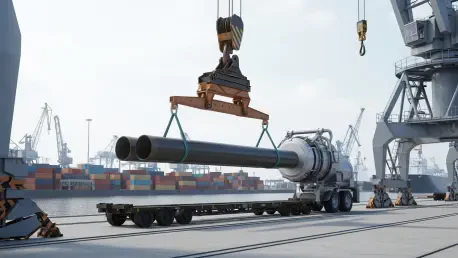

The rhythmic roar of heavy machinery at the Port of King’s Lynn is changing as traditional mechanical clanking gives way to the silent, invisible power of atmospheric pressure gripping massive industrial cargo. This shift marks a significant departure from the manual intensity of the past, where dockworkers relied on physical grit and heavy steel chains to move the world’s most essential goods. Today, a new era of logistics is unfolding, one where the delicate balance of suction and precision replaces the brute force of metal clamps.
Modern maritime hubs are facing a transformative period where the old ways of handling specialized, heavy-diameter cargo no longer suffice. As infrastructure projects demand higher quality materials and faster delivery times, the logistics industry has turned toward vacuum technology to solve its most pressing challenges. This innovation is not merely a tool for convenience but a fundamental necessity for ports aiming to maintain their competitive edge in a global market that values both speed and cargo integrity.
A New Era of Suction-Based Heavy Lifting
For decades, the sight of dockworkers manually securing slings around massive steel cylinders was a staple of maritime operations, yet this labor-intensive method is quickly becoming a relic of the past. At the Port of King’s Lynn, the introduction of specialized vacuum lifting systems represents a sophisticated, physics-driven approach to material handling. By utilizing the weight of the atmosphere, these systems create a secure grip that allows for the movement of heavy loads without the need for traditional physical restraints.
This transition signals a total reimagining of how materials move within the logistics sector, moving away from reliance on metal hooks and toward advanced suction technology. The result is an operation that is cleaner, quieter, and significantly more controlled than the legacy workflows it replaced. As global supply chains continue to automate, this shift at the quayside highlights how even the heaviest industrial tasks can benefit from the principles of modern engineering.
The Growing Need for Damage-Free Cargo Solutions
As global trade requirements become increasingly stringent, the margin for error in handling specialized materials like coated water pipes has virtually disappeared. These pipes are often treated with sensitive protective layers that are essential for long-term subterranean durability, making them vulnerable to the abrasive nature of traditional metal clamps. Any minor scratch or dent during the offloading process can compromise the pipe’s longevity, leading to costly failures once the infrastructure is in the ground.
Furthermore, modern ports face constant pressure to maximize throughput without compromising the safety of the cargo or the quayside personnel. Legacy equipment often creates a bottleneck where speed and care are in direct conflict with one another, leading to delays or damaged goods. To resolve this, port authorities are adopting vacuum technology to maintain high-volume productivity while meeting strict zero-damage quotas that are now standard in high-value utility and energy projects.
From Ship to Shore: The Mechanics of Modern Vacuum Lifters
The technical modernization of these logistics hubs is best observed through a synchronized two-stage process that removes human intervention from the most dangerous parts of the lifting cycle. In the first phase, high-capacity cranes equipped with vacuum attachments facilitate the initial discharge of cargo from the vessel’s hold. Using radio-controlled pad isolation, operators can secure and lift up to three 14-meter-long pipes simultaneously, moving weights up to 10,000 kilograms in a single motion onto transport wagons.
Once the cargo is moved from the quayside to the storage yard, the second phase begins with heavy-duty reach stackers that take over the stacking duties. These machines, boasting capacities that exceed 42,000 kilograms, utilize secondary vacuum systems to offload and stack the pipes with extreme precision. These systems were designed with interchangeable battery packs and adjustable pads, allowing for a seamless transition between various pipe diameters without requiring the workflow to stop for manual tool changes.
Prioritizing Structural Integrity and Personnel Welfare
Safety remains the primary catalyst for the adoption of vacuum technology, as it fundamentally removes the need for personnel to enter the “red zone” beneath suspended loads. By eliminating the manual attachment of hooks, the risk of crush injuries or falls was drastically reduced, creating a more secure environment for the quayside workforce. Technical specialists emphasize that this shift protects the employees while enhancing the overall reliability of the lifting process by removing human error from the equation.
Beyond human safety, the physics of vacuum lifting provides a unique advantage for the cargo by distributing pressure evenly across the surface of the load. Traditional mechanical grips often concentrate force at specific contact points, which can lead to “ovalization” or permanent deformation of cylindrical pipes. Suction technology bypasses this issue entirely, ensuring that every pipe retains its exact factory specifications from the moment it leaves the ship until it reaches its final destination in the storage yard.
Strategies for Integrating Vacuum Technology Into Port Infrastructure
The successful integration of vacuum-based workflows required a comprehensive assessment of load specifications to identify which materials benefited most from surface-safe handling. Port engineers ensured that vacuum attachments were perfectly calibrated to the lifting capacities of existing cranes and yard equipment to maintain operational balance. This strategic alignment allowed for a smooth transition where technical monitoring replaced manual rigging, empowering workers to manage complex lifts through remote interfaces.
Ultimately, the shift toward these advanced systems established a new benchmark for operational readiness in high-traffic maritime environments. Maintenance protocols were updated to include regular pad inspections and battery rotations, ensuring that the technology remained reliable during peak hours. By prioritizing long-term durability and personnel welfare, the logistics industry demonstrated that innovation was not just about speed, but about creating a more sustainable and precise method for moving the world’s most critical infrastructure components.