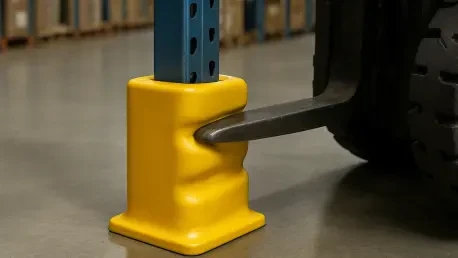

Walking through a bustling distribution center often reveals rows of heavy steel protectors that look invincible, yet these massive barriers might be the very reason structural integrity is failing. Many warehouse managers walk through aisles and feel a sense of security seeing heavy-duty, immovable steel guards bolted to the floor. However, the very rigidity that looks so impressive is often the silent catalyst for structural failure. While a guard might emerge from a forklift collision without a scratch, the pallet rack behind it is frequently absorbing the devastating kinetic energy that the guard refused to take. In the high-stakes environment of modern logistics, appearing “tough” is no longer a substitute for being effective.
The Illusion of Strength: Why Toughness Isn’t Safety
The common misconception in warehouse maintenance is that the most durable guard is the one that shows the least damage after an accident. When a piece of equipment is designed to be immovable, it essentially ignores the physical laws governing energy transfer. Instead of protecting the upright, a rigid steel protector serves as a bridge, allowing the force of a three-ton forklift to pass directly through the protector and into the rack. This can lead to hairline fractures in the rack upright or catastrophic failure of the floor anchors, which are often overlooked until it is too late.
Safety in 2026 requires a deeper understanding of how these forces interact with the infrastructure. A guard that does not bend or compress is not actually guarding anything; it is simply standing in the way while the rack does the hard work of stopping the vehicle. This dynamic creates a dangerous environment where the most visible safety tools are failing to perform their primary function. True protection must involve a mechanism that actively mitigates the energy of an impact before it can reach the sensitive structural components of the storage system.
The Shift from Resistance to Energy Management
The traditional philosophy of warehouse safety relied on brute force, assuming that the harder the material, the better the protection. This outdated approach fails to account for the physics of momentum in a high-velocity environment. When a forklift strikes a rigid object, that energy has to go somewhere; if the protector does not absorb it, it acts as a conductor, sending a shockwave directly into the rack’s uprights. Modern safety standards are moving toward “energy management,” a science-based strategy that prioritizes the preservation of structural integrity over the aesthetics of the guard itself.
By focusing on the management of energy rather than simple resistance, facilities can significantly extend the lifespan of their racking systems. This shift involves looking at the entire impact event as a sequence of energy transfers that must be interrupted. If the safety equipment can dissipate the force through internal movement or material compression, the rack remains isolated from the shock. This approach reduces the frequency of rack repairs and prevents the cumulative damage that eventually leads to localized structural collapses.
The Physics of the Impact: Hardness vs. Absorption
Understanding why rigid guards fail requires a look at the mechanics of a collision, specifically the “Conductor Effect.” This phenomenon occurs when rigid materials transfer 100% of the impact force to the rack’s baseplate and floor anchors. In contrast, the science of controlled deformation explains why a material must “give” to neutralize kinetic energy. A protector should strike a “Goldilocks” balance: it must be soft enough to absorb shock but firm enough to prevent the forklift from reaching the rack.
Furthermore, the recovery of the material is just as important as its initial reaction to the strike. High-performance polymers with “memory” allow a protector to return to its original shape after being compressed, ensuring it is ready for repeat impacts without requiring human intervention or replacement. This cyclical readiness is a major advantage over steel, which often becomes permanently deformed or loses its anchoring strength after a single significant hit. By neutralizing energy through internal air pockets, these systems ensure the rack remains undisturbed during a collision.
Engineering the Spring: Expert Insights on Impact Mitigation
Jim Ryan, founder of Sentry Protection Products, emphasizes that effective protection mimics the behavior of a spring rather than a wall. According to Ryan, the goal is to increase the duration of the impact, thereby reducing the peak force experienced by the structural members. Independent compression testing has validated this approach, showing that engineered air chambers and specialized polymers outperform static steel in real-world scenarios. These findings suggest that the most sophisticated safety tools are those that can compress and reset themselves autonomously.
The engineering behind these systems is sophisticated, utilizing internal air-chamber technology to create a cushion between the vehicle and the rack. This design allows for the dissipation of energy through the movement of air and the flex of the polymer material. When the peak force of a collision is spread out over a longer timeframe, the intensity of the shock is lowered to a level that the rack can easily withstand. This transition from static defense to active mitigation represents the pinnacle of modern warehouse safety engineering.
Strategies for Implementing a Science-Based Safety Plan
Transitioning from rigid barriers to energy-absorbing systems requires a strategic assessment of a facility’s specific risks. It is essential to audit impact zones to identify high-traffic intersections where spring-like absorption is most critical for operational safety. Evaluating guard composition by moving away from heavy-metal guards toward impact-resistant polymers has proven to be a superior long-term investment. Managers must also check floor anchors to determine if existing rigid guards are pulling up bolts during minor collisions, which indicates a failure in energy management.
The shift toward science-based protection offered a new perspective on long-term facility health. Operations that moved away from static barriers discovered that longevity depended on flexibility rather than brute force. This transition prioritized structural resilience and ensured that safety protocols matured alongside technological advancements. Warehouse teams that integrated polymer systems successfully reduced their maintenance costs by addressing the root cause of structural degradation. Ultimately, the evolution of safety equipment provided a measurable standard of reliability that legacy steel guards could not match.