
With decades of experience navigating the complex machinery of global supply chains, Marco Gaietti stands as a preeminent voice in management consulting. His deep understanding of strategic operations and customer relations allows him to see beyond the metallic sheen of new hardware, focusing instead on the transformative power of innovation in the warehouse. Today, he shares his perspective on why the recent recognition of Libiao’s AirRob PRO at the 2026 IFOY Awards marks a significant shift in how we approach intralogistics. This conversation explores the evolution of warehouse automation, specifically focusing on the elimination of traditional bottlenecks like decanting and the necessity of handling diverse packaging formats within a single system. We delve into the rigorous scientific evaluation required to earn global prestige and how climbing robot technology is reshaping storage density for sectors ranging from pharmaceuticals to high-fashion e-commerce.
Traditional warehouse automation often requires separate systems for cartons and totes, leading to complex workflows. How does a single-platform approach change the daily reality for warehouse managers?
The shift toward a single platform is a massive win for operational simplicity because it tackles the hidden drain of “decanting” head-on. In a typical facility, the smell of cardboard and the repetitive motion of moving items from shipping boxes into plastic bins take up hours of manual labor and significant floor space. By utilizing a system that handles both raw cartons and reusable totes simultaneously, managers can bypass those tedious intermediate steps entirely. This flexibility is powered by a pivoting pick arm that can reach both sides of an aisle, which actually reduces the number of workstations required to keep the flow moving. It’s about creating a smoother, more intuitive environment where the technology adapts to the inventory rather than forcing the inventory to adapt to the machine.
The IFOY Award is often called the “Oscars of intralogistics.” Given your background in consulting, what does this specific win tell us about the current standards of technical excellence?
Winning at the IFOY Night in Stuttgart is not just a marketing achievement; it is a validation of technical stamina and real-world utility. The process is incredibly demanding, starting with a pool of 49 products and solutions that are eventually whittled down to just 17 finalists for the final audit. I watched as 150 international guests gathered at the AEB headquarters to see who would survive the three-stage evaluation, which includes a scientific Innovation Check and a grueling “IFOY Test.” This rigorous vetting by a jury representing 19 different countries ensures that a product isn’t just a flashy prototype but a commercially relevant tool. When a system like this is recognized, it’s because it has proven it can handle the intense pressures of a modern high-throughput warehouse.
With space becoming a premium in logistics hubs, how does climbing robot technology influence the way companies think about their physical infrastructure?
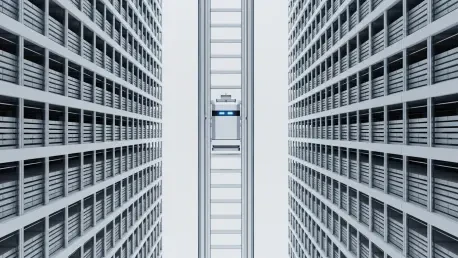
Climbing robot technology allows companies to stop thinking horizontally and start thinking vertically, which is crucial when you are stuck with an existing warehouse footprint. Instead of massive, expensive structural overhauls, these robots utilize the height of the building to maximize storage density without needing a complete redesign of the facility. You can feel the efficiency gain when you see these units maneuvering through aisles, using intelligent vision and suction technology to deposit loads with pinpoint accuracy. For sectors like grocery or pharmaceuticals, where every square inch carries a high cost of cooling or security, this ability to pack more into the same space is a game-changer. It transforms the warehouse from a static storage box into a dynamic, high-density fulfillment engine.
Warehouse operators are currently facing a perfect storm of labor shortages and rising costs. How does the scalability of these automated systems help a business stay resilient?
Scalability is the bridge between surviving today’s labor crisis and thriving in tomorrow’s market. When we look at the pressures of the modern supply chain, we see that the old way of throwing more people at a problem is no longer a viable strategy for 3PLs or parcel operators. Automated systems like this allow a facility to scale its throughput up or down based on seasonal peaks, such as the holiday rush in fashion and e-commerce, without the frantic search for temporary workers. By integrating transport and picking functions into one intelligent unit, businesses can maintain high levels of fulfillment efficiency even when the labor market is tight. This adaptability ensures that as a company grows, its automation can grow with it, protecting the bottom line from the volatility of rising operational costs.
What is your forecast for the future of warehouse robotics over the next decade?
I expect we will see a move away from “islands of automation” toward fully fluid, integrated ecosystems where robots are no longer tethered to specific zones. The success of systems that combine transport, climbing, and picking into a single platform suggests that the industry is hungry for versatile tools that can handle any packaging format on the fly. We are going to see a much heavier reliance on intelligent vision and adaptable gripping technology, allowing robots to interact with an even wider variety of goods with human-like dexterity but robotic consistency. Ultimately, the goal is a “dark warehouse” capability where the system is smart enough to optimize its own storage density and picking paths in real-time, responding to consumer shifts before the warehouse manager even sees the data.