
Marco Gaietti is a powerhouse in the logistics sector, bringing decades of strategic management and operational insight to the table. We discuss the massive expansion at the Bardon site, exploring how adding 6,000 frozen pallets strengthens the food supply chain. Our conversation delves into the shift toward multi-temperature hubs and the critical role of specialized services in maintaining retail continuity.
Increasing frozen storage by 6,000 pallets represents a roughly 30% boost in total network capacity. How does an expansion of this scale alter your daily operational strategy, and what specific metrics do you prioritize to ensure this new volume translates into improved service continuity for your clients?
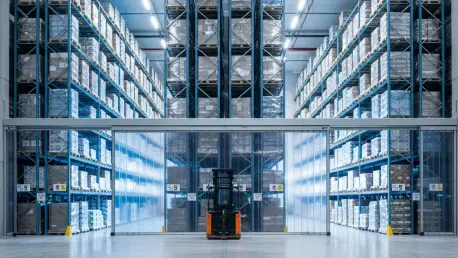
The addition of 6,000 pallets is a game-changer that forces us to recalibrate our daily workflow to handle a massive increase in throughput. By boosting our total network capacity by approximately 30%, we transition from a reactive stance to a proactive one where we can absorb sudden surges in retail demand without any loss in momentum. We prioritize metrics such as storage utilization rates and pick-face availability to ensure that this extra volume flows smoothly through the system. There is a palpable sense of confidence in the warehouse when you know the physical infrastructure is robust enough to protect our clients’ long-term growth trajectories.
Consolidating frozen, chilled, and ambient services into a single multi-temperature hub changes the traditional distribution workflow. What are the practical steps required to manage these distinct temperature zones under one roof, and how does this integration reduce logistics complexity for those supplying major retailers?
Managing frozen, chilled, and ambient zones in one facility requires rigorous architectural planning and high-performance thermal barriers to prevent any temperature migration. We implement specialized airlocks and dock seals that maintain the strict integrity of each environment while allowing our teams to transition between zones with precision. For food suppliers, this integration is a relief because it eliminates the need to coordinate three different trucks for three different product categories. The simplicity of a “one-stop shop” at Bardon cuts down on administrative headaches and ensures that major retailers receive consolidated, high-quality shipments every time.
Modern supply chains often require specialized value-added services, such as tempering solutions, alongside standard cold storage. Could you share an anecdote about how these technical services help food suppliers adapt to shifting market demands and what impact they have on long-term supply chain resilience?
I have seen instances where a supplier was hit with a sudden pivot in consumer trends that required moving products from a frozen state to a chilled state almost overnight to meet a promotion. Our tempering solutions act as the “secret sauce” in these scenarios, allowing us to control the thawing process safely and precisely to meet those shifting retail requirements. This technical capability prevents the heartbreak of wasted stock and gives our partners the agility to respond to market fluctuations without the fear of financial loss. It is a vital layer of resilience that transforms a standard warehouse into a strategic asset for long-term survival in the competitive food industry.
Selecting a strategic location for a large-scale cold store involves balancing current storage needs with future scalability. What specific geographic and infrastructure factors make a site ideal for a high-capacity hub, and how does this investment help a business stay ahead of evolving retail requirements?
A site like Bardon is selected because it sits at a geographic “sweet spot” that allows for rapid distribution to major population centers across the UK and Ireland. We look for infrastructure that can handle heavy vehicle traffic and provide seamless connectivity to major motorways, ensuring that the 6,000 new pallet spaces are always reachable. This investment is about future-proofing, creating a physical footprint that allows us to scale up as our clients’ businesses expand over the next decade. There is a certain peace of mind for a business owner knowing that their logistics partner has the space and the location to support their next phase of growth.
Building a smarter, more connected supply chain requires a focus on both efficiency and flexibility. In what ways does a single-depot solution streamline handling and distribution costs, and how does this model provide customers with more choices when navigating the challenges of the food supply chain?
A single-depot solution is the ultimate efficiency play because it completely removes the “dead miles” associated with moving goods between multiple specialized facilities. By consolidating everything at Bardon, we significantly lower handling costs and reduce the carbon footprint of the distribution process, which is a major win for sustainability-minded brands. Customers gain more choice because they can mix and match their storage needs dynamically without worrying about separate contracts or logistical silos. It creates a smarter, more connected environment where information and goods flow through a single, highly efficient funnel that gives everyone more confidence in the final delivery.
What is your forecast for the future of temperature-controlled logistics?
I forecast that the industry will move toward fully integrated, end-to-end hubs where the lines between storage and processing are completely blurred. The success at Bardon proves that the market is hungry for logistics environments that don’t just store food, but actively enable business growth through diverse services. We will see more massive investments in high-capacity frozen storage to combat global supply chain volatility and a heavier reliance on multi-temperature hubs to satisfy the “just-in-time” demands of modern retailers. The future belongs to those who can offer total flexibility and resilience within a single, strategically positioned location.