
Marco Gaietti has spent decades advising on the intricate machinery of global trade, helping businesses navigate the complexities of strategic management and operational efficiency. As the Gulf Cooperation Council (GCC) transforms into a premier trade hub, Gaietti offers a unique perspective on the massive infrastructure investments currently reshaping the region. In this conversation, we explore the expansion of heavy vehicle fleets, the creation of seamless bonded corridors, and the vital role of multimodal connectivity in safeguarding supply chains against global maritime disruptions. Our discussion highlights how the strategic integration of land and sea assets is fostering a more resilient and efficient trade environment for companies across the Middle East.
Logistics networks are scaling up by adding hundreds of heavy vehicles to handle tens of thousands of monthly trips. How does this massive influx of capacity change the day-to-day operations for regional trade?
The acquisition of 700 new trucks is a total game-changer because it allows for a staggering 35,000 truck trips every single month across the region. This investment provides a sense of certainty and reliability that was previously difficult to guarantee in such a fast-moving and volatile market. By scaling up to nearly 3,000 daily truck movements, providers can now handle everything from the first mile to the very last mile with much higher precision. You can feel the pulse of the region quicken as both containerized and non-containerized cargo move more fluidly between ports, economic zones, and warehouses. It effectively removes the friction that often plagues domestic and cross-border trucking, making the entire supply chain feel much more robust and responsive for every stakeholder.
Beyond just increasing the fleet size, what is the strategic importance of creating integrated multimodal networks and bonded corridors to connect ports with economic zones?
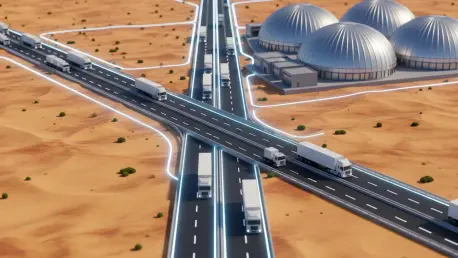
Developing fast-track bonded corridors, like those connecting East Coast gateways to Jebel Ali Port or linking Sohar in Oman, is essential for bypassing traditional logistical bottlenecks. These corridors allow cargo to flow under a single security bond, which drastically reduces the time goods spend sitting at customs or in transition between different modes of transport. We saw the real-world value of this recently when over 350,000 twenty-foot equivalent units (TEUs) were successfully routed overland to mitigate disruptions occurring at sea. This level of flexibility ensures that even when maritime routes are delayed or blocked, the land-based “nervous system” of the GCC can take over seamlessly. It is about building a web where warehouses, ports, and digital platforms talk to each other to provide a truly reliable port-to-door experience.
As global standards shift toward greener operations, how are regional leaders balancing the urgent need for fleet expansion with environmental responsibility?
The modern approach to logistics in the Gulf is no longer just about raw power; it is about smarter, cleaner energy that aligns with international emissions expectations. The new vehicles being deployed are specifically engineered to meet Euro V emissions standards, which is a significant step toward reducing the carbon footprint of regional freight. There is a palpable shift in the industry’s mindset where fuel efficiency is now seen as a core component of supply chain resilience rather than just a simple cost-saving measure. While these 700 trucks represent the cutting edge of current technology, there is also a clear roadmap toward exploring green-energy vehicles in the very near future. This dual focus ensures that as the volume of cargo grows, the environmental impact is managed carefully and professionally.
In an era of time-critical demands and global volatility, how does strengthening the land freight network specifically improve the resilience of businesses operating in the Middle East?
Strengthening the land network provides a vital safety valve that protects businesses from the unpredictable nature of global shipping schedules and maritime congestion. By leveraging routing options through Jeddah Islamic Port’s South Container Terminal and other key gateways, companies can bypass maritime delays that would otherwise halt production. The ability to move perishables, vehicles, and essential goods across a connected network of warehouses provides the “just-in-time” reliability that modern commerce demands. It is a sensory experience for the operators—seeing the constant flow of thousands of trucks ensures that the region remains a stable pillar of global trade regardless of external shocks. This agility allows for a much faster response to shifting market demands, ensuring that the GCC remains a competitive and reliable partner on the world stage.
What is your forecast for the evolution of integrated logistics in the GCC over the next few years?
I expect to see the GCC move toward a hyper-connected model where the lines between maritime and land freight become almost invisible to the end customer. The current investment in 700 trucks is just the start; we will likely see a massive push into digital integration where every movement of those 35,000 monthly trips is optimized by real-time data. We will also see the completion of more bonded corridors, potentially creating a seamless trade loop that encompasses the entire peninsula and connects to global hubs. As the region continues to diversify its economy away from oil, these logistics networks will become the primary engine of growth, making the Gulf the indispensable crossroads of the global economy. It is an exciting time to watch this infrastructure mature into a world-class, sustainable, and highly resilient powerhouse.