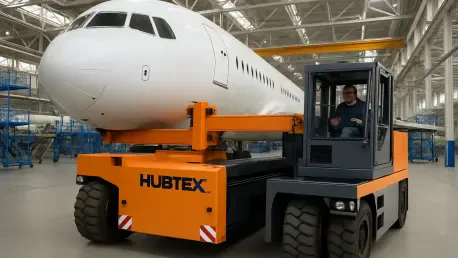

In the high-stakes environment of aerospace manufacturing, the ability to maneuver a forty-ton fuselage section with the delicate touch of a watchmaker represents the ultimate test of industrial engineering. Moving massive structures like aircraft wings requires more than just brute strength; it demands a synergy between immense weight capacity and microscopic control. Shifting the engineering focus from raw lifting capacity toward sophisticated process integration ensures that sensitive components measuring nearly 17 meters in length are handled with absolute care.
The challenge is not merely the weight, but the physical vulnerability of the cargo during facility transitions. When a transport system lacks precision, the risk to high-value aerospace assemblies increases exponentially. Successful logistics in this sector now require vehicles that act as an extension of the manufacturing process rather than just a means of conveyance, ensuring that structural integrity remains uncompromised from the assembly line to the hangar.
The Intersection: Colossal Scale and Surgical Precision
Handling aircraft components that weigh up to 40 tons requires a delicate balance between power and millimetric accuracy. In modern aerospace production, the focus has moved beyond simple transport to a deeper level of process integration where the vehicle must navigate tight tolerances. This precision is vital when dealing with sensitive structures that span nearly 17 meters, as any misalignment during the move could jeopardize the integrity of the entire aircraft frame.
The complexity of these operations stems from the need to dock massive parts into assembly jigs with zero margin for error. Traditional equipment often lacks the fine-tuned control necessary to achieve this, leading to longer cycle times and increased risk. By prioritizing specialized control systems, manufacturers can ensure that even the largest components are positioned with the exactitude required for high-tech aerospace assembly.
Why Traditional Heavy-Duty Logistics Fail Modern Aerospace Needs
Standard heavy-duty logistics solutions often struggle with the inherent fragility of high-value aerospace cargo. During transitions between different production zones, uneven surfaces and floor gradients can cause vibrations that damage sensitive electronic or composite parts. Furthermore, the reliance on older, less stable transport methods introduces significant risk when moving components through inclement weather or across outdoor storage areas where ground conditions are less than ideal.
The industrial demand for a cleaner production environment has also rendered traditional diesel-powered transporters obsolete. Modern aerospace facilities require a significant reduction in CO2 emissions, noise levels, and particulate matter to maintain the clean-room standards necessary for advanced component manufacturing. Consequently, the industry has looked for electric solutions that provide the same heavy-load capacity without the negative environmental impact of internal combustion.
Architectural Innovations: The SFX 40-SO All-Electric Transporter
The development of the SFX 40-SO addressed these challenges through the implementation of a multidirectional 360-degree all-wheel steering system. This design allows the massive 17-meter vehicle to navigate restricted spaces with a level of agility previously reserved for much smaller equipment. By utilizing a specialized steer-lift drive, the platform achieved precise positioning of transport frames, allowing for a seamless interface with existing production hardware.
Stability is maintained through an advanced hydraulic axle compensation system that ensures the chassis remains level on varying surfaces. Whether the vehicle is traversing smooth factory floors or uneven outdoor asphalt, the system automatically adjusts to compensate for slopes and bumps. This leveling capability was essential for protecting delicate cargo from the structural stress caused by tilting or sudden jolts during transit.
Proving Performance: Sustainable Power and Sensor Integration
Sustainability in heavy-duty transport was validated through rigorous battery efficiency benchmarks. During operational testing, the SFX 40-SO maintained 40 percent of its total power after a demanding 12-kilometer heavy-load cycle, proving that electric platforms can support multiple shifts without interruption. This level of availability ensured that production schedules remained on track while simultaneously achieving zero-emission targets within the facility.
Operational safety reached new heights through the integration of LiDAR and camera-based semi-automatic lane guidance systems. These advanced sensors provided real-time feedback that helped mitigate human error at critical transfer points, where precision is most required. By utilizing automated feedback loops, the transporter maintained a consistent and safe path, even when carrying the most awkwardly shaped and heavy components.
Frameworks: Deploying Scalable Heavy-Load Platforms
The modular nature of the SFX platform allowed for the deployment of scalable solutions that met diverse requirements ranging from 10 to 150 tons. This flexibility enabled manufacturers to integrate multidirectional vehicles into existing workflows without requiring extensive infrastructure modifications. Strategies for implementation prioritized the physical integrity of the cargo, ensuring that heavy-duty engineering served the specific needs of the aerospace environment.
Ultimately, the transition to these advanced transport platforms provided a reliable framework for managing the logistical complexities of modern aviation. The industry moved toward a model where heavy-load platforms acted as intelligent mobile workstations rather than simple carts. By focusing on precision and sustainability, these engineering solutions offered a clear path toward more efficient and safer aerospace production cycles.