
A single delayed vessel at a major port can now trigger a domino effect that halts production lines thousands of miles away, forcing logistics managers to rethink every link in their operations. As global trade faces a barrage of geopolitical shifts and climate-related disruptions, the traditional, rigid shipping model is proving insufficient for modern demands. The industry is reaching a turning point where the ability to pivot between sea, rail, and road isn’t just a logistical advantage but a requirement for survival.
Beyond the Linear Model: The New Standard for Global Logistics
The shift away from linear logistics represents a fundamental change in how goods move across the globe. For decades, the focus remained on the cheapest route from point A to point B, often ignoring the risks inherent in a single-mode dependency. However, the current landscape demands a more sophisticated approach that accounts for sudden port closures or rail strikes.
Transitioning to a multimodal standard allows for a dynamic response to these challenges. By moving beyond a one-dimensional path, businesses ensure that their goods stay in motion even when a primary route becomes obstructed. This evolution marks the end of the “set it and forget it” mentality in global shipping, replacing it with a model defined by constant adaptation and multi-layered connectivity.
The Growing Vulnerability of Traditional Trade Routes
Modern supply chains grapple with unprecedented volatility, ranging from severe port congestion to shifting trade lanes caused by regional instability. These pressures have exposed the inherent weaknesses of linear networks that lack redundancy. Consequently, a massive strategic shift occurred toward regionalization and the creation of connected networks that prioritize agility over simple cost-cutting.
This transition is backed by significant capital investment. The global multimodal transport market is projected to reach nearly $160 billion by 2032, representing a massive $60.7 billion growth opportunity for those who can master end-to-end visibility. This scale of investment suggests that the market no longer views diversified transport as an optional luxury but as a core financial necessity.
Bridging the Gap Between Coastal Hubs and Inland Infrastructure
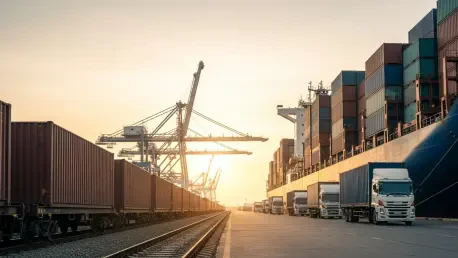
The core of modern resilience lies in the integration of maritime, rail, and road networks to create a seamless flow of goods. By evolving from rigid pipelines into flexible regional networks, companies can bypass bottlenecks that traditionally paralyze trade. This approach focuses on strengthening the links between major coastal hubs and regional inland ports, ensuring that cargo does not become stagnant at the water’s edge.
The integration of diverse transport modes allows businesses to flex their logistics strategies in real-time. This flexibility enables them to choose the most efficient path based on current conditions rather than being locked into a single, vulnerable route. Such adaptability is becoming the hallmark of successful global operations in an era of constant change.
Expert Insights: Redefining Trade Through Integrated Corridors
Industry leaders increasingly view integrated trade corridors as the primary defense against supply chain shocks. Ganesh Raj, Global COO of Marine Services at DP World, highlights that these corridors are now essential for maintaining steady cargo flows in an unpredictable market. By leveraging marine services to connect over 200 ports worldwide, organizations facilitated tens of thousands of annual sailings while bridging the infrastructure gap with rail and road solutions.
High-volume operations—handling millions of TEUs—depended entirely on the coordination of diverse transport modes to ensure speed to market and reliability. This firsthand experience demonstrated that maritime efficiency alone was not enough; the entire journey from the port to the final destination required a unified oversight mechanism. Coordination across different modes became the only way to guarantee consistency.
Actionable Strategies for Implementing a Multimodal Framework
To build a resilient supply chain, organizations moved beyond simply hiring carriers and started developing corridor-based logistics strategies. This process began with investing in digital tools that provided end-to-end cargo visibility, allowing for proactive decision-making when disruptions occurred. Companies prioritized the selection of logistics partners who offered integrated solutions rather than fragmented services.
Businesses also evaluated their regional footprints to ensure they leveraged local rail and road networks to supplement maritime routes. This established a fail-safe mechanism that kept goods moving regardless of regional bottlenecks. Ultimately, the successful implementation of a multimodal framework ensured that agility became a permanent fixture of global trade, allowing firms to navigate future uncertainties with confidence.