
Traditional pulse oximeters and blood pressure cuffs require physical contact that can lead to skin breakdown and increased infection risks in intensive care units. These persistent challenges have catalyzed a significant shift toward the development of non-contact medical Internet of Things (IoT) systems, which aim to redefine the standard of care by making monitoring invisible and entirely non-intrusive. A comprehensive systematic review published in Frontiers in Medical Technology provides an exhaustive look at this burgeoning field, synthesizing 88 recent studies to map the current technological landscape. These systems, ranging from wall-mounted radar to sophisticated computer vision setups, represent a move toward a paradigm where physiological data is collected without physical tethering. By eliminating the need for sticky electrodes and tight bands, hospitals are exploring a more humane approach to patient management that prioritizes comfort without sacrificing the data density required for critical decision-making.
The Motivation for Contactless Monitoring
The Challenge: Physical Contact Drawbacks
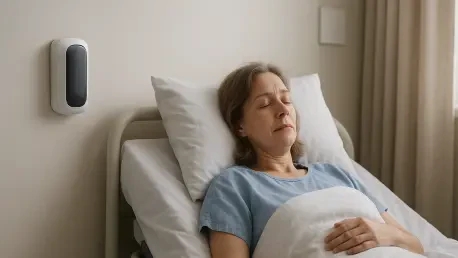
The primary motivation for this shift lies in the inherent drawbacks of traditional “tethered” medical instrumentation currently found in most clinical environments. Patients often face a daily struggle with adhesive ECG electrodes that irritate the skin or pulse oximeters that limit finger movement and cause significant discomfort over long durations. For specific populations, such as elderly patients with paper-thin skin or neonates in intensive care, these contact-based tools can even lead to painful skin breakdown and secondary infections. Beyond the physical toll on the patient, the literal maze of wires creates an operational burden for medical staff who must frequently troubleshoot false alarms caused by loose connections. The ongoing transition toward contactless systems aims to alleviate these pain points by creating a “set-it-and-forget-it” environment where monitoring occurs automatically as soon as a patient enters the room or lies in a hospital bed.
The Objective: Improving Clinical Workflow
Beyond patient comfort, the integration of non-contact IoT systems addresses the critical issue of mobility and staff efficiency within modern healthcare facilities. When patients are physically connected to bedside monitors, simple tasks like moving to a chair or using the restroom become complex maneuvers that require nursing assistance to manage wires and portable power units. This tethering not only increases the risk of accidental falls but also places a constant demand on clinical staff to reattach sensors that become dislodged during movement. By removing these physical constraints, non-contact systems allow patients to maintain a higher degree of independence while ensuring that their vital signs are continuously captured. This evolution in monitoring technology effectively streamlines the nursing workflow, as staff can spend less time managing hardware and more time delivering direct care, ultimately leading to better resource allocation in high-pressure hospital wards.
The Diverse Modalities of Contactless Sensing
Technological Approaches: Remote Health Tracking
Modern non-contact systems utilize several distinct modalities to gather physiological data remotely, with computer vision and radar-based systems emerging as the most dominant forces in current research. Computer vision technologies leverage high-resolution cameras to detect rhythmic color changes in the facial skin—known as remote photoplethysmography—or to track the precise rising and falling of the chest wall to calculate respiratory rates. These optical systems benefit from mature computational toolchains and provide high-precision monitoring in structured environments such as sleep laboratories or diagnostic clinics. By analyzing spatiotemporal data at a granular level, vision-based sensors can identify subtle patterns that might be missed by manual observation. However, they do require consistent lighting and a clear line of sight, which often limits their utility in darkened rooms or when patients are heavily obscured by hospital linens.
Environmental Sensing: Radar and Wireless Signals
In contrast to optical methods, radar-based systems—specifically those utilizing millimeter-wave technology—offer a unique advantage because they can “see” through blankets, clothing, and even wooden partitions. These sensors bounce radio waves off the human body to detect minute mechanical displacements caused by the heartbeat and the expansion of the lungs. Because radar is less sensitive to ambient light conditions, it has become a preferred modality for general hospital wards and intensive care units where lighting fluctuates frequently. Beyond radar and vision, other experimental methods like Wi-Fi sensing and acoustic tracking are beginning to gain traction. Wi-Fi sensing monitors how the human body interferes with ambient wireless signals, while acoustic sensors track sound patterns associated with breathing. These diverse technologies are being refined from 2026 to 2028 to provide a more resilient and multi-modal monitoring ecosystem that can adapt to various patient needs.
Current Limitations and Research Gaps
The Challenge: Achieving Clinical-Grade Utility
A significant hurdle in the current state of non-contact IoT remains the disproportionate focus on a narrow set of physiological indicators. While traditional clinical assessments rely on five primary vital signs—heart rate, respiration, blood pressure, oxygen saturation, and temperature—research has overwhelmingly prioritized the first two. This concentration is largely due to the “low-hanging fruit” nature of mechanical movement, as breathing and heartbeats create displacements that are relatively easy for sensors to resolve. In contrast, measuring blood pressure or oxygen saturation from a distance requires incredibly complex modeling of vascular properties and light absorption that current non-contact sensors struggle to master with clinical reliability. This creates a functional gap where a patient might still need to be tethered for certain measurements, effectively negating some of the benefits of an otherwise wireless environment for critical care patients.
Standardization Crisis: The Need for Benchmarking
Furthermore, the field currently faces a “benchmarking crisis” characterized by a lack of standardized reporting and evaluation metrics across different research groups. Because various studies use different markers for success—such as mean absolute error, correlation coefficients, or root-mean-square error—it is nearly impossible for clinicians to perform direct statistical comparisons between competing technologies. Most validation still occurs in controlled laboratory settings with healthy volunteers rather than in high-stress, unpredictable clinical environments like emergency departments or pediatric wards. Without a common set of open-access datasets and agreed-upon error metrics, hospital administrators lack the objective evidence required to make large-scale procurement decisions. Bridging this gap from 2026 to 2029 will require a concerted effort to standardize how these devices are tested against the “gold standard” of traditional contact-based monitors in real-world scenarios.
Implementation and Privacy in Modern Medicine
Deployment Strategies: Context and Redundancy
The future of non-contact monitoring will likely be defined by a highly tailored approach where the choice of technology is dictated by the specific clinical context and the patient’s environment. Radar remains the ideal choice for intensive care units and general wards where lighting is inconsistent and patients are often covered by bedding, as it provides a reliable stream of data without requiring visual clarity. On the other hand, vision and acoustic systems are far better suited for examination rooms and specialized sleep laboratories where lighting can be controlled and the rich data from cameras can be leveraged to detect complex behaviors or sleep apnea patterns. This context-driven strategy ensures that the technological limitations of one modality do not compromise the safety of the patient. By matching the sensor to the environment, healthcare facilities can optimize both the accuracy of the vitals captured and the comfort of the individual.
Operational Safety: Hybrid Systems and Redundancy
For high-stakes environments such as neonatal units or post-operative recovery rooms, the convergence of multiple technologies is becoming the standard to provide necessary redundancy. Hybrid systems that combine radar and vision sensors can work in tandem to ensure that data collection is never interrupted by a patient’s movement or a change in lighting. In these scenarios, if a patient shifts position and momentarily blocks an optical sensor, the radar component can maintain the signal, preventing catastrophic failures like an unrecognized respiratory arrest. This multi-layered sensor fusion not only increases the reliability of the system but also allows for cross-validation of data in real-time, reducing the frequency of false alarms that contribute to clinician burnout. This move toward integrated, multi-modal platforms represents the next logical step in creating a failsafe monitoring environment that mimics the reliability of wired systems.
Operational Integration: Privacy and Ethics
Integrating these non-contact systems into daily clinical practice required a fundamental rethinking of how data flows through the hospital infrastructure and how staff interact with patient information. Successful implementations focused on expanding the research into neglected biomarkers like blood pressure while ensuring that privacy-first architectures were the standard, not the exception. By establishing rigorous evaluation protocols and standardized error metrics, the industry moved toward a more transparent validation process that satisfied both medical boards and insurance providers. Ultimately, contactless monitoring became an essential, invisible layer of the modern healthcare system, enhancing patient safety and comfort by providing continuous “set-it-and-forget-it” protection. This transition allowed medical professionals to shift their focus away from the maintenance of hardware and wires, directing their time toward direct patient care and the interpretation of high-fidelity longitudinal data.