
Advancements in AI mapping allow these new devices to learn the specific geography of a building, ensuring safe navigation around obstacles and between floors. The transition from static security measures to dynamic, autonomous surveillance marks a significant evolution in the smart home industry, moving beyond the fixed viewpoints that have traditionally defined the sector. Amazon’s subsidiary, Ring, recently signaled this shift with the introduction of “Ring Robotics,” a division dedicated to mobile security solutions. By integrating flight and ground-based mobility with artificial intelligence, the company has created a proactive security environment for modern users. This expansion represents a strategic move to address the inherent limitations of traditional security cameras, specifically their inability to see around corners or cover multiple rooms without an excessive number of units. This democratization of robotics ensures that advanced tools are now accessible to the average homeowner and small business owner.
Residential Protection: Expanding Monitoring Through Aerial Surveillance
The Ring Drone Cam serves as the centerpiece for residential security, offering an indoor room-to-room monitoring solution priced at approximately $250. This hardware was engineered to provide comprehensive coverage, effectively eliminating the blind spots associated with stationary wall-mounted cameras. Development of this technology was born out of consumer feedback, where property owners expressed a desire for mobile eyes in areas a fixed camera simply could not reach. The device is built with an AI-driven core that facilitates instant mapping, allowing the unit to familiarize itself with interior layouts, including furniture and staircases. By utilizing this spatial awareness, the drone maintains a safe flight path while transitioning between levels of a home. This capability ensures that a single device performs the work of multiple static units, providing a high-tech solution for families seeking to maintain visibility across their entire living space without installing complex wiring.
A standout feature of this aerial platform is the Automatic Incident Response system, which links the drone directly to the broader security ecosystem of a household. If a window sensor is triggered or a doorbell detects suspicious motion, the drone automatically launches from its charging dock and flies to the site of the disturbance. This creates a powerful psychological deterrent, as an intruder is far more likely to retreat when confronted by a flying object equipped with integrated spotlights. During recent demonstrations, the efficacy of this automated response was highlighted as a way to provide real-time visual confirmation of events before human intervention is required. The drone uses a 2K video resolution that balances high-definition clarity with the battery efficiency needed for sustained flight operations. This balance allows for detailed recording during an event while ensuring the hardware remains lightweight enough for various indoor maneuvers.
Industrial Safety: Mobilizing Ground-Based Security Solutions
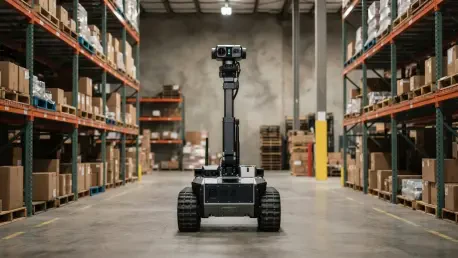
While the drone addresses aerial needs, the Ring Rover Cam focuses on the terrestrial requirements of businesses and large-scale industrial facilities. Priced at $1,000, this solution is a clear evolution of previous ground robotics, specifically re-engineered to handle the demanding environments of warehouses and retail spaces. The most notable design choice is the inclusion of a height-adjustable periscope camera, which allows the robot to see over high counters, office desks, or inventory shelving. This elevation provides a tactical advantage, as a floor-level unit would typically be blinded by physical obstacles in a professional setting. The Rover is designed to patrol large-footprint areas autonomously, performing scheduled rounds that mimic the presence of a human security guard. This ground-based mobility ensures that every corridor and storage aisle is monitored, providing business owners with oversight that was previously cost-prohibitive for many smaller enterprises.
Technological specifications for the Rover include support for 4K video streaming and high-resolution recording, ensuring that captured footage serves as reliable evidence if a security breach occurs. Because it is ground-based, the device can carry heavier hardware and more powerful processing units compared to its aerial counterparts. Beyond observation, the Rover serves as an active security presence equipped with a built-in siren, a light tower, and two-way audio communication. This setup allows for immediate interaction, where a business owner can remotely challenge an unauthorized individual or activate an alarm to alert local authorities. The integration of high-intensity LED lighting ensures that nighttime surveillance is as effective as daytime monitoring, maintaining a constant safety posture. This combination of mobility and high-resolution imaging creates a versatile tool for facility management, reliably checking on inventory or equipment status during off-hours.
Future Considerations: Integrating Autonomy Into Property Management
Both the Drone and Rover units are fully integrated into the existing Alexa Home Map and the standard mobile application, functioning as the mobile arms of a larger smart-home brain. Users can establish custom flight or patrol routes through an intuitive interface, allowing the devices to perform specific checks at set intervals throughout the day. This level of synchronization means the robots do not operate in isolation; instead, they communicate with other smart devices to form a cohesive defense network. For instance, a smart lock failure or a fire alarm could trigger a drone to investigate the kitchen while the Rover monitors the main exit. This shift toward autonomy as a service reduces the burden on property owners to manually check every notification, as the AI investigates the alert first. By providing immediate visual verification, the system filters out false alarms and ensures that users only need to take action when a legitimate threat is identified.
The adoption of these autonomous platforms has established a new benchmark for proactive property protection. Businesses that implemented ground-based robotics observed a significant reduction in physical security overhead by replacing manual patrols with automated surveillance rounds. For residential users, the introduction of aerial monitoring solved the long-standing problem of dead zones in home security layouts. Future considerations for property owners include the optimization of floor plans to facilitate robotic navigation and the integration of secondary charging stations for larger facilities. Those who invested in these systems benefited from a security posture that was less dependent on human error and more focused on real-time data collection. Moving forward, the industry prioritized the development of interoperable robotics that could communicate across different platforms to enhance safety standards. By shifting to a mobile-first approach, security enthusiasts successfully transformed their spaces.