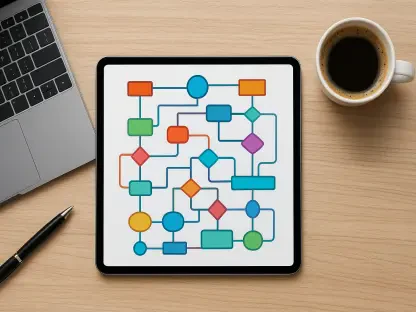

The silent friction of a departmental delay often stems from an invisible chokepoint that no single team member can accurately describe or resolve without a shared visual blueprint. When a high-stakes project stalls, the instinctual reaction is often to hunt for a person to blame, yet the culprit is almost always a fractured process rather than a negligent individual. In the modern workspace, where speed and precision are the primary currencies of success, the absence of a documented workflow acts as a persistent drain on productivity. Most teams operate within a haze of unspoken habits, relying on a precarious network of verbal instructions and historical assumptions. Without a standardized visual framework to guide these efforts, organizations remain trapped in a cycle of reactive troubleshooting, unable to see the structural flaws that turn minor inconveniences into systemic failures.
The transition from these chaotic, invisible workflows toward structured efficiency requires more than just a mandate for better communication; it necessitates a visual North Star. Process map templates provide this essential clarity by forcing hidden activities into the light of day, creating a tangible representation of how value actually moves through a company. These templates serve as a diagnostic tool, allowing leaders to scrutinize every handoff, decision point, and approval gate for signs of redundancy or delay. By establishing a universal language for how work is done, organizations can ensure that every stakeholder, from the newest hire to the most senior executive, understands their exact position within the operational machine. This alignment is not merely a convenience but a strategic imperative for any business aiming to scale without sacrificing quality or culture.
Stop Searching for Who Holds the Key to a Stalled Project
Most professional teams operate within a landscape of invisible processes where work occurs through a series of unspoken habits rather than documented, repeatable steps. When a critical deadline is missed or a handoff between departments fails, the lack of a clear visual framework makes it nearly impossible to pinpoint the exact moment the breakdown occurred. Managers often find themselves stuck in endless meetings, trying to reconstruct a timeline of events after the damage has already been done. Process map templates eliminate this ambiguity by providing a pre-built structure that forces these hidden workflows into the light. By using a standardized visual language, organizations can transition from a culture of reactive firefighting to one of proactive management, ensuring that every stakeholder understands exactly where they fit into the larger operational machine.
The utility of a process map template lies in its ability to strip away the subjectivity of individual perspectives and replace it with an objective source of truth. When a project hits a wall, the template acts as a map of the territory, showing the team exactly which path was taken and where the detour occurred. It transforms the conversation from a hunt for a scapegoat into a clinical analysis of a system. This shift is vital for maintaining morale and fostering a culture of continuous improvement. Instead of defending their actions, team members can point to the map and identify where the instructions were unclear or where the allocated resources were insufficient to meet the demand. This level of transparency is the only way to build a resilient operation that can withstand the pressures of rapid growth and shifting market demands.
Furthermore, these templates serve as a bridge between the strategic vision of leadership and the tactical execution of the front-line staff. Often, there is a significant gap between how leadership believes work is being done and how it is actually performed in the trenches. Process mapping bridges this divide by creating a shared document that reflects the ground-level reality. It allows for the identification of “shadow processes”—those unofficial workarounds that employees create to bypass inefficient formal systems. By documenting these deviations, leaders can either formalize the more efficient workarounds or fix the underlying issues that made the workarounds necessary in the first place. The result is a more honest and effective organization that no longer wastes time searching for keys that were never actually lost.
The High Cost of Operating Without a Visual North Star
In an era of increasing organizational complexity, tribal knowledge has become a significant liability that few companies can afford to ignore. When essential processes exist only in the minds of long-term employees, the departure of a single team member can paralyze an entire department, leading to a loss of momentum that takes months to recover. Process mapping serves as the essential background for organizational stability, providing a source of truth that survives personnel changes, reorganizations, and the inevitable challenges of scaling. Without this visual North Star, the cumulative wisdom of the organization is fragile and easily lost. Documentation through templates ensures that the “how-to” of the business is treated as a permanent asset rather than a fleeting memory, protecting the company’s operational integrity during times of transition.
Beyond the risks associated with personnel turnover, operating without a visual guide creates a breeding ground for hidden costs and inefficiencies. Redundant approvals, illogical feedback loops, and outdated steps often remain buried within a process for years, quietly draining resources and slowing down delivery speeds. In a market that demands extreme agility, these invisible drag factors can be the difference between a successful product launch and a costly failure. Process map templates address the modern need for transparency and compliance by making every step of a workflow auditable and visible. This visibility allows managers to see where “value-added” time ends and “waste” time begins, enabling them to make informed decisions about where to cut costs and where to invest more heavily.
The absence of a visual framework also complicates the implementation of new technologies and digital transformation initiatives. It is impossible to automate a process that has not first been clearly defined. Many organizations attempt to solve efficiency problems by throwing software at them, only to find that they have simply automated a bad process, making it fail faster than before. A process map acts as a blueprint for automation, showing exactly where manual intervention is required and where a digital tool can take over. By mapping the workflow first, companies ensure that their technology investments are aligned with their operational goals. This strategic approach prevents the waste of capital and ensures that the organization remains competitive in a landscape where digital proficiency is no longer optional.
Navigating the Diverse Landscape: Process Mapping Frameworks
To effectively solve bottlenecks, organizations must match their specific operational challenges with the correct mapping methodology. A basic process map might suffice for linear, internal tasks with few variables, but complex cross-departmental projects require more sophisticated structures that can account for diverse perspectives and shifting priorities. Selecting the wrong template can lead to a map that is either too simplistic to be useful or too complex to be understood. Therefore, understanding the nuances of different frameworks is the first step toward creating a document that actually drives performance.
- Swimlane Process Maps: These are indispensable for identifying friction at the borders between different departments or roles. By organizing tasks into horizontal or vertical lanes assigned to specific entities, these templates highlight exactly where handoffs are failing or where accountability has become too thin. They are particularly effective in large enterprises where “siloed” thinking often prevents teams from seeing how their work impacts the next person in line. Seeing the “lanes” helps clarify who is holding the baton at any given moment, reducing the likelihood of tasks falling through the cracks.
- Value Stream Mapping: Originating in the high-stakes environment of lean manufacturing but now essential for service and software industries, this template focuses exclusively on the flow of value to the customer. It forces the team to distinguish between value-added actions and non-value-added “waste,” such as waiting times, over-processing, or unnecessary movement of data. By visualizing the time spent in each stage, value stream mapping makes it easy to identify the primary tool for lean optimization and overall lead-time reduction.
- SIPOC (Suppliers, Inputs, Process, Outputs, Customers): This high-level framework is typically used as a preliminary step before diving into granular detail. It helps leaders align on the broad scope of a process, ensuring that the team doesn’t waste time mapping irrelevant sub-tasks or missing critical external dependencies. SIPOC maps are excellent for stakeholder alignment, as they provide a bird’s-eye view of the entire ecosystem in which a process operates, identifying all the “players” and “pieces” before the game begins.
- Workflow Process Maps: These focus specifically on the technical movement of data, documents, and information. They serve as the functional blueprint for digital transformation and the eventual implementation of automated systems. By mapping the “digital path,” these templates reveal where information is siloed, where manual data entry is creating errors, and where API integrations could streamline the entire operation. They are the essential link between business logic and technical execution.
Ultimately, the choice of a framework depends on the specific outcome the organization is trying to achieve. If the goal is to reduce errors in a manufacturing line, Value Stream Mapping is the clear choice. If the objective is to improve the onboarding experience for new employees, a Swimlane map might be more appropriate to show how HR, IT, and Finance interact. The diversity of these templates ensures that no matter how complex or specialized a workflow may be, there is a visual structure available to bring it into focus. The key is to treat these frameworks not as rigid rules, but as flexible tools that can be adapted to the unique needs of the business.
Why Visual Clarity Outperforms the Standard Operating Manual
Modern research consistently demonstrates that the human brain processes visual information significantly faster and more accurately than dense, text-based instructions. A hundred-page standard operating procedure manual is often a decorative relic on a shelf, ignored by the very people it was intended to guide, whereas a single-page process map is used as a daily reference tool. This is because visuals allow for the simultaneous processing of relationships, sequences, and hierarchies, whereas text requires a linear, cognitively taxing effort to decode. Operations experts frequently note that the act of mapping is often more valuable than the final diagram itself. The process of creation forces diverse teams to sit in a room and confront the discrepancies between how they believe work is being done and the messy reality of daily operations.
When a workflow is visualized, bottlenecks manifest as physical clusters of arrows, a stack of “decision diamonds” that lead to nowhere, or a single person’s lane overflowing with tasks. These visual cues serve as immediate, intuitive indicators of where the system is overloaded. In a text-based manual, a delay might be buried on page 74 under a sub-heading; in a process map, that same delay is a giant roadblock that anyone can see. This visual evidence makes it much harder for stakeholders to ignore problems or maintain the status of the status quo. It creates a sense of urgency and a common understanding of the problem, which is the necessary precursor to any successful change management initiative.
Furthermore, process maps facilitate a higher level of engagement from the workforce. When employees can see the “whole picture,” they are more likely to understand the importance of their individual contributions. They can see how a delay in their task ripples through the entire system, affecting colleagues three steps down the line. This systemic perspective fosters a sense of shared responsibility and encourages teams to collaborate on solutions rather than defending their own small piece of the puzzle. In contrast, text-based manuals tend to isolate tasks, making them feel like chores rather than integrated components of a larger goal. Visual clarity, therefore, is not just about efficiency; it is about building a more connected and motivated organization.
Five Practical Steps: Transform Your Workflow from Static to Executable
Implementing process map templates requires a systematic and disciplined approach to ensure the resulting documentation is both accurate and useful for daily operations. Many mapping initiatives fail because they are treated as a one-time exercise in drawing, rather than a foundational shift in how work is managed. To turn a static image into a living, breathing workflow, organizations must follow a structured path that moves from initial definition to final execution and continuous monitoring.
- Set the boundaries: The first step is to clearly define the trigger event that starts the process and the measurable outcome that signals its completion. Without these bookends, the mapping exercise will inevitably suffer from scope creep, where the team tries to map everything at once and ends up mapping nothing well. Defining the boundaries ensures that the focus remains on a specific, repeatable sequence of events that leads to a clear result.
- Identify every touchpoint: Once the boundaries are set, the team must identify every person, system, and department involved in the process. This is best done through interviews and “walk-throughs” with the people actually doing the work. It is essential to include those who provide inputs—such as data or materials—and those who simply receive notifications, as these minor touchpoints are often where communication breaks down and delays begin.
- Draft the sequence: Using action-oriented language, document each step in the chronological order in which it occurs. It is vital to maintain a consistent level of detail; if one part of the map is extremely granular while another is high-level, the map will be difficult to follow and lose its credibility as a source of truth. Every box should represent a clear action that moves the project closer to its defined end point.
- Pressure-test the logic: No process runs perfectly every time. To make a map truly useful, the team must map out “exception paths” and decision points to account for what happens when things go wrong. What is the path when an approval is rejected? What happens if a required input is missing? By documenting these alternative routes, the organization provides a guide for troubleshooting, ensuring that the workflow doesn’t grind to a halt the moment a problem arises.
- Move to a living system: The final and most important step is to transition the static map into a work management platform. A diagram on a wall can be ignored, but a digital workflow that automatically triggers tasks, sends notifications, and tracks status updates in real-time is impossible to miss. In this environment, bottlenecks are flagged by hard data rather than manual observation, and the process map becomes the actual interface through which the work is completed.
This transition from documentation to execution is what separates average organizations from high-performing ones. By integrating the process map into the daily tools of the workforce, leadership ensures that the “ideal” way of working becomes the “only” way of working. This doesn’t mean the process is rigid; rather, it provides a stable baseline from which improvements can be made. When a process is live and measurable, the team can see exactly which steps are taking too long and adjust the map accordingly. This creates a cycle of continuous improvement where the workflow is constantly evolving to meet the needs of the business and its customers.
The journey toward operational excellence was paved with the hard lessons of mismanaged growth and the realization that tribal knowledge was a poor substitute for structural clarity. Organizations that embraced the transition toward visual mapping found that their internal silos began to dissolve, replaced by a culture of mutual accountability and shared understanding. They moved away from the frantic search for “who holds the key” and toward a system where the keys were visible to everyone at all times. This shift did not occur overnight, but rather through a series of intentional decisions to prioritize transparency over tradition and visuals over verbosity.
As these companies integrated their process maps into digital work management environments, the nature of their bottlenecks changed. No longer were they mysterious, invisible forces that derailed projects without warning; instead, they became identifiable data points that could be addressed with surgical precision. The maps themselves evolved from static diagrams into dynamic blueprints that guided automation and informed strategic resource allocation. This evolution allowed teams to scale their operations with a level of confidence that was previously impossible. They learned that a well-designed process is not a constraint on creativity, but the very foundation that allows it to flourish by removing the administrative chaos that so often smothers innovation.
Ultimately, the successful adoption of process map templates required a fundamental change in the organizational mindset. It required leaders to admit that their understanding of the workflow might be incomplete and demanded that employees take an active role in defining how their work should be done. This collaborative approach turned documentation into a source of empowerment rather than just another administrative requirement. The resulting clarity provided a sense of security and direction that boosted morale and performance across the board. In the end, the most significant benefit of process mapping was not just the time saved or the errors avoided, but the creation of a more resilient, transparent, and agile organization that was prepared to face any challenge.