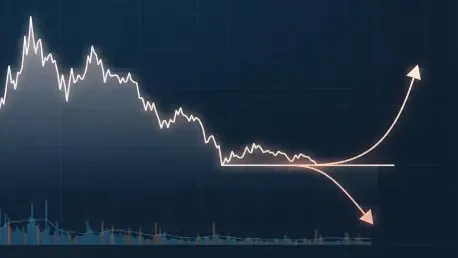

The decentralized finance landscape has reached a pivotal juncture where the survival of even the most dominant scaling solutions depends on their ability to maintain liquidity floors during periods of market apathy. Arbitrum, long considered the standard-bearer for Ethereum’s Layer 2 expansion, currently finds itself navigating a complex transition. As the ecosystem moves further into 2026, the initial excitement surrounding Optimistic Rollups has matured into a rigorous demand for sustainable tokenomics and institutional-grade security. The network continues to lead in total value locked, yet this dominance is no longer an absolute shield against the shifting sentiments of a highly discerning investor base.
The broader market environment currently tests the resilience of the Arbitrum Nitro stack. While the network’s technical efficiency remains high, the competitive landscape has expanded to include a myriad of specialized chains and interoperability layers. This environment requires more than just low transaction costs; it demands a clear value proposition for the ARB token within a governance-heavy framework. The current state of the industry suggests that the next phase of growth will be driven by those who can bridge the gap between retail usability and the stringent requirements of decentralized autonomous organizations.
Evaluating the Layer 2 Ecosystem and Arbitrum’s Market Position
Arbitrum maintains a formidable presence as a leading Optimistic Rollup, serving as a primary destination for decentralized applications that require deep liquidity and Ethereum-equivalent security. Its role in the scaling hierarchy remains central, even as the market moves toward a multi-chain reality. The transition to Arbitrum Orbit chains has empowered developers to launch customized Layer 3 solutions, effectively extending the network’s reach into gaming and high-frequency trading. This architectural expansion is a key component of the strategy to maintain market share against a growing tide of rival Layer 2 networks.
However, the pressure from competitors is relentless, as liquidity fragmentation becomes a significant hurdle for all scaling solutions. To combat this, the Arbitrum DAO has focused on governance-led incentives to attract and retain capital. These efforts are often balanced against the evolving regulatory landscape, which demands higher transparency and more robust decentralization milestones. The successful implementation of recent security upgrades has reinforced the network’s integrity, but the market continues to weigh these technological achievements against the immediate price performance of the ARB token.
Institutional adoption has emerged as a major catalyst for the current market structure. Large-scale participants are increasingly looking for platforms that offer not only speed but also a predictable regulatory path. Arbitrum’s proactive approach to compliance and its established security track record have made it a preferred choice for traditional finance entities exploring on-chain assets. This institutional interest provides a stabilizing force, yet it also subjects the network to broader macroeconomic fluctuations that influence the risk appetite for scaling assets.
Technical Dynamics and Price Action Analysis
Navigating Volatility Compression and Momentum Divergence
The current price action for ARB is defined by an unresolved setup at the $0.17 level, characterized by an exceptionally narrow trading range. This volatility compression is further evidenced by a 14-period Average True Range of only $0.02, suggesting that the market is coiled for a significant directional move. Such low volatility environments often precede a breakout, as the lack of conviction among participants eventually gives way to a dominant trend. The session range has been tightly constrained between $0.16 and $0.17, indicating a state of extreme equilibrium that cannot persist indefinitely.
A compelling divergence is visible when examining momentum oscillators. The Relative Strength Index sits at a neutral-to-bearish 41.03, which traditionally implies that further downside remains possible before reaching oversold conditions. In contrast, the Stochastic oscillator displays an extremely oversold reading, with the %K and %D lines well below the 10 mark. This conflict suggests that while the broader trend remains sluggish, the immediate selling pressure may have reached a point of exhaustion. Traders are watching this divergence closely, as a bullish cross in the Stochastic could signal a relief rally toward established resistance zones.
The moving average structure remains a significant hurdle for any recovery attempt. A bearish stack, consisting of the 7-day, 20-day, and 26-day averages, creates a multi-layered ceiling at the $0.18 level. This resistance cluster acts as a psychological and technical barrier that has repeatedly rebuffed upward movement. Furthermore, the 50-day Simple Moving Average at $0.19 reinforces this bearish outlook over the medium term. Until the price can successfully reclaim this cluster, the path of least resistance remains skewed toward the lower boundaries of the current range.
Quantitative Projections and Critical Support Thresholds
Analyzing the Bollinger Band configuration reveals that the price is effectively hugging the lower band at $0.17. This positioning often precedes a volatility expansion, and in a bearish context, it risks a downward “walk” along the bands. The middle band at $0.18 aligns perfectly with the moving average cluster, highlighting the importance of that level for any potential mean-reversion move. If the support at $0.16 fails to hold on a daily closing basis, the risk of a sharp decline toward the $0.12 long-term SMA increases significantly, representing a return to historical support levels.
Volume profiles on major exchanges like Binance show a modest $7.38 million in spot trading volume, which reflects the current lack of directional momentum. However, derivatives data provides a more nuanced view of market sentiment. Open interest has seen a slight uptick, rising by 3.41% to $47.70 million. This increase in participation during a price drift suggests that new positions are being established, likely as a hedge against further volatility. The outlook for the remainder of 2026 suggests that the market will remain sensitive to these volume shifts, especially as participants look for signs of accumulation at these record lows.
Historical cycles in the crypto market often point toward periods of extended consolidation before a structural trend reversal occurs. For Arbitrum, the current growth projections for the network must be reconciled with the immediate technical reality of a suppressed token price. While the network’s fundamental metrics, such as transaction count and active addresses, remain healthy, the price action reflects a broader skepticism regarding the dilutive effects of supply expansion. This tension between network utility and token value is a primary theme in the quantitative assessment of the asset’s future trajectory.
Obstacles to Recovery in a Competitive Blockchain Environment
One of the most persistent challenges facing the network is the ongoing dilutive effect of continuous token unlocks. From 2026 to 2028, the scheduled release of assets into the circulating supply creates a constant source of sell-side pressure that requires significant fresh capital to absorb. This structural headwind often dampens the impact of positive technological news, as investors remain wary of the long-term supply overhang. Strategies to mitigate this through governance-directed staking or burn mechanisms have been discussed, yet they remain in the early stages of proposal within the DAO.
Liquidity fragmentation across the Ethereum ecosystem further complicates the recovery process. As more Layer 2 and Layer 3 solutions emerge, the available capital is spread thin, making it harder for any single network to maintain the momentum needed for a breakout. Arbitrum must compete not only on transaction fees but also on the “stickiness” of its DeFi ecosystem. The emergence of ZK-rollups, which offer the promise of sub-second finality and enhanced privacy, poses a direct threat to the dominance of Optimistic solutions. Navigating this competitive landscape requires constant innovation to reduce finality times and further lower transaction costs.
Bearish sentiment can become self-reinforcing when a token consistently fails to clear layered resistance. The lack of directional conviction in the current market has led to a “sell the bounce” mentality among short-term traders. To break this cycle, the network needs a catalyst that goes beyond incremental updates. This might include a major partnership or a breakthrough in interoperability that simplifies the user experience for cross-chain transactions. Without such a driver, the risk remains that the ARB token will continue to underperform the broader market, even as the underlying network remains functional and secure.
The Regulatory Framework and Security Standards
Global crypto regulations are playing an increasingly important role in how decentralized governance is structured. The Arbitrum DAO must navigate a complex web of legal requirements that vary significantly between jurisdictions. These regulations influence everything from how incentives are distributed to how the network handles transaction privacy. Compliance with these standards is no longer optional for a network that seeks institutional participation. Consequently, the Arbitrum Nitro stack is subject to rigorous security audits and regulatory reviews to ensure that it meets the necessary standards for transparency and resilience.
The classification of Layer 2 assets by legal authorities could significantly influence future market accessibility and liquidity. If certain scaling assets are deemed to have different legal statuses, it may affect their availability on centralized exchanges and their use within regulated financial products. The Arbitrum community has been proactive in engaging with legal experts to ensure that the network’s decentralization milestones align with emerging legal frameworks. This focus on security and compliance is intended to maintain the integrity of the stack, even as the global regulatory environment remains in a state of flux.
Evolving standards for security are also driving the development of new safety protocols within the ecosystem. The focus on multi-signature requirements and decentralized sequencers is part of a broader effort to eliminate single points of failure. These technological safeguards are essential for maintaining user trust, particularly during periods of high market volatility. By adhering to the highest security standards, the network aims to position itself as a safe harbor for decentralized finance, regardless of the regulatory pressures that may emerge in the coming years.
Future Outlook: Innovation and Network Expansion
The introduction of Arbitrum Stylus represents a potential paradigm shift in the market by enabling multi-language smart contract development. By allowing developers to write contracts in Rust, C++, and other popular languages, the network significantly expands its potential talent pool. This innovation is expected to attract a new wave of developers who were previously deterred by the limitations of Solidity. The resulting influx of diverse applications could drive a surge in network activity, creating fresh demand for the ARB token as a utility and governance asset within a more vibrant ecosystem.
Emerging DeFi primitives and gaming-specific Layer 3 chains are also poised to influence the long-term appreciation of scaling assets. These specialized environments allow for higher throughput and lower costs tailored to specific use cases, such as on-chain gaming or complex derivative trading. As these niches grow, the demand for Arbitrum’s underlying security and settlement layers should naturally increase. This expansion into new sectors is a critical part of the network’s roadmap, as it seeks to diversify its user base and reduce its reliance on traditional DeFi applications.
The global economic environment and Ethereum’s own roadmap will continue to play a decisive role in the future of the network. As Ethereum continues to refine its own scaling capabilities, the relationship between the Layer 1 and its rollups will evolve. Arbitrum’s ability to adapt to these changes, while maintaining its competitive edge in transaction speed and cost, will determine its long-term viability. The integration of global liquidity and the maturation of the digital asset market suggest that while the road ahead is challenging, the opportunities for innovation within the scaling space remain vast.
Final Assessment: Stabilization or Structural Failure
The technical assessment of the ARB token indicated that the market was positioned at a generational crossroads where historical support met modern liquidity constraints. The $0.16 level was identified as the ultimate line in the sand for the bullish defense, with a daily close below this threshold signaling a likely structural failure. In contrast, the potential for stabilization was supported by extreme oversold readings in the Stochastic oscillator and a notable increase in the taker buy/sell ratio at the $0.17 level. These conflicting signals created a high-stakes environment where participants were forced to weigh immediate bearish pressure against long-term fundamental value.
Derivatives data provided a nuanced perspective on the next major move, showing that while top traders remained optimistic with a long/short ratio of 1.4546, the broader market was more hesitant. The neutrality of funding rates suggested that neither side had gained a definitive upper hand in the leverage battle. Monitoring these metrics, along with open interest and taker buy volume, was recommended as a primary strategy for gauging when the volatility squeeze would finally break. The market’s reaction to these data points served as a vital indicator for the network’s ability to maintain its structural integrity under pressure.
Looking ahead, the focus shifted toward the implementation of multi-language contract support and the expansion of the Orbit ecosystem. These technological milestones were viewed as the most likely catalysts for a sustained recovery, provided the $0.16 support remained intact. The period of volatility compression was ultimately seen as a necessary phase of market consolidation, allowing for the redistribution of tokens from speculative holders to long-term participants. The final recommendations centered on maintaining a balanced investment viewpoint, acknowledging both the breakdown risks and the potential for a powerful mean-reversion rally once the current selling exhaustion was fully realized.