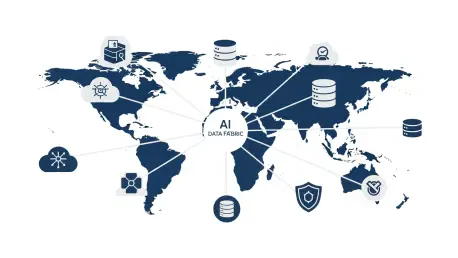

The rapid transition from experimental artificial intelligence pilots to the deployment of complex autonomous agents has fundamentally altered the requirements for enterprise data architecture during the current 2026 cycle. While the previous decade focused on centralizing information into massive repositories, today’s intelligent systems require a dynamic, context-aware environment that goes beyond mere storage. An AI data fabric has surfaced as the essential governance layer that allows these autonomous agents to interact seamlessly with existing data ecosystems without necessitating a complete overhaul of legacy systems. This architecture acts as a sophisticated bridge, enabling agents to navigate through historically disconnected storage areas while adhering to stringent business rules and security protocols. For technology leaders, the objective has moved away from the logistical challenge of moving data to the intellectual challenge of providing the nuanced context that agents need for high-stakes decision-making. By creating an abstraction layer that harmonizes disparate systems, the data fabric allows enterprises to maximize their current infrastructure investments while paving the way for truly independent machine reasoning within a controlled framework.
Overcoming the Persistent Obstacles of Data Silos
Most large-scale organizations continue to struggle with data that is scattered across various departments, local servers, and multiple cloud platforms, creating a fragmented landscape that hampers innovation. When an autonomous agent is assigned a complex task, such as managing a comprehensive mortgage application or conducting a multi-region supply chain audit, it cannot perform effectively if its vision is restricted to isolated pockets of information. The AI data fabric addresses this fundamental fragmentation problem by establishing a unified path that connects these diverse sources into a coherent stream. Instead of forcing every piece of data into a single warehouse, the fabric leaves information where it resides while providing the agent with a virtual map to find exactly what it needs at the right moment. This approach ensures that the agent has a holistic view of the operational environment, allowing it to identify correlations and patterns that would otherwise remain hidden within the dark corners of departmental silos. Consequently, the quality of agent-led output improves as the system gains access to a broader, more accurate dataset that reflects the reality of the business.
Beyond the basic connectivity of information, the AI-oriented fabric introduces a critical layer of intelligence that distinguishes it from traditional data management models. Experts note that this modern model ensures autonomous agents do not merely interact with raw numbers, strings, or dates, but actually comprehend the significance of that data within a specific business setting. For instance, an agent operating within a retail environment must understand that a “returned item” has different implications for inventory management than it does for customer loyalty programs. The data fabric provides this depth of understanding by enriching raw data with metadata and relational logic, effectively transforming a simple computer program into a system that acts more like a seasoned employee. This evolution is vital as companies move toward more ambitious automation goals where agents are expected to make autonomous judgments rather than just following scripted workflows. By bridging the gap between raw data and actionable intelligence, the fabric serves as the cognitive foundation upon which reliable and sophisticated enterprise AI is built, ensuring that every action taken by an agent is grounded in a deep understanding of the corporate context.
Establishing Semantic Logic for Autonomous Interpretation
One of the most significant components of this modern architecture is the semantic layer, which provides the essential vocabulary for machine communication. While human employees possess the intuition to know that a “client” listed in a sales database is the same as a “subscriber” found in a marketing application, autonomous agents require explicit guidance to make those identical connections. By utilizing advanced tools such as knowledge graphs and a shared business vocabulary, the AI data fabric provides agents with the semantic context necessary to interpret data accurately as they move across different sectors of the organization. This prevents the frequent misunderstandings that often occur when AI systems encounter conflicting terminology or inconsistent data formats. When an agent can look at a dataset and immediately understand the relationships between different entities, its ability to perform cross-functional tasks increases dramatically. This shared understanding is what enables an agent to synthesize information from the finance department with logistics data to provide a comprehensive forecast of future revenue, maintaining a high level of accuracy that was previously difficult to achieve without manual human intervention.
As the deployment of autonomous agents grows in scale and complexity, the ability for human operators to maintain direct oversight over every individual interaction becomes an impossible task. The data fabric addresses this challenge by providing a centralized mechanism to manage how these agents behave and what specific information they are permitted to consume. This governance becomes especially critical when dealing with security and privacy; the fabric acts as a vigilant gatekeeper, ensuring that if an agent is performing a task on behalf of a specific user, it only has access to the data that the user is legally and operationally authorized to view. This dynamic permissioning system is integrated directly into the fabric, meaning that security policies are applied consistently regardless of which application or agent is requesting the information. This level of granular control is essential for maintaining trust in agentic systems, particularly in highly regulated industries such as healthcare or financial services where data leaks can have catastrophic consequences. By embedding governance directly into the data path, the fabric allows organizations to scale their AI initiatives with the confidence that their most sensitive assets remain protected from unauthorized use.
Harmonizing Data Fabric with Distributed Mesh Architectures
A common misunderstanding in current architectural discussions is the idea that a data fabric is intended to replace a data mesh, when in reality, the two frameworks are highly complementary. While a data mesh focuses on a decentralized approach where individual teams own and manage their own data as a product, the fabric provides the global access point and connective tissue that allows AI agents to work effectively across those disparate domains. This combination allows for decentralized ownership and agility at the local level while maintaining a governed, easy-to-use interface for the entire organization. By implementing a fabric over a mesh, a company can preserve the autonomy of its engineering teams while ensuring that its autonomous agents have the necessary breadth of access to perform enterprise-wide functions. This synergy is particularly useful for global corporations that must balance local data residency requirements with the need for centralized AI-driven insights. The mesh provides the structure for high-quality data production, while the fabric provides the delivery mechanism that makes that data consumable for intelligent agents.
This integrated setup also significantly enhances the technological flexibility of the enterprise, allowing for future adaptations without disrupting existing workflows. Since the data fabric provides a consistent and steady interface for autonomous agents, the underlying storage systems, databases, and cloud providers can be updated, migrated, or completely changed without breaking the agents’ operational logic. Whether an organization decides to switch to a more cost-effective cloud storage solution or implement a new high-performance vector database for search, the data fabric absorbs the impact of those infrastructure shifts. The agents continue to query the fabric using the same semantic terms and access protocols, completely unaware of the complex changes happening beneath the surface. This decoupling of the intelligence layer from the physical storage layer is a strategic advantage that prevents vendor lock-in and reduces the technical debt associated with rapid AI adoption. It ensures that the enterprise remains agile and capable of adopting the latest technological breakthroughs as they emerge in the coming years, maintaining a competitive edge in a fast-paced market.
Evaluating Performance Through Strategic Observability
As autonomous agents take on increasingly significant responsibilities within the corporate structure, it is imperative that businesses maintain the ability to audit and analyze their decision-making processes. Traditional monitoring tools designed for static applications often fail to capture the complex, multi-step “thought process” that characterizes an advanced AI system. A successful AI data fabric must therefore include native observability features that meticulously track every piece of data an agent accesses and every logical step it takes to reach a conclusion. This level of transparency is necessary not only for internal quality control but also to ensure that the AI remains fully compliant with evolving government regulations and ethical standards. If an agent makes a mistake or produces a biased result, the observability layer within the fabric allows developers to trace the error back to its source—whether it was a flawed data point, a misunderstood semantic relationship, or an improper security permission. This ability to reconstruct the agent’s path provides a safeguard against the “black box” nature of artificial intelligence, fostering a culture of accountability.
The implementation of a robust data fabric proved essential for organizations navigating the complexities of the current technology cycle. Leaders recognized that without a centralized governance layer, the promise of autonomous agents remained stalled by data inconsistencies and security vulnerabilities. The integration of semantic context and advanced observability allowed these systems to move beyond simple automation into the realm of reliable, independent decision-making. Strategic focus should now transition toward refining these semantic layers to accommodate more specialized agentic roles in niche fields like legal analysis and complex engineering. Organizations that successfully established this architectural foundation found themselves better positioned to iterate on their AI strategies with minimal friction. Moving forward, the priority must be the continuous enrichment of the knowledge graphs that power these fabrics to ensure they keep pace with the expanding capabilities of the agents they support. By treating the data fabric as a living, evolving part of the corporate infrastructure, businesses ensured that their AI investments yielded long-term, sustainable value across all departments.