
Scientific progress is currently hindered by fragmented data ecosystems where the valuable insights from failed experiments are rarely recorded or reused for future breakthroughs. For decades, the global economy has been forced to confront a troubling reality: while the volume of capital and high-level talent directed toward research and development has reached historic heights, the actual yield of significant technological progress has largely stalled. This trend, often referred to as the innovation paradox, indicates that new ideas are becoming fundamentally harder to find. In current industrial contexts, the sheer weight of existing information and the complexity of modern science mean that researchers are often running just to stand still, using more resources to achieve the same incremental gains that were once won with far less effort. To break this cycle, the focus is shifting away from isolated digital tools toward a more holistic, integrated framework where artificial intelligence does more than just accelerate a single task. By redefining the R&D process through an integrated discovery loop, organizations are beginning to see how technological complementarities can redefine the very economics of how knowledge is produced, ensuring that every cycle of inquiry builds directly upon the last.
Navigating the Innovation Paradox and Declining Yields
The most visible victim of declining research productivity in recent years has been the semiconductor industry, which serves as a bellwether for the broader tech sector. To uphold Moore’s Law—the consistent doubling of transistors on a microchip roughly every two years—the industry now requires approximately eighteen times more researchers than it did in the 1970s. This massive increase in labor for the same relative output serves as a stark warning for all high-tech sectors: the low-hanging fruit of basic science has been picked, leaving only complex and costly challenges that require specialized infrastructure. This phenomenon is not limited to computing; similar patterns are appearing in the pharmaceutical and materials science industries, where the cost of bringing a single new product to market has continued to climb despite the proliferation of digital design tools. The yield per unit of research effort is shrinking because the barriers to entry for transformative discovery have shifted from simple observation to the management of immense data sets and multi-layered physical interactions.
Several structural factors contribute to this persistent decline, most notably the sheer complexity of modern knowledge ecosystems. As scientific fields mature, researchers must specialize in increasingly narrow niches, which often prevents them from identifying cross-disciplinary breakthroughs that occur at the intersection of different domains. This siloed approach leads to a “burden of knowledge” where the time required for a scientist to reach the frontier of their field leaves less time for actual innovation. Additionally, the high cost of physical experimentation and the lack of a standardized system to record and learn from failed experiments mean that valuable data is often discarded. When a research team concludes a project, the negative results are frequently buried in internal reports, forcing subsequent teams to repeat the same mistakes elsewhere. This failure to capitalize on the “economics of failure” creates a massive drag on productivity, as organizations effectively pay for the same negative information multiple times across different departments and years.
Defining the Five Core Constraints of Discovery
To solve the productivity problem, we must first identify the specific bottlenecks that currently hinder scientific progress across various industries. The first primary constraint is search: the human brain and traditional laboratory methods cannot possibly navigate the near-infinite combinations of chemicals, materials, or structural designs available today. This is followed immediately by a significant information gap, where researchers struggle to predict which specific ideas have the highest probability of success before committing substantial funds to them. Without the ability to simulate outcomes with high fidelity, teams are often forced to rely on professional intuition, which is subject to bias and limited by the individual’s previous experience. These constraints mean that even the most talented teams are only exploring a tiny fraction of the potential solution space, potentially missing revolutionary breakthroughs that lie just outside their established theoretical frameworks.
The remaining hurdles involve the practicalities of bringing an intersection of theoretical ideas into the physical world. Performance constraints make it difficult to ensure a new design meets rigorous safety or technical standards, such as a battery’s heat resistance or a medicine’s binding affinity, without multiple rounds of expensive physical prototyping. Experimentation bottlenecks arise from the time and physical labor required for laboratory testing, where manual processes often slow down the verification of even the most promising theories. Finally, a learning constraint exists because many organizations fail to capture data from every cycle to inform future research, resulting in a stagnant discovery process that lacks a memory. When these five constraints—search, information, performance, experimentation, and learning—are addressed in isolation, the gains are marginal. However, a systemic approach that tackles all of them simultaneously allows for a fundamental shift in how research is conducted and measured.
Five Mechanisms for AI-Enabled Research
Artificial intelligence addresses these long-standing constraints through five specific mechanisms, starting with vastly improved discovery throughput. By using computer simulations to screen millions of molecular combinations in seconds, AI allows researchers to explore a much wider range of possibilities than ever before. This high-volume approach ensures that no stone is left unturned in the initial phases of a project, transforming the search process from a manual hunt into a systematic scan of the digital landscape. This in silico screening does not replace the lab, but it ensures that only the most viable candidates ever reach the physical testing stage. In fields like materials science, this has already led to the identification of new crystal structures and alloys that would have taken decades to discover using traditional trial-and-error methods.
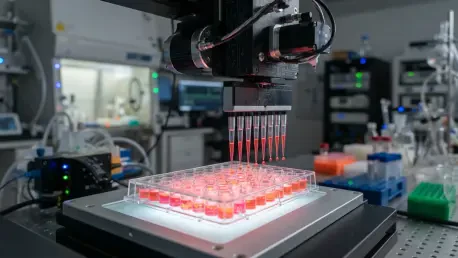
The second and third mechanisms focus on the quality of ideas and the reduction of decision-making uncertainty. AI models now provide “predictive prioritization,” allowing teams to place their bets on the most promising candidates by calculating a probability of success based on historical data. Simultaneously, AI optimization tools refine these candidates to ensure they hit peak technical performance, such as ensuring a new metal alloy can withstand extreme pressure or that a drug binds perfectly to its target with minimal side effects. The final mechanisms involve the physical aspects of the lab, where AI speeds up experimentation through simulations and “self-driving laboratories” that operate with minimal human intervention. Most importantly, it enables cumulative learning, where every data point—whether it represents a success or a failure—is fed back into the model to improve its next round of predictions. This turns the entire R&D operation into a self-correcting system that grows more efficient with every experiment it conducts.
The Multiplicative Power of Technological Complementarity
The real magic of AI in the R&D sector happens through compounding gains rather than simple linear improvements. If a research team uses AI to increase its initial candidate pool by fifty percent, improves its success rate by only five percent, and increases the quality of each discovery by twenty percent, the total output doesn’t just grow incrementally; it can skyrocket by over one hundred and seventy percent. This illustrative arithmetic shows that small improvements across the entire pipeline lead to massive overall productivity shifts when they are linked together. This is the essence of technological complementarity: the value of one tool increases when paired with another. In the current 2026 landscape, organizations are realizing that investing in a high-speed hypothesis generator is only useful if there is an automated lab ready to test those ideas immediately, creating a seamless flow from digital theory to physical reality.
This synergy requires a shift in how budgets are allocated, moving away from “point solutions” toward integrated platforms. A multi-million dollar robotic lab is a waste of resources if there isn’t a smart AI feeding it high-quality candidates, just as a powerful predictive model loses value if its suggestions must wait in a three-month queue for manual lab testing. When these tools are linked, the discovery loop is closed, and the return on investment for research and development begins to trend upward for the first time in decades. This approach also allows for better risk management, as the cost of failure is dramatically reduced when simulations can rule out poor ideas early. By focusing on the multiplicative effect of these technologies, leaders can transform their R&D departments into engines of exponential growth, where the focus shifts from finding a single “silver bullet” to building a superior system of discovery.
Designing the Integrated Discovery Loop
To achieve these gains, organizations must move away from using AI as a series of isolated tools and instead build a fully Integrated Discovery Loop. In this model, human researchers are not replaced but are elevated to the role of architects who set the high-level goals and parameters of a study. The AI takes over the heavy lifting of generating and prioritizing hypotheses based on massive datasets that no human could process alone. This creates a cycle where the results of every physical or simulated experiment are used to calibrate the next set of predictions in real-time. This “active learning” cycle turns every failed experiment into a valuable data point, ensuring that the system never makes the same mistake twice. This integration is the key to overcoming the fragmentation that has plagued scientific inquiry for centuries, creating a living repository of knowledge that evolves alongside the project.
This active learning process allows for “sample-efficient optimization,” which is a fancy way of saying that researchers can reach their targets with significantly fewer physical experiments. Instead of being viewed as a waste of time or capital, a negative result helps the AI eliminate a specific area of the search space, making the next attempt much more likely to succeed. This shift is particularly impactful in industries like chemical engineering and biotechnology, where physical materials are expensive and lab time is a premium resource. By treating discovery as a data-driven loop rather than a linear path, companies can maintain a continuous state of innovation, where the system is always learning and always optimizing. This model also democratizes discovery within an organization, as the central AI model can synthesize insights from various teams, ensuring that a breakthrough in one department can immediately benefit a related project in another.
Distinguishing Scientific Reality from Hype
While the potential for AI in R&D is immense, it is crucial to distinguish between verified industrial successes and the unverified hype that often accompanies new technological cycles. Technologies like self-driving laboratories and experimental optimization models have been proven to work in numerous peer-reviewed studies published throughout the current decade. These tools have successfully demonstrated that AI can match or exceed traditional research methods while requiring up to forty percent fewer experiments to reach the same result. For example, the GOLLuM study, led by Ranković and colleagues in early 2026, provided empirical proof that uncertainty-calibrated AI could optimize complex material properties more efficiently than even the most experienced human researchers. These are not theoretical possibilities; they are the new standard for competitive research organizations.
However, the field is also prone to controversy and exaggerated claims that can lead to strategic missteps if not handled with care. For instance, high-profile reports of AI discovering entirely new classes of materials are sometimes met with skepticism or even formal retractions when the underlying data fails to hold up to the rigors of independent replication. A notable example was the Toner-Rodgers controversy, where a widely cited preprint was later scrutinized and eventually led to a “no confidence” statement from MIT in 2025. This serves as a vital reminder that while AI can accelerate the process, it does not bypass the need for scientific rigor and physical verification. Managers and scientists must remain objective, ensuring that their AI strategies are built on solid, peer-reviewed evidence and that they maintain high standards for data quality to avoid the “garbage in, garbage out” trap that can undermine even the most advanced algorithms.
The Mathematical Framework for Discovery Output
To help leaders manage these new systems, modern economists use a specific mathematical framework to measure quality-adjusted discovery output. This model evaluates the scientific value of a success, the probability of that success, and the total number of candidates generated within a given timeframe. Crucially, it highlights that if an organization’s physical testing capacity is a bottleneck, generating more ideas with AI will add zero value until that capacity is expanded or made more efficient. This formula allows managers to pinpoint exactly where their R&D pipeline is failing, whether it is a lack of high-quality ideas or a slow verification process. By quantifying these variables, companies can move away from “gut feel” management and start treating research productivity as a solvable engineering problem that can be optimized through strategic investment in specific technical areas.
There is also a mathematical way to look at how knowledge accumulates over time, which is essential for long-term planning. The learning formula suggests that more experiments only help the organization if they provide informative data and if the company has the digital infrastructure to absorb that feedback effectively. Without a way to ingest and reuse experimental data, an organization is simply running in place, regardless of how many advanced AI tools it employs. This year, 2026, has seen a surge in “knowledge graph” implementations that aim to solve this by linking disparate data points into a cohesive whole. This ensures that the information “yield” from each experiment is maximized, turning the R&D process into a cumulative asset. For a leadership team, understanding these formulas is the difference between blindly chasing the latest AI trends and building a robust, data-driven engine for sustainable innovation and market leadership.
Climbing the R&D Maturity Ladder
Organizations typically adopt AI through a four-stage progression that requires both technical and cultural shifts. It begins with “Assisted Research,” where AI handles basic tasks like summarizing scientific papers or formatting data, providing local efficiency gains without changing the underlying process. This moves into “AI-Augmented Discovery,” where the technology starts to improve the quality of the opportunities being explored by suggesting new avenues for research. At this stage, the organization sees measurable improvements in the “hit rate” of its experiments, but the different stages of the research pipeline are still largely disconnected. Most companies currently find themselves in these first two stages, benefiting from AI as a high-powered assistant rather than a core structural component of their discovery strategy.
The most advanced organizations in 2026 have reached the stages of “Integrated” and “Adaptive” discovery. In these final phases, search, selection, and testing are fully connected through a unified data architecture, and a continuous feedback loop drives persistent productivity gains. In an adaptive discovery environment, the AI models are not just static tools; they are dynamic systems that update themselves in real-time as new lab results come in. This is where the innovation paradox is finally challenged, as the system becomes more productive with every experiment it performs. Reaching this level of maturity requires a commitment to breaking down internal silos and investing in automated hardware that can keep pace with the speed of digital hypothesis generation. This transformation marks the end of the traditional R&D model and the beginning of a new era of self-accelerating scientific progress.
Strategic Imperatives for R&D Leadership
Research leaders recognized that the path forward required more than just the adoption of new software; it necessitated a systemic overhaul of how knowledge was managed and distributed. Organizations that successfully bridged the gap between computational prediction and physical experimentation discovered that their internal rates of innovation grew exponentially. These pioneers shifted their focus from short-term optimization to long-term discovery cycles, effectively turning every laboratory trial into a permanent asset in their digital library. By prioritizing the integration of high-throughput testing with uncertainty-calibrated models, they transformed the R&D department from a cost center into a self-accelerating engine of scientific progress. This shift allowed them to identify high-value opportunities that were previously hidden behind the veil of scientific complexity and high experimental costs.
Success in this new era depended on a delicate balance between machine-driven optimization and human-led exploration. While AI proved excellent at refining what had worked in the past, human researchers ensured the system continued to explore radical, unconventional ideas that challenged existing paradigms. By building a system that captured every failure and turned it into fuel for the next success, organizations finally made the process of discovery easier again, securing a competitive advantage in an increasingly complex global market. This transition was not merely about speed, but about the quality and reliability of the scientific output. Ultimately, the industry moved away from the stagnant yields of the previous era, adopting a model where every successful breakthrough and every instructive failure paved the way for the next generation of technological advancement.