
The global textile and apparel sector functions as an incredibly complex manufacturing web where disparate stages of production traditionally operate as disconnected silos with isolated data logs. For decades, this fragmentation meant that errors in fiber quality or mechanical timing remained hidden until the final product reached inspection, causing massive material waste and financial loss. As the industry navigates the landscape of 2026, it is witnessing a total overhaul of these legacy systems through the deliberate application of the Internet of Things and Artificial Intelligence. This technological merger has enabled a transition from a reactive model—where problems were addressed only after they surfaced—to a proactive ecosystem where data flows seamlessly from the factory floor to the boardroom. By digitizing every stage of the value chain, manufacturers are effectively dismantling the walls between spinning, weaving, and dyeing departments. This integration creates a holistic view of production that allows for more agile responses to market fluctuations and consumer demands. The current transformation is not merely an incremental upgrade but a fundamental reimagining of how textiles are produced, tracked, and optimized. As global markets demand higher transparency and shorter lead times, the ability to harness real-time data has become the primary differentiator between industry leaders and those struggling to keep pace with modern manufacturing requirements.
The Multi-Layered Architecture: Sensing and Connectivity
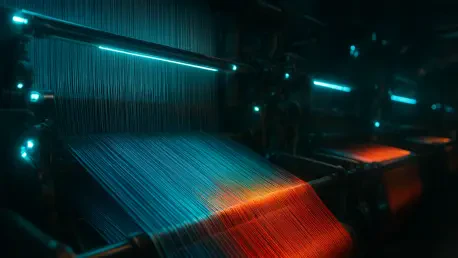
To understand the mechanics of a modern smart mill, one must first look at the foundational sensing layer that now defines the production environment. In these advanced facilities, sensors are no longer mere add-ons but are deeply integrated into high-speed machinery like spinning frames, circular knitting machines, and air-jet looms. These devices monitor mechanical integrity by capturing vibration and acoustic signatures, allowing the system to detect the earliest signs of bearing wear or spindle misalignment. Furthermore, process parameters such as yarn tension, speed, and torque are tracked with millisecond precision. This constant stream of data ensures that delicate fibers are not overstressed, maintaining the structural integrity of the fabric while pushing machines to their maximum safe operating speeds. This hardware foundation acts as the nervous system of the plant, relaying vital signs to a central brain that can adjust settings autonomously or alert operators to impending issues before they escalate into production failures.
Beyond the mechanical aspects of the machinery, the sensing layer has expanded to encompass the entire physical environment of the textile mill. Because natural fibers like cotton and wool are hygroscopic and highly sensitive to atmospheric conditions, maintaining precise temperature and humidity levels is critical for consistent quality. Modern IoT systems utilize distributed sensors to create a climate-controlled grid that adjusts HVAC systems in real-time based on local fluctuations within the factory. Additionally, resource monitoring has become a standard component of this architecture, with flow meters and electrical sensors tracking the precise consumption of water, steam, and electricity. By correlating energy usage with specific production batches, manufacturers can identify inefficiencies in real-time, such as a particular dye vat that is drawing excessive power or a washing line that is wasting water. This granular level of environmental and resource visibility provides the necessary data to optimize the mill’s carbon footprint while simultaneously lowering operational overhead.
Real-Time Visibility: Eliminating Traditional Blind Spots
The most immediate benefit of a connected factory is the elimination of the production blind spots that have historically plagued textile manufacturing. In a traditional setting, a loom might run with a subtle tension error for hours before a human inspector notices a streak in the finished cloth, leading to miles of unsellable fabric. Modern facilities have replaced this reliance on delayed manual inspection with real-time dashboards that provide a “glass factory” view. These digital interfaces allow supervisors to monitor every machine on the floor simultaneously, highlighting any deviations from set benchmarks the moment they occur. Whether it is a slight drop in spindle speed or an inconsistent chemical concentration in a finishing bath, the system provides immediate alerts. This level of oversight ensures that overall equipment effectiveness remains at its peak, as managers can make informed decisions based on live data rather than waiting for end-of-shift reports that only document past failures.
Building on this visibility, computer vision and automated inspection have revolutionized quality control within the production line. High-definition cameras equipped with specialized AI algorithms now scan fabrics as they are woven or knitted at incredible speeds, detecting defects like slubs, holes, or mispicks with a degree of accuracy that far surpasses the human eye. What makes these systems truly transformative in 2026 is their ability to link quality data back to specific machine sensors in a closed-loop system. When a defect is detected, the AI can cross-reference the timing with mechanical logs to identify the root cause—perhaps a specific vibration in a motor or a brief drop in air pressure. This capability allows the factory to not only stop the production of faulty goods but also to fix the underlying mechanical issue immediately. This proactive approach to quality ensures that “first-time-right” production becomes the standard, drastically reducing the volume of waste and the costs associated with re-working or discarding defective materials.
Predictive Analytics: Redefining Machine Maintenance
The textile industry is currently moving away from traditional maintenance schedules toward a model of predictive and proactive care. In the past, machines were serviced on a fixed schedule or repaired after they broke down, both of which resulted in significant inefficiencies. By utilizing the massive amounts of data generated by IoT sensors, AI models can now identify the specific thermal and vibration patterns that precede a component failure. For example, a motor that is starting to overheat or a bearing that exhibits a non-standard frequency can be flagged weeks before a catastrophic breakdown occurs. This predictive capability allows maintenance teams to schedule interventions during planned downtime, ensuring that the production flow remains uninterrupted. This shift has not only extended the functional lifespan of expensive textile machinery but has also significantly reduced the capital expenditure required for emergency repairs and replacement parts.
This transition to predictive maintenance also has a direct impact on the overall economic stability of the manufacturing process. When a high-speed knitting machine fails unexpectedly, the ripple effects can be felt across the entire supply chain, delaying garment assembly and retail delivery. By ensuring that every piece of equipment operates within its optimal parameters, manufacturers can provide more accurate lead times to their clients, enhancing trust and reliability. Moreover, the data-driven nature of this maintenance strategy allows for a more efficient allocation of human labor. Instead of performing routine checks on machines that are functioning perfectly, maintenance staff can focus their expertise on high-value tasks and system optimizations identified by the AI. This evolution from a “fix-it-when-it-breaks” mentality to a sophisticated, data-backed preservation strategy is a cornerstone of the modern textile mill’s competitive advantage in a high-demand global market.
Digital Twins: Simulating Efficiency in a Virtual Space
The concept of the Digital Twin has become a central pillar of textile manufacturing, offering a dynamic, virtual replica of physical assets that breathes and changes in sync with the factory floor. These models are far more advanced than static simulations; they are fed a constant stream of real-time data from IoT sensors, allowing engineers to visualize the current state of a single machine or an entire plant. In 2026, this technology is primarily used for virtual prototyping and process optimization. For instance, before starting a new production run with a complex fabric blend, a manager can simulate the process within the Digital Twin to predict how the fibers will behave under specific tension and temperature settings. This allows for the identification of potential bottlenecks or failure points before a single yard of material is ever physically processed, saving immense amounts of time and raw material during the research and development phase.
The synergy between Digital Twins and AI creates a powerful loop of prescriptive intelligence that guides daily operations. In this cycle, the physical machines sense and generate data, the AI interprets that data to find inefficiencies, and the Digital Twin tests various “what-if” scenarios to determine the optimal course of action. This maturity in digital transformation allows mills to move beyond simply describing what is happening to prescribing specific adjustments. For example, if a Digital Twin simulation suggests that increasing the humidity in the weaving shed by five percent will reduce yarn breakage by ten percent, the system can automatically adjust the HVAC settings and monitor the results. This level of integrated intelligence ensures that the factory is always operating at its theoretical limit of efficiency. By shifting the trial-and-error process from the physical world to a risk-free virtual environment, textile companies have significantly accelerated their innovation cycles and reduced the environmental impact of their experimental phases.
Resource Management: The Data-Driven Path to Sustainability
Sustainability has shifted from a corporate social responsibility goal to a core operational requirement, and digital tools are the primary drivers of this change. The “wet processing” stages of textile manufacturing, such as scouring, dyeing, and finishing, have traditionally been the most resource-intensive, consuming vast quantities of water and chemicals. Modern IoT-enabled dye houses now use precision dosing systems and real-time monitoring to ensure that only the exact amount of chemical required is used for each batch. This prevents the over-application of dyes and reduces the chemical load in wastewater, making the treatment process more manageable and less environmentally damaging. By tracking every drop of water and every watt of energy, manufacturers can now generate a detailed environmental footprint for every garment produced, meeting the increasing demands for transparency from both regulators and consumers.
Digital Twins are also playing a significant role in enhancing these conservation efforts by allowing for the virtual testing of dyeing recipes and finishing processes. Traditionally, achieving a specific color match required several physical trials, each consuming fabric, water, and heat. Today, engineers use virtual models to simulate how different dyes will interact with specific fiber types under varying conditions, significantly reducing the number of physical samples needed. This “digital sampling” not only saves resources but also speeds up the design-to-production timeline. Furthermore, by identifying energy-intensive stages of production through real-time data, mills can shift certain operations to hours when renewable energy is more plentiful or grid demand is lower. This data-driven approach to resource management ensures that sustainability is built into the fabric of the manufacturing process rather than being an afterthought, positioning the industry to meet the stringent environmental targets set for the period from 2026 to 2030.
The Frontier of Smart Wearables and Integrated Fibers
Innovation in the textile sector is not confined to the factory floor; it is fundamentally changing the nature of the products themselves through the rise of smart textiles. We are no longer simply attaching sensors to the surface of a garment; instead, engineers are integrating conductive materials and micro-electronics directly at the fiber level during the spinning and weaving processes. These intelligent fabrics are capable of sensing physiological signals such as heart rate, respiration, and muscle activity, effectively turning a simple shirt into a sophisticated medical or performance monitoring device. In 2026, the focus has shifted toward making these “e-textiles” as durable and comfortable as traditional fabrics, ensuring they can withstand repeated washing and high-intensity wear without losing their sensing capabilities. This represents a massive opportunity for the healthcare and sports industries, where continuous, non-invasive monitoring can provide life-saving data.
A significant area of ongoing research and implementation involves the development of self-powered textiles that address the historical challenge of battery life in wearables. By utilizing triboelectric nanogenerators and other energy-harvesting technologies, these fabrics can capture the kinetic energy generated by the wearer’s movement and convert it into electrical power for the onboard IoT sensors. This eliminates the need for bulky batteries and frequent charging, making smart clothing much more practical for everyday use. Additionally, these garments can function as active nodes within a broader IoT ecosystem, communicating with smart home systems or medical databases via low-power wireless protocols. As the technology matures from 2026 onward, we are seeing applications ranging from uniforms that track the safety of industrial workers to performance gear that provides real-time coaching feedback to athletes. This integration of intelligence into the fiber itself marks a new era where the boundaries between clothing, technology, and data become increasingly blurred.
Overcoming Infrastructure and Human Capital Challenges
Despite the rapid pace of digital adoption, the transition to a fully connected textile industry is not without its significant hurdles. One of the primary obstacles is the presence of legacy infrastructure, as many textile mills across the globe still rely on machinery that is several decades old and lacks any form of digital interface. Retrofitting these “old iron” machines with modern sensors and connectivity modules is a complex engineering task that requires significant capital investment and technical expertise. Furthermore, even when sensors are installed, the challenge of data interoperability remains; machines from different manufacturers often speak different proprietary languages, making it difficult to create a unified data stream for the entire factory. Overcoming these barriers requires a commitment to open standards and the development of middleware solutions that can bridge the gap between old mechanical systems and modern digital platforms.
Beyond the hardware and software challenges, the human element represents a critical factor in the success of the Industry 4.0 transition. The move toward a data-driven manufacturing model necessitates a workforce that is not only skilled in traditional textile techniques but also comfortable with data analytics, AI interfaces, and digital maintenance protocols. This has sparked a massive re-skilling effort across the global industry, as traditionally labor-intensive roles are being transformed into technical positions. Companies are investing heavily in training programs to help their employees navigate the complexities of smart factories, emphasizing the importance of human-machine collaboration. Furthermore, as mills become more connected, the threat of cyberattacks and industrial espionage has become a major concern, requiring the implementation of robust cybersecurity measures to protect sensitive production data and proprietary designs. Successfully managing these infrastructure and human capital challenges is essential for any manufacturer looking to thrive in the increasingly digitized textile economy.
Final Synthesis: The Result of the Digital Transition
The successful integration of AI and IoT provided a stable foundation for the growth observed in the textile sector over the recent years. Stakeholders recognized that data was the most valuable asset in the mill, leading to a complete restructuring of capital investments toward digital infrastructure rather than just mechanical speed. The industry achieved a significant milestone as the move toward a “self-optimizing mill” shifted from a theoretical concept to a practical reality in high-output facilities. These advancements allowed manufacturers to reduce material waste by nearly thirty percent, while the implementation of predictive maintenance protocols virtually eliminated unplanned downtime for those who adopted the technology early. By the end of this transformative period, the digital thread that connected raw fiber production to the final garment became the standard for quality assurance and supply chain transparency across the global market.
Strategic shifts in how companies approached resource management and workforce development ensured that the transition was sustainable in both environmental and economic terms. Leaders in the sector prioritized the development of interoperable systems, which allowed for a more democratic adoption of smart technologies among medium-sized enterprises. The focus on human-machine collaboration proved that technology could augment rather than replace the artisan’s skill, leading to higher-quality products and safer working environments. As the industry looked toward the next decade, the foundations laid by the convergence of AI, IoT, and smart textiles created a more resilient and responsive manufacturing ecosystem. The lessons learned during this period of intense digitization established a new set of best practices that prioritized precision, transparency, and agility, effectively future-proofing one of the world’s most essential industrial sectors against the uncertainties of a changing global economy.