
A New Era of Flexibility in Industrial Material Flow
The ability to synchronize complex material movements without human intervention has become the defining competitive advantage for high-volume distribution centers. The debut of the Jungheinrich EAC 212a at LogiMAT 2026 marks a pivotal shift in how businesses approach internal logistics. This Autonomous Mobile Robot (AMR) offers a sophisticated solution for pallet transport, bridging the gap between goods receipt and dispatch. By acting as a catalyst for integrated flow, it simplifies the path to automation through high-performance lifting and software that adapts to the modern warehouse environment.
The Evolution From Fixed Infrastructure to Autonomous Mobility
Historically, warehouse automation relied on rigid conveyors or massive storage systems that dictated the layout of the entire facility. While effective, these setups lacked the agility required to respond to changing market demands or seasonal peaks. The industry gradually moved toward Automated Guided Vehicles (AGVs) that followed fixed paths, but the real breakthrough arrived with AMRs like the EAC 212a. This robot builds upon proven mechanical foundations but introduces a level of autonomy that allows it to navigate complex environments without needing magnetic tape or floor modifications.
Seamless Integration Across Diverse Operational Environments
Bridging Functional Silos With Integrated Lifting
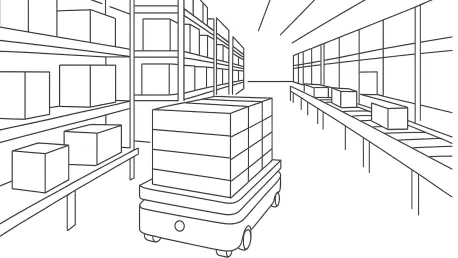
The EAC 212a excels at connecting disparate areas of a facility through its integrated lifting function. It transitions smoothly between floor storage, narrow block storage lanes, and high-tech conveyor interfaces. This versatility effectively eliminates the “dead zones” in automation where manual intervention was typically required to move goods. By acting as a universal connector, the robot ensures that a pallet arriving at the dock can move through production and into dispatch with minimal human oversight, reducing the risk of bottlenecks.
Scalability Through a Modular “Start Small” Philosophy
High initial capital expenditure often deters automation, but the EAC 212a addresses this through a modular strategy. Companies can deploy a single unit to handle a specific bottleneck before scaling to a full fleet as operational needs grow. This architecture allows new units to be added to the existing ecosystem without disrupting current workflows. This approach not only lowers financial risk for mid-sized enterprises but also allows larger corporations to utilize “try-and-buy” programs before committing to a full digital transformation.
Advancing Autonomy With Physical AI and Intelligent Recovery
Beyond simple transport, the EAC 212a incorporates Physical AI to handle the unpredictability of the warehouse floor. This advanced software architecture enables the robot to perform autonomous recovery, meaning it can resolve navigation disruptions independently without calling for a technician. Furthermore, the future-proof design is built to support camera-based recognition systems. This shift from programmed logic to intelligent perception ensures that the equipment remains a relevant asset even as warehouse configurations and packaging standards continue to evolve.
Future-Proofing Logistics Through Intelligent Automation
As the market looks ahead, the EAC 212a signals a move toward low-barrier automation. Future developments will likely see even deeper integration between AMRs and warehouse management systems (WMS), where robots act as data-gathering nodes that optimize their own routes based on real-time traffic. We can expect a trend where the boundary between various types of equipment—such as robots, conveyors, and human-operated machinery—becomes increasingly blurred, creating a collaborative environment where efficiency is maximized through constant communication and machine learning.
Strategies for Implementing AMR Technology in Modern Warehousing
To maximize the benefits of this technology, businesses should begin by identifying the most repetitive and labor-intensive pallet movements within their current operations. Utilizing the “try-and-buy” model helps validate the robot’s performance in specific floor conditions, such as block storage or narrow aisles. Professionals should focus on training their existing workforce to manage and interact with these autonomous systems, shifting human labor from mundane transport tasks to higher-value supervisory roles. By adopting a phased rollout, companies ensure that their infrastructure and staff evolve alongside the tech.
Embracing the Next Generation of Pallet Transport
The Jungheinrich EAC 212a functioned as a blueprint for the future of industrial mobility. By combining robust mechanical lifting with the intelligence of Physical AI, it addressed the core challenges of flexibility and scalability that previously hindered the widespread adoption of automation. Forward-thinking companies prioritized these agile solutions and found they optimized their workflows by auditing floor layouts for compatibility early in the process. The implementation of such technology proved that moving pallets was only the beginning of a broader journey toward a smarter, more efficient, and more adaptable industrial ecosystem.