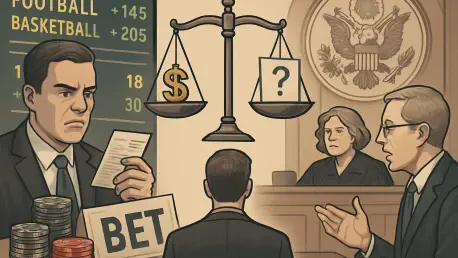

The legal landscape of American betting is currently undergoing a seismic shift as federal courts grapple with whether a sports wager is a simple gamble or a complex financial instrument. At the heart of this controversy is the clash between the Commodity Futures Trading Commission (CFTC) and state gaming regulators, sparked by the rise of prediction markets like Kalshi. These platforms allow users to trade on everything from election results to celebrity sightings, challenging the traditional boundaries of the Commodity Exchange Act (CEA). As the Third and Ninth Circuits move toward a potential split, the financial services industry watches closely to see if “event contracts” will fundamentally redefine the jurisdiction of federal oversight versus state police powers.
This discussion explores the recent judicial pivot toward classifying sports-related event contracts as “swaps” and the resulting friction with state gambling statutes. We delve into the difficult distinction between legitimate commercial hedging and pure speculation, the skepticism of judges comparing prediction markets to traditional sportsbooks like Caesars, and the broader implications for consumer protection. The conversation highlights the technical definitions that could either empower federal regulators or preserve the long-standing authority of state gaming boards.
The Third Circuit recently identified sports-related event contracts as “swaps” because they affect stakeholders like advertisers and franchises. How does this classification change the regulatory hierarchy between federal agencies and state gaming commissions, and what specific hurdles do states now face when asserting their police powers over these markets?
The Third Circuit’s decision to classify these contracts as “swaps” essentially pulls the rug out from under state regulators by invoking the doctrine of federal preemption. Under the Commodity Exchange Act, the CFTC is granted exclusive jurisdiction over “swaps,” which are defined as agreements where payments depend on the occurrence of an event associated with a potential financial or economic consequence. When a court recognizes that a sports outcome affects a broad web of stakeholders—ranging from television networks and sponsors to local franchises—the contract moves out of the “gambling” bucket and into the “financial instrument” bucket. This creates a massive hurdle for states like New Jersey, which have historically relied on their police powers to oversee betting activities within their borders. Because the court found both field and conflict preemption, state gaming commissions are now effectively barred from enforcing their own statutes against licensed exchanges like Kalshi, even if those exchanges are offering products that look exactly like sports betting.
Courts are debating whether bets on niche outcomes, such as a celebrity’s attendance at a basketball game, meet the legal definition of a swap. How do you draw a definitive line between events with legitimate commercial consequences and those that are purely speculative, and what metrics determine that distinction?
Drawing a line between a legitimate financial swap and a neighborhood wager is becoming an increasingly “thorny issue” for the judiciary. The Third Circuit majority took a broad view, suggesting that if an event has any potential economic consequence, it fits the plain language of the CEA. However, the dissent correctly pointed out the absurdity of this logic by noting that even a friendly ping-pong match could be seen as having a financial consequence if the winner receives a payout. On platforms like Kalshi, we see contracts tied to whether Timothée Chalamet will attend at least nine Knicks playoff games, which pushes the definition to its absolute limit. Does the attendance of a single celebrity at a game truly impact the commercial bottom line of the NBA or the local economy in a measurable way? Currently, there is no established metric or “significance threshold” in the law; the mere existence of a potential consequence—no matter how small—appears sufficient for some judges to trigger federal jurisdiction.
Federal guidelines suggest event contracts should serve both hedging and speculative purposes, yet critics argue sports-related markets lack real-world hedgers. In a market focused on specific player performances or game outcomes, who are the typical “hedgers,” and how does their presence impact the legal standing of these exchanges?
In traditional futures markets, you have a clear balance between hedgers—like a farmer locking in a price for corn—and speculators who provide necessary liquidity. In the realm of sports-related event contracts, the identity of the “hedger” is far more elusive and often feels like a legal fiction. One could argue that a local business owner near Madison Square Garden might “hedge” against the economic loss of a short playoff run by betting on the Knicks to lose, but that is a far cry from traditional financial risk management. The CFTC’s own website admits that these contracts serve two purposes: to offset real-world risks and to provide a venue for profit-seeking speculation. If a market is dominated entirely by speculators with no actual commercial risk to offset, it loses its character as a financial tool and begins to look like a pure gambling product. This lack of meaningful hedgers is a primary reason why the Ninth Circuit and other skeptics are hesitant to grant these markets the same legal protections as oil or interest rate swaps.
With the Ninth Circuit expressing skepticism about treating prediction markets differently than traditional sportsbooks, a legal split appears imminent. What are the broader implications for the financial services industry if the Supreme Court intervenes, and how might a ruling shift the operations of licensed designated contract markets?
If the Ninth Circuit diverges from the Third Circuit’s pro-Kalshi stance, we are almost certainly headed for a Supreme Court showdown that could redefine federalism in the financial sector. During the April 16, 2026, arguments, judges were openly skeptical, with some asking for the functional difference between a bet at Caesars and a contract on a prediction market. If the Supreme Court rules that these are indeed gambling products rather than swaps, companies like Kalshi, Robinhood, and Crypto.com would face a fragmented regulatory nightmare, having to comply with varying laws in all fifty states. Conversely, a Supreme Court victory for the exchanges would cement the CFTC as the primary arbiter of all “event-based” trading, potentially stripping states of their ability to regulate any digital market that labels itself an exchange. This would likely lead to an explosion of new financial products tied to pop culture, weather, and politics, all shielded from state gambling taxes and oversight.
If federal law continues to preempt state gambling statutes in the prediction market space, how might states adapt their enforcement strategies? What specific risks arise for individual participants if traditional consumer protections provided by state gaming boards are replaced by federal oversight of these financial instruments?
States will likely find themselves in a defensive crouch, perhaps lobbying the CFTC to use its discretionary power to prohibit certain contracts that are “contrary to the public interest.” While the CFTC can review six specific categories of contracts, including those involving “gaming,” they have been slow to act, which leaves a massive gap in consumer protection. State gaming boards are designed to handle the social fallout of gambling, offering resources for addiction and strict local oversight that federal financial regulators are simply not equipped to provide. For the individual participant, the risk is that they are entering a market that is regulated for “market integrity” and “transparency” rather than “consumer welfare” or “anti-addiction.” If the local neighborhood ping-pong match or celebrity attendance bet is suddenly a federal swap, an individual trader could technically be committing a felony by participating in these transactions outside of a licensed DCM, a radical shift that could criminalize casual social behavior.
What is your forecast for the future of prediction markets in the United States?
My forecast is that we are entering a period of extreme volatility for prediction markets where the “wait-and-see” approach will dominate the industry’s strategy. While the Third Circuit’s 2-1 decision gave exchanges a temporary victory, the pending Ninth Circuit ruling is the true wildcard that could freeze expansion plans for major players. I expect that regardless of the judicial outcome, Congress will eventually be forced to step in and provide a more surgical definition of “swaps” to prevent the CEA from being used as a universal “get out of jail free” card for sports betting. In the short term, you will see exchanges continue to push the envelope with niche contracts—like the 30 or so purported swaps currently relating to Timothée Chalamet—to test the limits of what constitutes an “economic consequence.” Ultimately, if these markets cannot prove they provide real utility for commercial hedgers, they will likely be reabsorbed into the state-regulated gambling framework after a definitive, and likely restrictive, Supreme Court ruling.