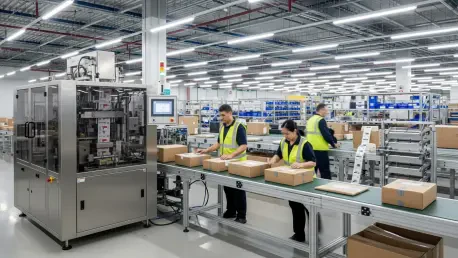

The relentless surge of digital commerce has pushed warehouse floor managers to reconsider the physical limits of their sorting facilities as they hunt for ways to shave seconds off every dispatch cycle. In an era where delivery speed defines brand loyalty, UK fulfillment centers can no longer afford to let manual bagging slow down their operations. As order volumes surge across the e-commerce landscape, the pressure to transition from labor-intensive hand-packing to streamlined automation has never been more urgent.
The introduction of the PackHub marks a pivotal shift, offering a specialized solution designed to handle the repetitive strain of packaging while allowing facilities to scale without the need for a massive floor-space expansion. By shifting the burden of mundane tasks to machine logic, businesses managed to preserve their human capital for more complex problem-solving roles within the warehouse.
Breaking the Fulfillment Bottleneck with High-Speed Precision
Modern logistics providers are increasingly caught between the need for higher throughput and the physical limitations of existing warehouse footprints. Traditional industrial automation often requires a total facility redesign, a luxury many third-party logistics (3PL) and retail distribution centers cannot afford. The rise of plug-and-play technology addresses this gap, providing tools that offer immediate productivity gains without the overhead of permanent infrastructure.
This trend reflects a broader industry movement toward flexible, modular systems that can adapt to fluctuating seasonal demands and labor shortages. Rather than committing to rigid, bolted-down conveyor systems, facilities opted for agile machinery that fits into the current flow. This shift enabled companies to remain competitive even as consumer expectations for next-day delivery became the standard across the United Kingdom.
The Evolution of Scalable Automation in Constrained Environments
The system is engineered to automate the most redundant steps of the bagging process, effectively reducing packaging time by up to 50% per order. Central to its design is a high-capacity hopper capable of holding 500 bags, paired with a precision friction feeder that ensures consistent singulation. Such reliability is crucial during peak shopping periods when any mechanical failure could lead to a cascading backlog of unshipped goods.
To maintain accuracy during high-speed operations, a vacuum cup holding station stabilizes each bag, facilitating ergonomic product insertion and automated rotation. This technical precision is rounded out by an integrated labeling unit that prints and applies carrier labels directly to the envelope. This integration ensured every package was ready for immediate dispatch within standard parcel workflows, eliminating the need for separate labeling stations.
Key Technical Features and Throughput Enhancements: PackHub
Industry leaders from Sitma and their UK distributor, Engelmann & Buckham, emphasize that the system serves as a critical bridge between manual labor and full-scale robotics. Experts suggest that the current logistics climate favors tools that keep operator interactions simple and intuitive while significantly boosting accuracy. By synthesizing technical precision with strategic flexibility, this partnership provided local businesses with the consultation necessary to navigate the transition.
The consensus among logistics specialists remained clear: immediate efficiency gains were no longer a luxury but a requirement for remaining competitive. This hybrid approach allowed for a smoother cultural transition within the workforce, as employees saw automation as a tool for assistance rather than a threat to their positions. The collaboration between Italian engineering and British distribution expertise created a support network that addressed specific regional requirements.
Expert Perspectives: The Shift to Hybrid Logistics Solutions
To successfully integrate the bagging system into a fast-paced environment, facilities leveraged the wheeled frame and compact footprint to place it exactly where the workflow demanded. Operators maximized the utility of the system by aligning its automated labeling capabilities with existing carrier software to eliminate manual data entry errors. This alignment proved essential for maintaining data integrity across the entire supply chain.
Because the system was designed for mobility, it was relocated across different zones of a facility as demand shifted between product categories. Utilizing local technical support for initial calibration ensured a seamless transition, which allowed logistics providers to manage growing order volumes with a smaller, more efficient labor footprint. The move toward compact automation established a blueprint for future facility upgrades, prioritizing versatility over static scale.
Implementing Compact Bagging Systems: Existing Distribution Lines
Future strategies for UK distribution centers involved a deeper integration of modular units that communicate directly with warehouse management systems. Facilities moved toward a model where hardware was no longer static but could be reconfigured in real-time based on live order data. This flexibility provided a safeguard against the unpredictable nature of global supply chains and shifting consumer habits.
Decision-makers prioritized the adoption of systems that required minimal training, ensuring that seasonal staff reached peak productivity within hours. By focusing on ergonomic improvements and automated label synchronization, businesses successfully mitigated the risks of repetitive strain injuries and shipping errors. These proactive steps ensured that the e-commerce sector remained resilient, efficient, and ready for the next phase of industrial evolution.