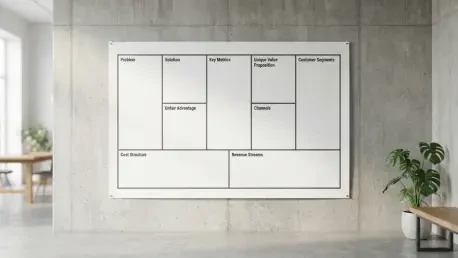

Agile development eliminates wasted time and resources by focusing on iterative design cycles and incremental product improvements based on data. In the hyper-accelerated landscape of 2026, where artificial intelligence has compressed product life cycles from years into weeks, the traditional business plan has become an artifact of a slower era. Today, the ability to pivot based on real-time market signals is more valuable than any long-term forecast. Entrepreneurs now recognize that the primary risk is not technical failure, but rather building something that nobody actually wants. The Lean Startup Canvas provides a structured, one-page framework that forces founders to confront their riskiest assumptions immediately. By distilling complex business models into nine high-impact blocks, this tool enables teams to visualize their entire strategy at a glance, fostering a culture of rapid experimentation and validated learning. As the barrier to entry for launching new products continues to drop, the premium on strategic clarity and problem-solving mastery has never been higher, making this canvas an essential component of the modern startup toolkit. This approach ensures that every dollar spent and every hour worked contributes directly to finding a repeatable and scalable business model that resonates with the target audience.
1. From Industrial Manufacturing to Constant Innovation
The conceptual foundations of the lean movement were established long before the digital revolution, tracing back to the early twentieth century. During the manufacturing era, industrial success was defined by mass production, economies of scale, and operational efficiency. However, the post-World War II landscape forced a radical shift in thinking, particularly within the Japanese automotive industry. Taiichi Ohno at Toyota pioneered the Toyota Production System, which later became known as lean manufacturing. This system was designed to eliminate waste and deliver value to the customer as quickly as possible. By focusing on just-in-time production and continuous improvement, Toyota was able to outcompete larger rivals who remained wedded to rigid, mass-production models. This historical transition demonstrates that the core principles of lean thinking—reducing waste and prioritizing the customer’s immediate needs—are universal and adaptable to any era of economic development.
As the global economy transitioned from physical manufacturing to digital products and services, the need for speed and adaptability intensified. The Internet essentially removed the traditional barriers between a company and its customers, creating a world where feedback is instantaneous and customer demands are more sophisticated than ever. This shift led to the emergence of the “continuous innovation” mindset, where products are no longer viewed as static entities but as evolving services that must be fine-tuned to solve specific customer problems. In 2026, this mindset is augmented by machine learning and real-time data streams, allowing for a level of precision in product development that was previously unimaginable. The movement from traditional Waterfall development to Agile and Lean methodologies reflects this new reality, where the primary goal is not just to build a product, but to build a business that can learn and adapt faster than its competitors can react.
The evolution of these frameworks highlights a fundamental change in how value is created in the modern world. In the manufacturing age, the unfair advantage was often found in the ability to produce the most units at the lowest cost. In the digital age, the advantage shifted toward those who could manage complex software requirements. Today, the advantage belongs to the organization that can manage the feedback loop between the customer and the product most effectively. The lean startup methodology is essentially the application of the scientific method to business building, where every feature is a hypothesis and every launch is an experiment. This structured approach to uncertainty allows founders to navigate the chaotic waters of the 2026 market with a clear roadmap, ensuring that they remain focused on the problem rather than becoming enamored with their own technical solutions.
2. Core Principles of the Lean Startup Methodology
The lean startup movement, famously championed by Steve Blank and Eric Ries, fundamentally altered the curriculum of modern business schools and the strategies of global venture capital firms. At its core, this methodology favors experimentation over elaborate planning and prizes customer feedback over founder intuition. This approach marks a radical departure from the traditional “big design up front” model, which often led companies to spend millions of dollars on products that failed to find a market. Instead, the lean methodology encourages building a “minimum viable product” to test essential business hypotheses as early as possible. This shift has democratized entrepreneurship, allowing individuals to test ideas with minimal capital and iterate toward success. In the current 2026 environment, where specialized AI agents can prototype ideas in hours, the speed of this feedback loop has become the defining characteristic of successful ventures.
A critical pillar of this methodology is the recognition that a business plan is essentially a document of untested assumptions. While a traditional plan assumes that the unknowns of a business can be researched and solved in isolation at a desk, the lean startup methodology recognizes that these truths can only be discovered in the marketplace. This leads to the concept of “validated learning,” where the success of a startup is measured by how much it has learned about its customers rather than how many features it has shipped. When founders embrace this scientific approach, they become less emotionally attached to their initial ideas and more focused on the data. This objectivity is vital when the time comes to “pivot”—a strategic change in direction intended to test a new hypothesis about the product, strategy, or engine of growth—or to persevere in the face of temporary setbacks.
Furthermore, the Lean Startup methodology emphasizes that a startup is not simply a smaller version of a large corporation. While established companies excel at executing a known and validated business model, startups are temporary organizations specifically designed to search for a business model that is both repeatable and scalable. This distinction is vital for resource allocation and management styles. A large corporation might focus on optimizing existing processes, but a startup must prioritize the discovery of value. This necessitates a culture of high-speed iteration and a tolerance for failure, provided that failure leads to actionable insights. In 2026, the most resilient startups are those that have institutionalized this search process, using the Lean Canvas as a living document that evolves alongside their understanding of the market.
3. Contrasting the Strategic Frameworks of the Lean Canvas and the Business Model Canvas to Identify Key Structural Differences
The Business Model Canvas, originally proposed by Alexander Osterwalder and Yves Pigneur, revolutionized how people visualize an organization’s value creation through nine core building blocks. It remains a powerful tool for analyzing established businesses and understanding the complex interdependencies among partnerships, resources, and revenue streams. As the startup landscape became more volatile, entrepreneurs like Ash Maurya identified a need for a more risk-focused adaptation. The original canvas was often criticized for being too general for early-stage founders who are trying to solve a specific problem for a specific audience. This realization led to the development of the Lean Canvas, which replaces some of the more operational blocks of the Business Model Canvas with elements that are more critical for a startup in the discovery phase.
The primary difference lies in what the canvases prioritize for the user; specifically, the Business Model Canvas is excellent for viewing an organization from an “outside-in” perspective, helping consultants and executives understand how an existing machine functions. In contrast, the Lean Canvas was designed by an entrepreneur for entrepreneurs, focusing on the “inside-out” perspective of building something from nothing. By substituting “Key Partners,” “Key Activities,” “Key Resources,” and “Customer Relationships” with “Problem,” “Solution,” “Key Metrics,” and “Unfair Advantage,” Maurya shifted the focus toward the highest areas of risk for a new venture. In 2026, where technical resources are often commoditized via cloud services and AI, the real risk is almost always found in the problem-market fit, making the Lean Canvas an increasingly relevant tool for the modern founder.
Another key distinction is the actionability of the information contained within the canvas, as the Lean Canvas encourages founders to document their assumptions in a portable, one-page format that can be easily shared and debated. This portability is crucial for the “search” phase of a startup, as it allows for rapid updates as new data comes in from customer interviews or MVP testing. While the Business Model Canvas might remain static for long periods in a stable industry, a Lean Canvas is expected to change frequently. This dynamic nature reflects the iterative reality of startup development, where the goal is to systematically de-risk the venture by moving from high uncertainty to validated knowledge. For a founder in 2026, choosing between the two frameworks depends entirely on whether they are managing an existing business or searching for a new one.
4. Navigating the Nine Essential Components of the Business Model Canvas to Develop a Comprehensive Strategic Framework for Your Organization
The first steps in completing a Lean Canvas involve defining the Problem and the Customer Segments, as it is essential to identify the top three challenges your target audience faces rather than listing every minor annoyance. Simultaneously, you must be extremely specific about who your customers are. If you are targeting multiple distinct groups, such as freelance designers and corporate attorneys, you must create a separate canvas for each, as their problems and the channels required to reach them will differ significantly. In 2026, precision in customer segmentation is often aided by granular data analytics, allowing founders to identify “early adopters”—those individuals who feel the problem so acutely that they are willing to overlook the imperfections of an early-stage product to find a solution.
Once the problem and audience are defined, the focus shifts to the Unique Value Proposition and the Solution, where the Unique Value Proposition is a single, clear, and compelling message explaining why your product is different and worth buying. It is effectively the “hook” that captures attention in a crowded market. The Solution block should outline the minimum set of features required to deliver that value proposition, commonly referred to as the Minimum Viable Product. Many founders make the mistake of over-engineering the solution before validating the value proposition. In the current era, where AI can help generate dozens of feature ideas in seconds, the discipline to focus only on the top three features that directly address the core problem is a vital competitive advantage for any development team.
Distribution and financial health are covered by the Channels, Revenue Streams, and Cost Structure blocks, which represent the paths used to reach customers and the economic engine of the business. Channels include everything from organic search and social media to direct sales or content marketing. By 2026, the cost of customer acquisition through traditional digital channels has reached record highs, forcing founders to look for innovative, high-leverage alternatives. Revenue Streams and Cost Structure form the financial foundation of the company. Founders must move beyond simple pricing to understand the assumptions underlying their gross margins, break-even points, and customer lifetime value. A sustainable business model requires more than just a great product; it requires a mathematical path to profitability that justifies the ongoing investment of time and capital.
The final two blocks, Key Metrics and Unfair Advantage, are often the most difficult to complete accurately but are the most critical for long-term viability. Key Metrics should focus on the one or two actions that truly indicate value for the customer and health for the business, such as daily active usage or retention rates. This prevents founders from being misled by “vanity metrics” like total registrations or page views. The Unfair Advantage is a “moat” that protects your business from competitors once you have proven the model. This could be anything from proprietary data or network effects to a deeply specialized team. In 2026, an unfair advantage is rarely a single feature, as features are easily copied; instead, it is a structural advantage that makes it difficult for others to compete even if they know exactly what you are doing.
5. Identifying and Strengthening Your Unfair Advantage
A common misconception among early-stage founders is the belief that being the “first to market” or having the “best features” constitutes a sustainable competitive advantage. In reality, anything that can be easily copied or purchased is not a true unfair advantage. As the market in 2026 is flooded with AI-generated software and automated marketing strategies, the ease of replication has reached an all-time high. A true unfair advantage is something that cannot be easily replicated by a competitor with more capital or a larger engineering team. This might include confidential insider information, a single-minded obsession with a specific niche, or a unique personal brand that provides instant authority in a market. By identifying these moats early, a startup can focus its resources on strengthening the barriers to entry that will protect its future profit margins.
It is also important to distinguish between the Unique Value Proposition and the Unfair Advantage, as they serve different purposes in the business model. The value proposition is external-facing; its job is to convince a customer to try the product by promising a specific benefit. The unfair advantage is internal-facing and defensive; its job is to deter copycats and established incumbents from encroaching on your territory. For example, a social media platform’s value proposition might be “staying connected with friends,” but its unfair advantage is the massive network effect—the reality that the service becomes more valuable as more people use it, making it nearly impossible for a new entrant to lure users away. In 2026, the most potent unfair advantages often involve proprietary training data that allows a company’s AI models to perform significantly better than off-the-shelf alternatives.
Building a “Dream Team” or securing a celebrity endorsement can also provide a significant edge, but these must be leveraged correctly to become a structural advantage. A team with deep technical expertise in a nascent field like quantum computing or specialized biotechnology provides a moat because such talent is scarce and cannot simply be bought off the street. Similarly, existing customer bases or exclusive distribution partnerships can create a defensive perimeter around a business. As founders complete their Lean Canvas, they must be brutally honest about whether their listed advantage is truly “unfair” or if it is merely a temporary lead. The goal is to move from a position of “tinkering” to a position of “defensibility,” ensuring that the value created by the startup remains within the organization rather than being captured by more efficient followers.
6. Implementing Strategies for Massively Scalable Growth
The ultimate goal of using the Lean Startup Canvas is to reach a stage where the business can scale exponentially, which often begins with what is known as a “singularity moment”—the point where the first customer pays for the product. While one customer might seem insignificant, it represents the first real validation that someone finds the solution valuable enough to part with their hard-earned money. From there, the focus shifts to doubling and redoubling that success. The “10x” growth model encourages founders to stop thinking in terms of incremental improvements and instead look for the structural changes that will allow them to serve ten times as many customers. This mindset shift is essential because the strategies that work for ten customers are rarely the ones that will work for a thousand or a million.
Thinking in 10x terms forces a startup to prioritize the right types of risks at the right time, ensuring that the technical risk of whether a product can be built remains secondary to the market risk of whether anyone will use it. By focusing on a small group of ten customers initially, a founder can provide high-touch service, manually onboarding users and gathering deep qualitative feedback that would be impossible at scale. This “unscalable” work provides the insights needed to build the automation and infrastructure required for the next level of growth. In 2026, this process is significantly enhanced by AI-driven customer success tools that can simulate high-touch interactions, yet the underlying logic remains: prove the model with a few before attempting to conquer the many.
As a company scales from 10 to 100 to 1,000 customers, the focus of the Lean Canvas must evolve, especially as the “Channels” block becomes increasingly important during the transition from founder-led sales to automated marketing funnels. The “Cost Structure” must be optimized to ensure that the business remains viable as it grows, and “Key Metrics” must shift from qualitative satisfaction to quantitative efficiency. The 10x model is not just about getting bigger; it is about giving the organization the “mathematical permission” to scale. It ensures that the foundation is solid before the weight of massive growth is applied. By treating growth as a series of manageable doublings, founders can navigate the transition from a small experiment to a market-dominating enterprise without losing sight of the core problem they set out to solve.
7. Addressing Crucial Startup Development Questions
One of the most frequent questions regarding the Lean Canvas is when to use it instead of the Business Model Canvas. The answer depends entirely on the stage of the venture. For early-stage startups that are still searching for product-market fit, the Lean Canvas is the superior tool because it focuses on the areas of highest uncertainty: the problem, the solution, and the metrics of success. For established businesses looking to optimize an existing model or analyze a competitor, the Business Model Canvas provides a broader overview of the organizational machinery. In 2026, many sophisticated founders use both, starting with the Lean Canvas to validate a new product idea and then transitioning to the Business Model Canvas once the venture matures and requires more complex partner management and resource allocation.
Another common inquiry concerns the amount of time that should be invested in completing the canvas, and founders are often surprised to learn that a first draft should take no more than twenty to thirty minutes. The Lean Canvas is intended to be a fast, iterative document, not a comprehensive strategic plan. It is better to have three or four different canvases for various customer segments than to spend hours perfecting one that might be based on flawed assumptions. The goal is to get the ideas out of the founder’s head and onto paper so they can be tested. In the fast-paced 2026 market, the speed of documentation is as important as the speed of development. Once the canvas is drafted, the real work begins: leaving the office to talk to customers and proving that the problems listed in the first block are actually real.
The role of “Key Metrics” is also a frequent point of confusion, with many founders gravitating toward vanity metrics that make the company look good but do not provide actionable insights. A true key metric is one that maps directly to revenue or customer retention. For a subscription-based AI service in 2026, this might be the “activation rate”—the percentage of users who perform a specific, meaningful action within their first hour of usage. Founders must ask themselves: “If this number goes up, does it mean my business is fundamentally better?” If the answer is no, then it is a vanity metric. By focusing on a single “North Star” metric, a startup can align its entire team toward a common goal, ensuring that every feature developed and every campaign launched moves the needle in a meaningful direction.
Finally, entrepreneurs often ask how AI has changed the way we approach these canvases in 2026; while the core blocks of the canvas remain the same, the speed at which they can be validated has increased exponentially. AI-powered market research tools can now analyze millions of data points to identify unmet customer needs, while low-code and no-code AI platforms allow founders to build and launch MVPs in a fraction of the time it once took. However, this increased speed also means that the “Unfair Advantage” block is more critical than ever. In a world where anyone can build an app in a weekend, structural moats—such as proprietary data, community, and network effects—are what separate successful companies from transient ones. The Lean Canvas remains the essential framework for navigating this high-speed environment with clarity and purpose.
8. Advancing Strategic Resilience Through the Comprehensive Implementation of Organizational Frameworks and Operational Protocols
The implementation of the Lean Startup Canvas shifted the focus of entrepreneurship from speculative planning to evidence-based execution. Founders realized that the most dangerous assumption was the belief that they already understood what the customer wanted. By using the canvas as a dynamic, living document, teams were able to identify their riskiest hypotheses and test them before significant capital was committed to development. This disciplined approach to innovation proved to be especially vital in the mid-twenties, as the rapid evolution of technology made traditional five-year plans obsolete. The framework provided a common language for founders, investors, and employees, ensuring that everyone was aligned on the primary problem being solved and the metrics that would define success.
The most successful ventures of the recent past were those that institutionalized the “Build-Measure-Learn” loop as a core competency. These organizations didn’t just use the canvas once at their inception; they returned to it with every new feature and market expansion. They treated the “Unfair Advantage” block not as a static statement, but as a strategic goal to be built over time. By focusing on “high-touch” customer interactions in the early stages, they gathered the qualitative insights that allowed them to build more effective AI-driven automation as they scaled. Founders discovered that the true value of the canvas was not the piece of paper itself, but the rigorous thinking and customer engagement that it demanded. This shift from “ego-driven” development to “data-driven” discovery remains the hallmark of modern strategic resilience.
For those looking to apply these principles today, the next steps involved a commitment to radical transparency and a willingness to be proven wrong. The process began with identifying a specific customer segment and its most painful problems, then moving quickly to validate those issues through direct interaction. The most effective strategy was to focus on the “minimum” in Minimum Viable Product, resisting the urge to add features until the core value proposition was proven. As the business model began to stabilize, the focus turned to identifying and protecting the structural advantages that would prevent commoditization. By viewing the startup as a continuous search for a repeatable model, entrepreneurs were able to navigate the uncertainties of 2026 with confidence, turning volatility into a competitive advantage for their growing organizations.