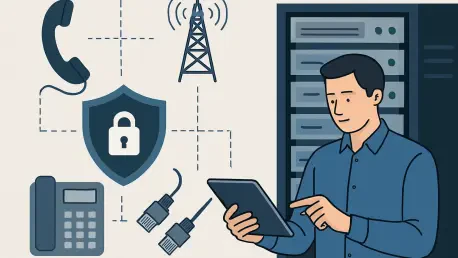

Industry projections suggest that global losses resulting from telecom fraud will exceed forty-one billion dollars by the end of the 2025 calendar year. This alarming statistic underscores the precarious bridge between historical reliability and modern digital vulnerability that thousands of global enterprises are currently crossing. The ongoing seismic shift away from traditional copper-wire Plain Old Telephone Service involves migrating mission-critical legacy equipment—such as fire alarms, elevator emergency systems, and secure building intercoms—directly onto corporate IT networks. While the transition to IP-based communication offers significant cost savings and flexibility, it often exposes an expanded attack surface that most standard cybersecurity strategies fail to account for properly. As these analog devices are converted to Session Initiation Protocol endpoints, they frequently bypass existing firewalls and network segmentation, leaving them visible to sophisticated threat actors who scan for unsecured voice-edge entry points.
Managing the Global Surge in Telecommunications Fraud
Analyzing the Financial Impact: Modern Voice Vulnerabilities
The sheer financial magnitude of the threat facing the modern enterprise is becoming impossible to ignore as telecommunications fraud evolves into a primary driver of organizational loss. According to recent industry data, global losses reached nearly thirty-nine billion dollars recently, and the climb toward the forty-one billion mark reflects a strategic shift by cybercriminals toward the often-unprotected voice plane. Supporting research indicates that nearly one-third of all devices currently operating on corporate networks remain outside the direct visibility or control of IT departments, leading to a massive governance gap. When mission-critical analog devices are ported to the internet-facing edge without the benefit of robust segmentation, they become low-hanging fruit for automated scanners. This systemic weakness allows attackers to perform comprehensive Session Initiation Protocol scanning to identify open ports, which then leads to catastrophic toll fraud or the interception of unencrypted data.
Addressing the Core Drivers: Why Fraud Grows Rapidly
The rapid escalation of these vulnerabilities stems from a fundamental disconnect between the speed of digital migration and the diligence of hardware inventory management. As organizations rush to decommission expensive copper lines to avoid rising maintenance fees, they frequently lose track of the specialized endpoints—such as emergency lift phones or alarm circuits—that once lived on isolated analog circuits. Once these devices are connected to a unified network without proper isolation, they effectively create a flat architecture that permits lateral movement by malicious actors. Recent intelligence reports have highlighted a significant surge in denial-of-service attacks targeting telecom infrastructure, often fueled by insecure voice endpoints. These devices can be hijacked to serve as botnet nodes or as pivot points for more destructive ransomware campaigns. The inability to distinguish between legitimate call traffic and malicious automated probes has turned the voice-edge into a significant liability.
Implementing Robust Session Border Controller Solutions
Utilizing Sentinel SBCs: Advanced Voice Edge Protection
To counteract these growing threats, M5 Technologies has introduced the Mediatrix Sentinel session border controller portfolio as a dedicated enforcement point for all voice-related traffic. This series of appliances acts as a secure boundary between the private corporate network and the public internet, ensuring that every session is validated and controlled. The portfolio is highly scalable, ranging from the virtualized Sentinel CS—which can manage up to twenty thousand concurrent sessions in cloud environments—to physical hardware like the Sentinel 400 for mid-sized operations. For smaller branch offices, the Sentinel Mini and Sentinel 100 provide essential protection for fewer sessions without requiring a complete overhaul of existing infrastructure. By positioning these controllers at the network edge, organizations effectively manage the race between migration and inventory. The controller ensures that even if an organization has not fully cataloged every legacy endpoint, the traffic from those devices must pass through a gateway.
Deploying Robust Encryption: Tactical Measures and Protocols
The defensive capabilities of the Sentinel series extend far beyond simple traffic filtering, employing sophisticated mechanisms like topology hiding to protect internal resources. By masking internal IP addresses and substituting them with aliases, the system prevents external threat actors from mapping out the internal architecture of a private voice network. Security is further reinforced through the implementation of Transport Layer Security for signaling and Secure Real-time Transport Protocol for the media streams themselves, utilizing AES-128 encryption to safeguard conversations. Additionally, the devices feature built-in protection against abusive peers by automatically blacklisting any IP address that attempts to connect with abnormal frequency. Call admission controls allow administrators to set strict limits on call volume and bandwidth on a per-trunk basis, effectively shielding the network from brute-force login attempts and resource exhaustion. This multilayered approach ensures that the voice-edge remains resilient against attacks and scanning.
Strategic Security Assessments: Establishing a Protected Framework
The transition away from traditional copper infrastructure represented a significant milestone for high-stakes sectors like healthcare and public safety. These industries realized that high-availability voice systems were non-negotiable and successfully utilized professional assessments to identify hidden vulnerabilities in their trunks. By implementing policy-enforced boundaries, leaders in these fields ensured that as legacy lines were retired, the critical devices left behind were fully protected. Future-proofing these networks now requires a commitment to continuous monitoring and the implementation of robust session border control as a standard architectural component. To maintain integrity, organizations must perform regular audits of their current voice-edge exposures and update encryption protocols to match evolving standards. By taking these proactive steps, enterprises move beyond the risks of unmanaged migration and establish a resilient digital framework. This forward-thinking approach provides a blueprint for any organization looking to secure its communications.