


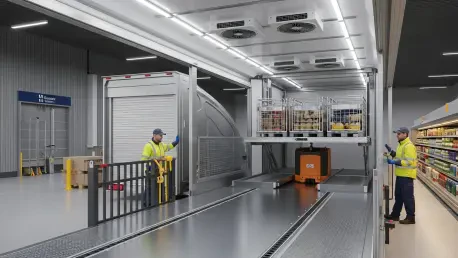

Empty shelf space is rarely about transport capacity alone; it is often about running two supply chains at once—chilled and frozen—without wasting cubic space or time between drops. That is the promise behind dual-temperature, moving double deck refrigerated trailers now rolling into UK grocery fleets. The concept blends thermal segregation with vertical capacity gains, aiming to cut journeys, fuel burn, and handling risk while keeping product quality intact.
Asda’s decision to order 55 step-frame units after trials signaled that this category had matured beyond novelty. The specification—Tiger chassis and moving deck, Carrier HE19 with MHS2200 single-discharge evaporators, Axscend telematics, and safety hardware throughout—positions the platform as a complete system rather than a parts list. The question for a technology review is not whether it works, but how it works under pressure, why it matters to retailers, and where the trade-offs sit against simpler single-temp or fixed-deck alternatives.
Body
Refrigeration Architecture: Two Zones, One Mission
The Carrier HE19 paired with MHS2200 single-discharge evaporators underpins the dual-zone setup. Instead of relying on bulky bulkheads or duplicated plants, this design steers airflow to create stable chilled and frozen envelopes that can be pulled down quickly after door events. That matters on multi-drop runs, where repeated openings typically erode thermal integrity and spike fuel use.
Energy efficiency is not only about compressor hours; it is about retention. With temperature-targeted airflow and insulated interfaces, the system reduces recirculation losses, and an LED fuel gauge gives drivers real-time cost cues. The result is fewer quality excursions, simpler compliance reporting, and more freedom to route mixed loads without dedicated runs for one temperature class.
Moving Deck and Payload Utilization
The three-quarter-length lifting deck, rated to 10 tons and driven by Tiger’s four-ram hydraulics, is the quiet productivity engine here. By stacking cages or pallets safely, fleets reach up to 43 pallets or 72 cages per trip, a material uplift versus single-deck fridge trailers. Ground- and bay-level controls shorten turnarounds and cut working-at-height exposure, which shows up in both labor minutes and incident rates.
Clearances—about 1940 mm on the lower deck and 1860 mm up top—are not arbitrary. They balance airflow for even temperatures while preventing load sway that can damage packaging or impair door seals. Compared with fixed double decks, the moving deck grants flexibility for variable load heights and mixed cage/pallet patterns, which reduces partially filled runs.
Thermal Integrity and Build Quality
Deep-insulated floor slabs and a temperature-retaining rear shutter address the classic cold-chain heat leak: the floor and the last meter of the door. Alloy flooring tolerates material-handling equipment without deforming, preserving seal lines and drainage paths. Joint design and reinforced interfaces minimize leak paths that otherwise become chronic fuel drains over a trailer’s life.
LeciTrailer’s body integration matters because body-chassis mismatches often drive warranty pain and micro-leaks. A paired design lowers the risk of thermal bridging at seams, which in practice means fewer hotspots, steadier compressor cycles, and more predictable maintenance intervals.
Safety Systems That Change Behavior
A heavy-duty gate at the moving deck’s front and multipurpose load-securing options do more than tick boxes; they shape safe loading sequences. Haldex’s TEM Safe Parking Valve, the Nexus ground-level sliding coupling, and reinforced rear bay buffers target the biggest loss events—roll-aways, coupling injuries, and dock impacts. Added protection against tree damage is a quiet nod to real-world routes where low branches can cost a week of downtime.
Operator-first ergonomics compress the risk envelope. Ground-level operation reduces climbs, and defined touchpoints cut improvisation. Safety in this class now competes as a differentiator; rivals may match payload, but not all match the system-level human factors.
Telematics and Measurable Uptime
Axscend TrailerMaster brings tire pressure and electronic brake performance into a single data plane. The value is compounding: good tires stabilize temperatures by reducing parasitic drag and vibration, while brake performance analytics inform preemptive service that avoids out-of-service events at the worst time—peak demand.
Data feeds slide into fleet platforms to automate compliance logs and create heat maps of repetitive faults. That makes the trailers more than assets; they become sensors that optimize routes, flag poor loading practices, and even correlate temperature deviations with driver behavior or specific bays.
Geometry, Aerodynamics, and Operational Fit
A step-frame chassis keeps overall height within route-critical thresholds while preserving cubic capacity. The shape trims aerodynamic penalties that often plague boxier double decks, which stabilizes the trailer in crosswinds and saves fuel on trunking. In urban runs, improved maneuverability and compatible dock heights prevent the “one-size-fits-none” problem that wastes bay time.
Compatibility with both cages and pallets widens deployment. Fleets can blend these units alongside ambient double decks and shorter urban fridge trailers, matching capacity to route density. The result is fewer empty miles and better store on-time performance without splitting the network by temperature.
Market Position and Competitive Context
Why this and not a simpler single-temp or a fixed double deck? The dual-temp moving deck collapses two workflows into one asset while keeping utilization high. Alternatives either force half-empty runs to protect temperatures or underdeliver on volume. Some competitors offer similar specs, but the combination—Tiger’s in-house hydraulics, Carrier’s airflow strategy, Axscend’s diagnostics, and integrated safety—forms a coherent stack that reduces integration friction and shortens commissioning.
Asda’s 55-unit order after trials is market signal, not just fleet news. It implies that real-world cost per delivered cage is trending down and that service levels are improving under mixed-load complexity. Competitive lead times since the 2024 launch also matter; availability can be the deciding factor when contracts hinge on seasonal promotions.
Limitations, Trade-Offs, and Economics
No system is magic. Maintaining hard thermal separation under messy, mixed-height loads demands training and disciplined loading plans. Moving decks introduce hydraulic wear and require strict inspection cycles. Upfront capex is higher than for single-temp fridges, and integrating telematics with legacy depot systems can stall rollouts.
Still, opex savings accrue from fewer trips, steadier temperatures, and reduced incidents. The breakeven depends on route density and drop counts; high-volume grocery networks typically see payback as multi-drop complexity rises. Lead-time risk remains a factor, especially when bespoke specifications stretch supplier capacity.
Conclusion
This platform delivered more than capacity; it fused thermal precision, vertical space, safety, and data into a single operations model. The unique edge lay in system coherence—refrigeration tuned to airflow, hydraulics designed for repeat cycles, and telematics that turned maintenance from reactive to predictive. For fleets with dense multi-drop routes, that combination translated into lower cost per delivered unit and fewer service failures.
Next steps were clear: standardize loading playbooks to protect thermal separation, integrate TrailerMaster outputs into driver coaching and depot scheduling, and pilot low-GWP refrigerants or hybrid power units to push fuel savings further. Buyers weighing options should model payback against mixed-load intensity and confirm service coverage for hydraulics and refrigeration. As networks pressed for safer, cleaner, and more predictable cold-chain capacity, dual-temperature moving double decks stood out as a pragmatic upgrade path rather than a speculative bet.







