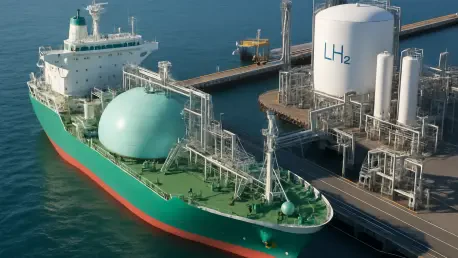

Industrial-scale hydrogen only becomes bankable when equipment can survive cryogenic extremes, hold tight pressure windows between shore and ship, and keep flowing day after day without hiccups that strand cargo or flare off value before it reaches market, and Japan’s latest move signaled that this pivot from promise to practice is starting to coalesce around hardware that has passed real‑world hurdles rather than just lab checks. Kawasaki Heavy Industries placed a significant order with Ebara Elliott Energy for liquid hydrogen booster pumps and cryogenic Hydrogen Return Gas Blowers, drawing a direct line from piloting to commercialization under the Liquefied Hydrogen Supply Chain Commercialization Demonstration. The project, led by Japan Suiso Energy with support from NEDO, is building core infrastructure at the Kawasaki L## Terminal in Kawasaki City, Kanagawa Prefecture. The choice hinged on metallurgy and rotating equipment know‑how proven in a 2022 world‑first L## centrifugal pump test.
From Prototype to Port Infrastructure
The Order: Mission-Critical Cryogenic Hardware
Kawasaki’s order reached into the heart of liquefied hydrogen operations: high‑pressure centrifugal pumps operating at about −253°C to raise storage pressure to process conditions, and cryogenic return gas blowers running near −240°C to move low‑pressure hydrogen gas for balancing the system during transfer. In liquid service, viscosity and density shift at extreme temperatures, so impeller geometry, clearances, and shaft seals must be tuned to avoid cavitation and heat ingress that risks flash boil. Ebara Elliott Energy’s units were designed to keep net positive suction head margins while minimizing parasitic heat loads, supported by alloys and bearing systems selected for dimensional stability at cryogenic setpoints. The package targeted the failure‑prone junctions: storage tanks to process skids, and process skids to carrier manifolds, where small pressure errors can cascade into venting.
Building on this foundation, the return gas blowers addressed the other half of the equation: keeping onshore facilities and the L## carrier’s cargo tanks in equilibrium as volumes shift during loading, boil‑off ebbs and flows, and line cooldown changes effective pressure. Rather than treating gas handling as an afterthought, the design integrated blower performance maps with control logic for ship‑shore links, enabling steady circulation without over‑spinning at low inlet densities. The goal was predictable, repeatable operation across transient events—startup, ramp, and shutdown—so operators could maintain custody transfer accuracy. With Japan Suiso Energy coordinating and NEDO backing the demonstration, Kawasaki positioned the hardware not merely as components, but as the backbone for a repeatable terminal template anchored at the Kawasaki L## Terminal in Kanagawa Prefecture.
Why Pressure Management Defines L## Logistics
Pressure control in L## is less about brute force and more about choreography: pumps must lift pressure without flashing the fluid, and blowers must shepherd return gas so ship and shore neither starve nor surge. The ordered pump trains were engineered for cold‑end stability, using precision‑matched impellers, cryo‑rated bearings, and thermal breaks to isolate ambient heat. Instrumentation—temperature, vibration, and suction pressure—fed condition‑based logic to keep operation inside narrow envelopes, countering cavitation and rotor whirl that can worsen as materials contract. By nailing these fundamentals, the system transformed a once‑fragile transfer into a disciplined process step, allowing downstream vaporizers, reliquefiers, or pipeline tie‑ins to receive L## at stable setpoints.
Moreover, the gas blowers offered a deliberate answer to boil‑off dynamics that complicate any maritime interface. During cargo cooldown and loading, return lines must handle changing composition and density while preventing backflow or resonance in long ship‑shore hoses. Ebara Elliott Energy’s blower design embraced wide turndown with efficiency guardrails, so operators did not sacrifice stability for flexibility. Controls synchronized with carrier tank pressures and terminal buffer volumes, making pressure balance a system property rather than a local fix. This approach naturally led to fewer venting events, tighter custody transfer, and better energy efficiency, reinforcing a central thesis: L## logistics rise or fall on the quiet competence of pressure management executed at cryogenic extremes.
Proving Reliability at Scale
Real-Fluid Testing: The Futtsu Center’s Role
EEE and Ebara advanced beyond paper qualifications by building a full‑scale test and development center in Futtsu City, Chiba Prefecture, billed as the first facility to conduct actual‑fluid, at‑scale L## pump testing. Using real L## instead of proxies matters because helium or nitrogen cannot reproduce hydrogen’s phase behavior, thermal stratification, or two‑phase onset the same way. The Futtsu rigs allowed long‑duration runs, thermal cycling, and start‑stop sequences that expose creep, micro‑crack growth, and seal behavior that short bench tests miss. The data set from these trials supported performance envelopes with confidence intervals that insurers and project financiers typically demand before underwriting a new terminal class.
In practice, that meant closing the gap between design curves and field reality. Engineers characterized head rise to shutoff at cryogenic setpoints, validated vibration limits at speed, and mapped efficiency across density swings. Coupled with blade‑tip clearance checks under contraction and lubrication strategies tailored for cryo bearings, the test results informed tweaks to impeller profiles, shroud treatments, and purge schemes. By institutionalizing real‑fluid qualification, the Futtsu center turned reliability from a promise into a measurable trait. This de‑risked the Kawasaki L## Terminal buildout and offered a replicable route for other ports, where stakeholders demand proof that equipment can meet uptime, safety, and throughput targets under commercial duty cycles rather than demonstration‑only conditions.
Implications for Global Hydrogen Trade
With hardware and testing aligned, the demonstration framed an operating model that other import hubs could adapt: validated L## booster pumps for stable pressure lift, synchronized return gas blowers for balance, and a qualification pathway using real‑fluid runs before commissioning. For shipowners, that translated into clearer interface specifications and reduced uncertainty around loading windows. For developers, it unlocked bankability levers—verifiable mean‑time‑between‑maintenance assumptions, spares strategies, and constructible tie‑ins. Importantly, NEDO’s role signaled a durable public–private compact: blend industrial capability with strategic funding to turn a fragile supply line into an investable corridor, with the Kawasaki L## Terminal as the anchor case.
Actionable next steps followed logically and had already been set in motion. Terminal operators should codify pressure‑balance setpoints into ship‑shore checklists, align blower control logic with carrier fleet variations, and adopt condition‑based maintenance using the same sensor suites qualified at Futtsu. Financiers and insurers should require actual‑fluid certificates for critical rotating equipment before financial close, shrinking surprises at startup. Shipyards could standardize manifold and return line designs against the Kawasaki template to compress commissioning time. Taken together, these moves converted a one‑off demo into a playbook: prove it at real scale, specify it in contracts, and replicate it port by port. By the time this order advanced, the groundwork for that replication had been laid.