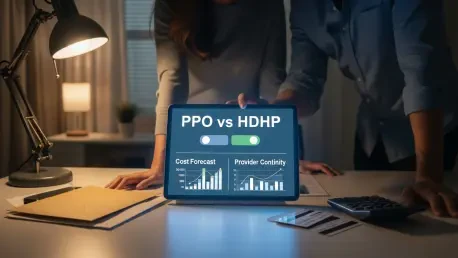

Late-night phone glow often meets high-stakes benefits math when cash-flow fears collide with plan jargon, turning open enrollment into a tense decision sprint that static pages rarely help win. That is the core tension driving the comparison between static FAQs and personalized decision support in employee benefits: one distributes facts, the other converts facts into decisions under pressure.
Context, Definitions, and Industry Landscape
Static FAQs in benefits are curated pages or PDFs that answer common questions about eligibility, premiums, deductibles, out-of-pocket maximums, networks, HSAs, and FSAs. Personalized decision support, by contrast, is an interactive system—often AI-powered—that reasons through a household’s specifics, modeling PPO versus HDHP trade-offs, family versus single coverage, and expected utilization.
Costs and complexity heightened the urgency this year. Kaiser Family Foundation (KFF) reported average family premiums at $26,993 in 2025, with workers contributing about $6,850; single deductibles averaged $1,886 after a decade-long 43% climb. HR teams, brokers, and benefits administrators deploy both approaches, but Cascade AI’s analysis of thousands of interactions showed the context has shifted from learning to choosing—favoring tools that test scenarios, not just define terms.
Across industries, employees face PPO versus HDHP choices with family premium gaps nearing $3,000, layered by network rules and plan mechanics. This article evaluates which approach reduces financial risk and decision anxiety while improving plan fit and confidence, using KFF’s survey data and Cascade AI’s behavioral signals as primary reference points.
Head-to-Head Comparison Across Critical Dimensions
Availability, Timing, and Access Modality
Static FAQs are always “on,” yet they are non-interactive and unwieldy on mobile when questions stack. Without after-hours escalation or iterative help, they struggle when an employee needs quick confirmation at 10 p.m.
Personalized decision support operates 24/7, mobile-first, and in short, iterative sessions. Cascade observed that more than 20% of questions arrive after hours, with nearly 10% more on weekends, underscoring that night-time, phone-based decision bursts reward conversational, stepwise guidance rather than document scanning.
Depth of Guidance, Interactivity, and Decision Quality
Static FAQs follow a linear path and assume uniform needs, which breaks down with layered cases such as specialist-heavy years, high-cost drugs, childbirth, or mixed in- and out-of-network care. They also leave confirmation gaps that amplify anxiety.
Personalized decision support engages in multi-step reasoning and scenario testing. Cascade reported 59% of sessions required at least four back-and-forth turns, and one user asked 59 questions before reaching confidence. With family premiums at $26,993 and single deductibles averaging $1,886, depth matters: a tool that translates plan rules into personalized forecasts shifts choices from guesswork to grounded trade-offs.
Network Continuity, Mental Health Access, and Behavior Change
Static FAQs may list providers or summarize network types, but they rarely validate therapist or specialist continuity during carrier changes or flag mental health access obstacles. That silence is costly when networks are narrow or directories are outdated.
Personalized decision support prompts employees to verify provider continuity, estimate “worst-case” costs, and weigh the ripple effects of network shifts. KFF noted that 8% of firms offer narrow networks, and about one-third cited gaps in timely mental health access. Cascade found that question mix moved from “how benefits work” to plan comparisons, rising from 38% to 55% year over year, and employees were less likely to default to last year’s plan when guided by personalized reasoning.
Challenges, Limitations, and Selection Considerations
Static FAQs demand heavy content governance and frequent updates, especially when premiums, contributions, or deductible structures shift. They fit foundational knowledge but falter with complex, family-specific scenarios, and they reveal little about confusion intensity or anxiety signals.
Personalized decision support depends on accurate plan files, contribution tables, cost-sharing logic, and clean provider directory feeds. It must safeguard PHI/PII, provide audit trails, and address vendor bias with transparent reasoning. Network realities—directory accuracy, mental health access variability, narrow-network rules—require real-time updates and explicit caveats to prevent misguidance.
Operational needs include after-hours expectations, accessible mobile UX, and integrations with HRIS or benadmin portals to meet employees where they decide. Governance should measure session timing, escalation patterns, scenario volume, and anxiety markers, while establishing dispute-resolution paths for network or cost estimate discrepancies.
Summary, Tool Fit, and Actionable Recommendations
The throughline was simple: rising costs and intricate trade-offs created anxiety, not basic confusion. Static FAQs stabilized baseline understanding, yet personalized, on-demand decision support closed the gap between knowledge and action, especially for PPO vs. HDHP comparisons with ~$3,000 family premium spreads, provider continuity checks, mental health access questions, and after-hours decisions.
Static FAQs worked when delivering definitions, compliance notes, timelines, and links—content with low variance across employees. Personalized decision support proved superior for utilization modeling, “what-if” testing on specialist visits and high-cost prescriptions, childbirth planning, and mobile-first, late-night guidance. Leading platforms, such as Cascade AI, were best evaluated on reasoning depth, auditability, integrations with plan and provider data, security posture, mobile UX, and measurable effects on plan switching and default reduction, with KFF-like benchmarks grounding recommendations in current costs.
Given these findings, the recommended path favored deploying 24/7, mobile-first interactive guidance, integrating transparent network tools with mental health checks, enabling scenario-based out-of-pocket forecasts, educating earlier with total-cost comparisons, and instrumenting analytics to staff resources when and where decisions actually happened.