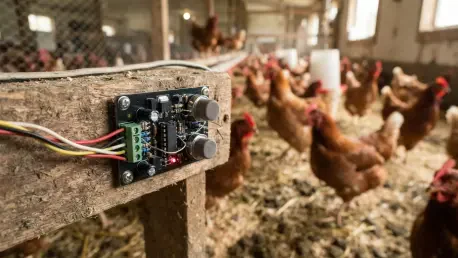

The integration of an ADS1115 16-bit analog-to-digital converter allowed the Raspberry Pi units to interface with analog gas sensors for high-fidelity environmental data acquisition. As the global egg industry faces a sweeping structural transformation, driven by evolving welfare legislation and a firm push toward cage-free housing, the importance of such high-resolution data has never been clearer. Modern poultry systems prioritize the ability of birds to express natural behaviors, yet these environments inadvertently concentrate organic waste on the litter floor, placing manure directly within the birds’ immediate breathing zone. This shift necessitates a deeper understanding of the chemical micro-environment of the barn, where the accumulation of ammonia, methane, and carbon dioxide can compromise avian health and worker safety alike. Without a robust method to track these fluctuations, producers risk unseen productivity losses and animal distress. Consequently, the development of low-cost, real-time monitoring systems has emerged as a cornerstone for sustainable precision livestock farming in the current landscape.
Building an Affordable Edge Computing Framework
The technological backbone of this environmental surveillance relies on the implementation of a sophisticated yet cost-effective Internet of Things framework. At the heart of each monitoring node was a Raspberry Pi 5 single-board computer, which functioned as the primary edge computing hub for all data acquisition tasks. Because the native hardware of these units is optimized for digital signals, researchers utilized a multi-channel configuration to bridge the gap between physical chemistry and digital analysis. The sensing suite utilized four distinct modules, including the MQ137 for ammonia detection and the MQ4 for methane monitoring, alongside a specialized MG811 channel for carbon dioxide and an MQ135 for general air quality context. This configuration allowed for a comprehensive view of the atmospheric conditions without requiring the multi-thousand-dollar investment typically associated with reference-grade laboratory equipment. By deploying these nodes at the pen level, it became possible to observe the specific air quality nuances that occur within the immediate vicinity of the flock.
Software architecture played an equally vital role in maintaining the reliability of the sensing network, especially given the challenging conditions found in commercial poultry barns. A custom service written in Python was tasked with managing the timing and formatting of data sweeps, which occurred at 15-second intervals to ensure no sudden spikes in gas levels were missed. To account for the intermittent internet connectivity that frequently plagues agricultural facilities, the researchers engineered a local buffering system that allowed data to be stored on-site during network outages. Once a stable connection to the ThingSpeak cloud platform was re-established, the units automatically synchronized their logs, ensuring a continuous and unbroken timeline of environmental data. This proactive approach to data integrity is essential for creating a system that farmers can trust for long-term monitoring. Moreover, the use of edge computing allowed for preliminary data processing to happen on the device itself, reducing the bandwidth requirements for cloud transmission and making the system more scalable.
Ensuring Accuracy Through Rigorous Calibration
The inherent variability of low-cost metal-oxide sensors required a meticulous approach to metrology to ensure that the findings were scientifically sound and reproducible. One of the primary criticisms of affordable IoT sensors is their susceptibility to baseline drift and cross-sensitivity to environmental variables like temperature and humidity. To mitigate these risks, the deployment was preceded by a rigorous 48-hour calibration workflow conducted in a controlled laboratory setting. The first 24 hours were dedicated exclusively to a thermal stabilization period, allowing the internal heaters of the sensors to reach a steady state, which is critical for consistent chemical reactions on the sensor surfaces. Following this, the researchers established clean-air baselines and quantified the mutual agreement between different hardware units. This screening process allowed the team to identify and rectify any voltage mismatches or wiring inconsistencies before the sensors were exposed to the dust and ammonia of the active poultry environment, thereby reinforcing the overall accuracy of the experimental data set.
Translating raw electrical resistance into meaningful gas concentration estimates involved the application of complex mathematical models specifically calibrated for the metal-oxide technology. For the methane and ammonia sensors, the team utilized a power-law resistance-ratio model, while the carbon dioxide channel required an approximately logarithmic transformation. While the researchers acknowledged that these values represent high-fidelity estimates rather than absolute reference concentrations, the real-world value of this technology lies in its ability to track longitudinal trends and relative differences between treatment groups. By focusing on these patterns, the system could detect subtle shifts in air quality that would be invisible to traditional manual sampling methods. This level of sensitivity is particularly useful for evaluating the impact of dietary interventions, as it allows for a direct comparison of how different feed formulations influence the chemical output of the manure. Ultimately, this approach provides a balance between affordability and scientific rigor, making high-level environmental surveillance accessible to poultry producers.
Investigating Chlorella as a Nutritional Solution
The study sought to evaluate the potential of nutritional science to solve environmental problems by integrating a Chlorella-based diet into the poultry management routine. Chlorella is a nutrient-dense microalga known for its ability to influence gut health and microbial composition, and this trial aimed to determine if those internal benefits translated into cleaner air within the barn. The subjects of the study were 72-week-old laying hens, a demographic that is particularly sensitive to environmental stress due to their age and consistent production cycle. These birds were categorized into three dietary groups, including a control group on a basal diet and two supplemented groups receiving 0.25% and 0.50% Chlorella, respectively. After a six-week adaptation period designed to let the birds’ digestive systems and the resulting manure chemistry stabilize, the IoT units were installed to begin the air quality monitoring phase. This long-term dietary preparation ensured that any differences observed in the air were the result of established biological changes rather than temporary fluctuations in feed intake.
Ensuring the integrity of the data required a physical setup that mirrored the complexities of a real-world cage-free environment while maintaining controlled variables. The sensing units were strategically mounted 0.30 meters above the wood-shaving litter, positioning them directly in the breathing zone of the hens where gas concentrations are typically at their highest and most hazardous. To prevent the air from one treatment group from mixing with another, the researchers installed tarpaulin barriers between the adjacent pens. However, they were careful to leave the upper sections open to ensure the barn’s natural ventilation system continued to function normally, replicating the conditions found in commercial poultry houses. Over the course of eight consecutive days, the system logged thousands of data points, creating a high-resolution map of the air quality across the different treatment groups. This setup allowed for a clear comparison of how the presence of Chlorella in the diet influenced the immediate atmosphere surrounding the birds, providing a direct link between what the birds ate and the air they breathed.
Measuring the Impact of Diet on Air Quality
Analysis of the sensor data revealed a significant and consistent reduction in gas concentrations within the pens where hens were fed the microalgae supplement. While the first 48 hours showed a stabilization period where the differences between groups were less pronounced, a clear pattern emerged from the second monitoring period onward. The most dramatic results were observed in methane levels, where the group receiving the 0.50% Chlorella supplement exhibited the lowest concentrations across the board. In contrast, the control pen consistently showed the highest levels of methane, suggesting that the standard diet contributed to a more active anaerobic decomposition process within the litter. Ammonia levels followed a similar downward trend in the supplemented groups, which is a finding of paramount importance for respiratory health. Because ammonia is a known irritant that can lead to lesions and increased susceptibility to infection, the ability to lower its concentration through simple dietary adjustments represents a major breakthrough in non-invasive poultry welfare management.
The biological mechanism driving these improvements is rooted in the way Chlorella interacts with the avian microbiome and the subsequent nitrogen cycle in the waste. Previous research has indicated that microalgal supplements can effectively shift the microbial communities within poultry manure, promoting the growth of bacteria that retain nitrogen in non-volatile forms while suppressing those responsible for ammonia production. Furthermore, the inclusion of Chlorella appears to inhibit the activity of methanogenic microorganisms that thrive in the anaerobic conditions of floor litter. By changing the chemical makeup of the manure at the source, the supplement prevents the release of these gases into the air, effectively turning the litter into a more stable and less hazardous byproduct. This study confirmed that these biochemical shifts are robust enough to be detected by low-cost sensors in a naturally ventilated space, proving that nutritional interventions can serve as a powerful tool for environmental control. This synergy between diet and air quality offers a proactive strategy for maintaining high production standards.
Tracking Daily Fluctuations and Future Potential
Beyond the overall reduction in gas levels, the IoT platform provided a window into the complex diurnal fluctuations that characterize poultry house environments. By visualizing the data on an hourly basis, the researchers observed that gas concentrations are far from static, often reaching their peaks during the late night and early morning hours when ventilation might be reduced or bird activity changes. Interestingly, the supplemented pens showed more significant temporal excursions, with gas levels rising and falling more sharply than the control group, which tended to hover at a consistently higher baseline. For example, the 0.50% treatment group displayed higher relative carbon dioxide levels overnight followed by a steady decline throughout the day. These findings underscore the inherent limitations of manual snapshot sampling, which often takes place during daylight hours when gas levels might be at their lowest. By capturing the full 24-hour cycle, the IoT system provided a much more accurate assessment of the total environmental stress experienced by the flock, highlighting the need for continuous monitoring.
The synthesis of nutritional science and edge computing in this study demonstrated that real-time environmental management is both feasible and affordable for modern poultry operations. It was clear that small dietary adjustments, specifically the inclusion of Chlorella, worked in tandem with digital surveillance to create a more transparent and manageable production environment. This research established that the integration of low-cost sensors allowed for the detection of subtle but critical shifts in air quality, providing farmers with the data needed to make informed decisions about ventilation and flock health. Moving forward, the industry should look to incorporate these technologies into larger, multi-pen trials to further refine the predictive models and account for variations in airflow and litter moisture. By adopting this data-driven approach, the poultry sector took a vital step toward reconciling the challenges of cage-free housing with the high standards of animal welfare and environmental sustainability. This evolution in farming practices ensured that the sniffing capabilities of modern IoT devices became a standard part of the toolkit.